






Smart Phones


Trending Now
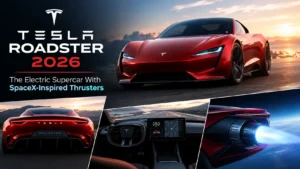

Tesla Roadster 2026: SpaceX-Inspired Thrusters
Tesla has unveiled its redesigned second-generation Tesla Roadster 2026, bringing a new level of ambition to the electric sports car market. Presented by Elon Musk in October 2026, the vehicle attracted attention for its extreme acceleration claims, futuristic styling and SpaceX-inspired cold-gas thruster technology. Tesla says the Roadster can accelerate from 0 to 60 mph in under one second in its high-performance configuration and reach speeds exceeding 230 mph. The company has also demonstrated a version capable of brief airborne manoeuvres using thrusters. However, these are company-reported capabilities, and the flight-oriented version is not approved for public-road use. With production planned for 2028, the Roadster is not yet an ordinary showroom purchase. Here’s a closer look at its reported specifications, three variants, reservation costs, technology and expected availability. Key specifications and features The following separates the newly reported Roadster details from Tesla’s original official website specifications. Specification Latest reported Roadster Vehicle type All-electric sports supercar Acceleration Claimed 0–60 mph in under 1 second for the Thrust version Top speed Claimed over 230 mph (370 km/h) Reported range Around 300 miles (483 km) Seating Two seats in Performance and Thrust; one in Rocket Special technology Cold-gas thrusters on higher-performance variants Production target 2028 Reservation Performance and Thrust reservations listed; Rocket is invite-only Why Is the Tesla Roadster Taking So Long? The Roadster’s development timeline has extended well beyond its original expectations. Tesla initially discussed production around 2020, but the vehicle did not enter regular customer production on that schedule. Tesla’s broader priorities have included expanding its electric vehicle lineup, increasing manufacturing capacity, developing battery technology, and investing in other products. The Roadster is a more specialized vehicle, with performance goals that may require additional engineering and testing. For buyers, the main takeaway is simple: an unveiling and a reservation announcement do not guarantee a confirmed delivery date. Before placing an order, prospective customers should check Tesla’s latest official announcements for updated specifications, production plans, and reservation terms. Battery and Driving Range Tesla’s original presentation listed a 200 kWh battery pack and a range target of up to 620 miles. That figure was part of the vehicle’s announced specifications, rather than a verified result from a final production model. A large battery can support long-distance driving and high power demands, but it also adds weight and affects vehicle design. The Roadster’s real-world range will depend on its final battery, driving speed, temperature, road conditions, and energy consumption. At high speeds, aerodynamic drag rises sharply, which can reduce range. Drivers should therefore expect the car’s maximum claimed range and its range during sustained high-speed driving to be different. How Does the SpaceX Thruster System Work? One of the most unusual features demonstrated with the Tesla Roadster is its proposed SpaceX-inspired thruster system. The idea combines an electric sports car with technology inspired by aerospace engineering. During the October 2026 unveiling, Tesla demonstrated a Roadster using thrusters to perform mid-air movements. The demonstration also showed a suction system that helped the vehicle travel upside down along a specially designed ramp. However, these demonstrations do not establish that the car can fly safely or legally on public roads. [INTERNAL LINK: future of cloud computing] What Are Cold-Gas Thrusters? Cold-gas thrusters release stored pressurised gas through nozzles to create thrust. By directing the gas in different directions, a system can generate forces that help control movement. Spacecraft use similar principles for orientation and movement in space. Applying this technology to a road vehicle is a very different engineering challenge because the system must work alongside conventional driving, braking, passenger protection, and vehicle stability systems. The Roadster demonstration suggests several possible uses: Additional acceleration: Thrusters may provide extra force under certain conditions. Movement control: Directional nozzles may help control the vehicle during specialised manoeuvres. Demonstration stunts: The technology can create dramatic movements that ordinary sports cars cannot perform. Tesla has not established that these capabilities will be available for unrestricted everyday driving. The final system’s performance, safety limits, and operating conditions will need further confirmation. Can the Tesla Roadster Actually Fly? The October demonstration showed the thruster-equipped car lifting off the ground and performing a mid-air manoeuvre. That is different from proving that the Roadster can operate as a practical flying car. A vehicle capable of sustained flight needs reliable lift, control, stability, and systems that meet aviation safety requirements. A brief demonstration does not prove that these requirements have been met. For now, it is more accurate to describe the Roadster as an electric sports car with an experimental rocket-style thrust system than as a fully functional flying car. Tesla Roadster Performance, Thrust and Rocket Variants Tesla’s latest Roadster presentation brought attention to different versions, including models focused on conventional high performance and more specialised thruster technology. Reported reservation information distinguishes the Performance and Thrust versions, while the Rocket version is described as invitation-only. Details may change before production. Variant Main focus Reported reservation deposit Performance High-performance electric driving $50,000 Thrust Performance with acceleration thrusters $250,000 Rocket Specialised full-flight-system concept; invitation-only Not clearly confirmed These deposits are reservation amounts, not the final vehicle prices. Prospective buyers should confirm the latest terms directly with Tesla before paying. Performance Version The Performance version is aimed at drivers who want extreme acceleration and sports-car handling. Its final production specifications, battery details, range, and delivery schedule should be checked against Tesla’s latest official information. Thrust Version The Thrust version is associated with additional acceleration thrusters. Its appeal is the possibility of combining electric performance with a specialised thrust system. The practical value of this feature will depend on its final capabilities, safety restrictions, and whether it can be used outside controlled demonstrations. Rocket Version The Rocket version has attracted the most attention because of the proposed full-flight system. Reports describe it as a special, invitation-only model rather than a regular mass-market vehicle. Its final passenger capacity, operating limits, road legality, and delivery terms remain important questions. Buyers should not assume that every feature shown at the unveiling will

Best OPPO Phone Under 15000 in India (2026)
You don’t have to sacrifice all the important features when you buy a new smartphone on a budget. If you are

Future of AI Infrastructure : What Every Business Must Know
Artificial Intelligence is no

OPPO Find X10 Specifications, Price in India & Features
OPPO Find X10: Specifications, Features, Camera, Battery and