
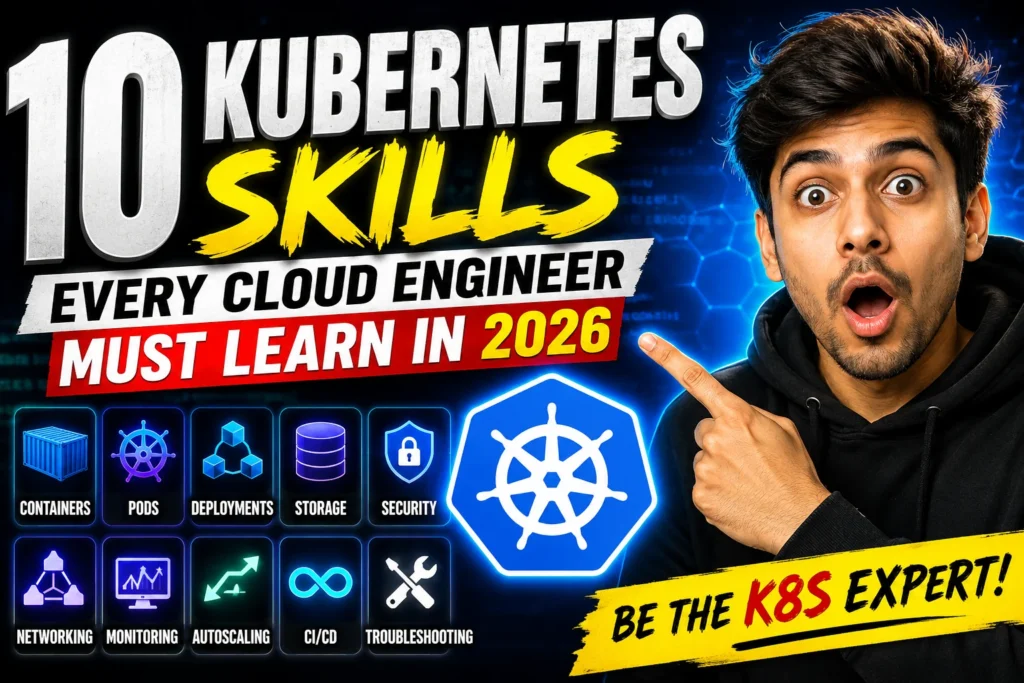
Cloud computing continues to evolve at a rapid pace, and Kubernetes has become the industry standard for container orchestration. Whether you want to become a cloud engineer, DevOps engineer, site reliability engineer (SRE), or platform engineer, mastering Kubernetes is no longer optional.
- Why Kubernetes Is One of the Most Important Cloud Skills in 2026
- Essential Kubernetes Skills Every Cloud Engineer Needs
- 1. Understand Kubernetes Architecture
- 2. Master Pods, Deployments, and ReplicaSets
- 3. Learn Kubernetes Networking
- 4. Understand Persistent Storage
- 5. Learn Kubernetes Security Best Practices
- Kubernetes Learning Roadmap for Beginners
- Why Kubernetes Skills Are in High Demand
- Kubernetes vs Docker: Understanding the Difference
- 6. Learn Kubernetes Monitoring and Observability
- 7. Understand CI/CD Integration with Kubernetes
- 8. Master Helm for Kubernetes Package Management
- 9. Develop Kubernetes Troubleshooting Skills
- 10. Follow Kubernetes Best Practices
- Kubernetes Certifications to Boost Your Career
- Common Kubernetes Interview Questions
- Career Opportunities After Learning Kubernetes
- Frequently Asked Questions
- Conclusion
Organizations of all sizes now rely on Kubernetes to deploy, scale, and manage applications efficiently across hybrid and multi-cloud environments. As businesses continue modernizing their infrastructure, professionals with strong Kubernetes expertise are among the most sought-after in the technology industry. If you’re planning your cloud career in 2026, this guide explains the 10 Kubernetes skills every cloud engineer should master, why each skill matters, and how you can build practical experience.
Why Kubernetes Is One of the Most Important Cloud Skills in 2026
Kubernetes automates the deployment, scaling, networking, and management of containerized applications. Instead of manually configuring servers, organizations use Kubernetes to maintain highly available, resilient, and scalable applications.
Some reasons why Kubernetes remains one of the highest-demand technologies include:
- Growing adoption of cloud-native applications
- Increasing use of microservices architecture
- Hybrid and multi-cloud deployments
- Automation of infrastructure
- Better application scalability
- Improved disaster recovery
- Reduced operational costs
As companies continue adopting cloud-native technologies, Kubernetes expertise has become one of the highest paying tech skills for cloud professionals.
If you’re exploring future technology careers, also read our guide on emerging technology trends 2026.
Essential Kubernetes Skills Every Cloud Engineer Needs
| Skill | Importance | Difficulty |
|---|---|---|
| Kubernetes Architecture | Very High | Medium |
| Pods & Workloads | Very High | Easy |
| Networking | High | Medium |
| Storage Management | High | Medium |
| Security | Very High | Advanced |
| Monitoring | High | Medium |
| CI/CD Integration | High | Medium |
| Helm | Medium | Easy |
| Troubleshooting | Very High | Advanced |
| Kubernetes Best Practices | Very High | Medium |
1. Understand Kubernetes Architecture
Before deploying applications, every cloud engineer should fully understand Kubernetes Architecture.
A solid understanding of architecture helps you troubleshoot issues, optimize deployments, and design scalable cloud environments.
Key Kubernetes components include:
Control Plane
The control plane manages the entire cluster.
Its major components include:
- API Server
- Scheduler
- Controller Manager
- etcd Database
Each component works together to maintain the desired state of the cluster.
Worker Nodes
Worker nodes are responsible for running application workloads.
Each node contains:
- kubelet
- kube-proxy
- Container Runtime
Understanding how these services interact helps engineers quickly identify deployment or networking issues.
Cluster Communication
You should also understand:
- Internal networking
- Service discovery
- DNS resolution
- API communication
- Load balancing
Learning architecture first makes every other Kubernetes topic much easier.
2. Master Pods, Deployments, and ReplicaSets
Pods are the smallest deployable unit in Kubernetes.
Every application running inside Kubernetes eventually runs inside a Pod.
Cloud engineers must understand how Pods interact with:
- Deployments
- ReplicaSets
- Namespaces
- Labels
- Selectors
- Services
A Deployment automatically maintains the desired number of Pod replicas.
For example:
- If one Pod crashes,
- Kubernetes automatically creates another,
- ensuring high availability.
Important concepts include:
- Rolling Updates
- Rollbacks
- Scaling
- Self-healing
- Replica Management
Understanding these resources forms the foundation of every Kubernetes Tutorial and production deployment.
3. Learn Kubernetes Networking
Networking is one of the biggest challenges beginners face.
Without proper networking knowledge, applications cannot communicate effectively.
Cloud engineers should understand:
- Cluster IP
- NodePort
- LoadBalancer
- Ingress
- DNS
- Service Discovery
- Network Policies
Understanding Ingress Controllers is particularly valuable because they manage external traffic entering Kubernetes clusters.
Networking skills become even more important when deploying applications across multiple cloud providers.
Professionals interested in cloud architecture should also read future of cloud computing to understand where enterprise infrastructure is heading.
4. Understand Persistent Storage
Containers are temporary by nature.
If a container crashes, its local data disappears.
That’s why Kubernetes provides persistent storage.
Cloud engineers should understand:
- Persistent Volumes (PV)
- Persistent Volume Claims (PVC)
- Storage Classes
- Dynamic Provisioning
Understanding storage enables applications like:
- Databases
- File storage
- Logging systems
- Backup services
Without persistent storage, production applications cannot reliably store business-critical information.
5. Learn Kubernetes Security Best Practices
One of the most valuable skills in 2026 is Kubernetes Security.
Security should never be an afterthought.
Modern organizations expect cloud engineers to secure workloads from day one.
Important security concepts include:
- Role-Based Access Control (RBAC)
- Service Accounts
- Secrets Management
- Pod Security Standards
- Admission Controllers
- Network Policies
- Image Scanning
Cloud engineers should also learn how to:
- Limit container privileges
- Use least-privilege access
- Encrypt sensitive secrets
- Secure API access
- Rotate credentials regularly
These practices greatly reduce security risks in production clusters.
Kubernetes Learning Roadmap for Beginners
The following roadmap can help beginners build practical Kubernetes expertise.
| Stage | Topics |
| Beginner | Containers, Docker, Linux, YAML |
| Intermediate | Pods, Deployments, Services |
| Advanced | Networking, Storage, Security |
| Expert | Monitoring, Helm, GitOps, Troubleshooting |
Following a structured Kubernetes Roadmap helps learners avoid confusion and build skills progressively.
Why Kubernetes Skills Are in High Demand
Nearly every major cloud platform now offers managed Kubernetes services.
Examples include:
- Amazon EKS
- Azure AKS
- Google Kubernetes Engine (GKE)
Organizations prefer Kubernetes because it offers:
- Scalability
- Portability
- Automation
- High availability
- Vendor flexibility
- Better resource utilization
This widespread adoption has significantly increased demand for professionals with Kubernetes expertise.
Kubernetes vs Docker: Understanding the Difference
Many beginners confuse Kubernetes vs Docker, but they solve different problems.
| Docker | Kubernetes |
| Creates and runs containers | Manages containers at scale |
| Single-host container runtime | Multi-node orchestration platform |
| Builds container images | Deploys and manages workloads |
| Focuses on containers | Focuses on clusters |
Docker and Kubernetes complement each other rather than compete. A cloud engineer should understand both technologies before working in production environments. If you’re interested in modern deployment approaches, check out our serverless computing guide to understand when serverless is a better choice than Kubernetes.
6. Learn Kubernetes Monitoring and Observability
Deploying applications is only half the job. Keeping them healthy is equally important. That’s why Kubernetes Monitoring is a must-have skill for every cloud engineer.
Monitoring helps you:
- Detect performance issues
- Identify application bottlenecks
- Track resource usage
- Improve cluster reliability
- Reduce downtime
Popular Kubernetes monitoring tools include:
| Tool | Purpose |
|---|---|
| Prometheus | Metrics collection |
| Grafana | Visualization dashboards |
| Kubernetes Dashboard | Cluster management |
| Loki | Log aggregation |
| Jaeger | Distributed tracing |
Cloud engineers should monitor key metrics such as:
- CPU utilization
- Memory usage
- Pod health
- Node status
- Network traffic
- Storage consumption
- Application latency
A proactive monitoring strategy allows teams to fix issues before they affect users.
7. Understand CI/CD Integration with Kubernetes
Modern software teams release updates frequently. Kubernetes works best when integrated with Continuous Integration and Continuous Deployment (CI/CD) pipelines.
A typical Kubernetes deployment pipeline includes:
- Developers push code.
- CI tools build the application.
- Container images are created.
- Images are stored in a container registry.
- Kubernetes deploys the updated application automatically.
Common CI/CD tools include:
- Jenkins
- GitHub Actions
- GitLab CI/CD
- Argo CD
- Flux CD
Learning GitOps practices with tools like Argo CD is becoming increasingly valuable because they simplify application deployment and improve version control.
8. Master Helm for Kubernetes Package Management
Managing Kubernetes YAML files manually becomes difficult as applications grow.
Helm solves this problem by acting as the package manager for Kubernetes.
Benefits of Helm include:
- Faster deployments
- Reusable templates
- Easier application upgrades
- Simplified configuration management
- Version control for releases
Every cloud engineer should understand:
- Helm Charts
- Values files
- Repositories
- Chart dependencies
- Rollbacks
Helm significantly reduces deployment complexity, especially in enterprise environments.
9. Develop Kubernetes Troubleshooting Skills
Every production environment experiences issues. Skilled cloud engineers know how to diagnose and resolve problems quickly.
Common Kubernetes issues include:
- Pods stuck in Pending state
- CrashLoopBackOff errors
- ImagePullBackOff errors
- Networking failures
- DNS issues
- Insufficient resources
- Storage mounting errors
Useful troubleshooting commands include:
kubectl get pods
kubectl describe pod
kubectl logs
kubectl get events
kubectl top nodes
kubectl top pods
Effective troubleshooting requires understanding logs, events, resource limits, and cluster architecture.
Strong debugging skills often distinguish experienced engineers from beginners.
10. Follow Kubernetes Best Practices
Learning Kubernetes commands is important, but following Kubernetes Best Practices ensures your deployments remain secure, scalable, and reliable.
Some recommended best practices include:
- Use namespaces to organize workloads.
- Set CPU and memory requests and limits.
- Avoid running containers as the root user.
- Keep container images lightweight.
- Use health and readiness probes.
- Store secrets securely.
- Enable Role-Based Access Control (RBAC).
- Regularly update Kubernetes versions.
- Back up etcd data.
- Monitor cluster performance continuously.
Following these practices improves security, stability, and operational efficiency.
Kubernetes Certifications to Boost Your Career
A recognized certification validates your practical knowledge and improves your chances of landing high-paying cloud roles.
Popular certifications include:
| Certification | Best For |
| Certified Kubernetes Application Developer (CKAD) | Application developers |
| Certified Kubernetes Administrator (CKA) | Cluster administrators |
| Certified Kubernetes Security Specialist (CKS) | Security professionals |
While certifications strengthen your resume, employers also value real-world projects and hands-on experience.
Common Kubernetes Interview Questions
Preparing for interviews is an important step in your Cloud Engineer Career Path. Here are a few commonly asked Kubernetes Interview Questions:
- What is Kubernetes, and why is it used?
- Explain the Kubernetes architecture.
- What is the difference between Pods and Deployments?
- How does Kubernetes perform service discovery?
- What is the purpose of etcd?
- Explain ConfigMaps and Secrets.
- How does rolling deployment work?
- What is an Ingress Controller?
- How do you troubleshoot a failing Pod?
- How do Kubernetes and Docker work together?
Practicing these questions alongside hands-on labs will help you perform confidently during technical interviews.
Career Opportunities After Learning Kubernetes
Kubernetes expertise opens the door to many high-demand roles.
Some popular Cloud Engineer Jobs include:
| Job Role | Typical Responsibilities |
| Cloud Engineer | Manage cloud infrastructure |
| DevOps Engineer | Automate deployments |
| Platform Engineer | Build internal developer platforms |
| Site Reliability Engineer (SRE) | Improve reliability and uptime |
| Kubernetes Administrator | Manage production clusters |
| Cloud Solutions Architect | Design scalable cloud solutions |
As cloud adoption continues to grow, Kubernetes professionals are expected to remain among the most sought-after technology experts.
Frequently Asked Questions
Is Kubernetes difficult to learn?
Kubernetes has a learning curve, but with consistent practice and a structured roadmap, beginners can become proficient within a few months.
Do I need Docker before learning Kubernetes?
Yes. Understanding Docker and container fundamentals makes Kubernetes much easier to learn.
Which cloud platform is best for Kubernetes?
All major providers support Kubernetes. Your choice depends on business requirements.
- Amazon Web Services (EKS)
- Microsoft Azure (AKS)
- Google Cloud Platform (GKE)
Is Kubernetes still worth learning in 2026?
Absolutely. Kubernetes continues to be the leading platform for orchestrating containerized applications and remains one of the most valuable cloud skills.
Which Kubernetes certification should beginners choose?
The Certified Kubernetes Administrator (CKA) is an excellent starting point for cloud engineers interested in infrastructure management.
How long does it take to learn Kubernetes?
With regular practice, most learners can build solid fundamentals in three to six months.
Conclusion
Kubernetes has become the backbone of modern cloud-native infrastructure. From managing containerized applications to automating deployments and improving scalability, it is a skill every cloud engineer should prioritize.
Mastering Kubernetes architecture, networking, storage, security, monitoring, CI/CD, Helm, troubleshooting, and industry best practices will prepare you for the evolving cloud landscape in 2026. Whether you’re starting your cloud journey or advancing your existing skills, investing time in Kubernetes today can lead to better career opportunities, higher salaries, and long-term professional growth.