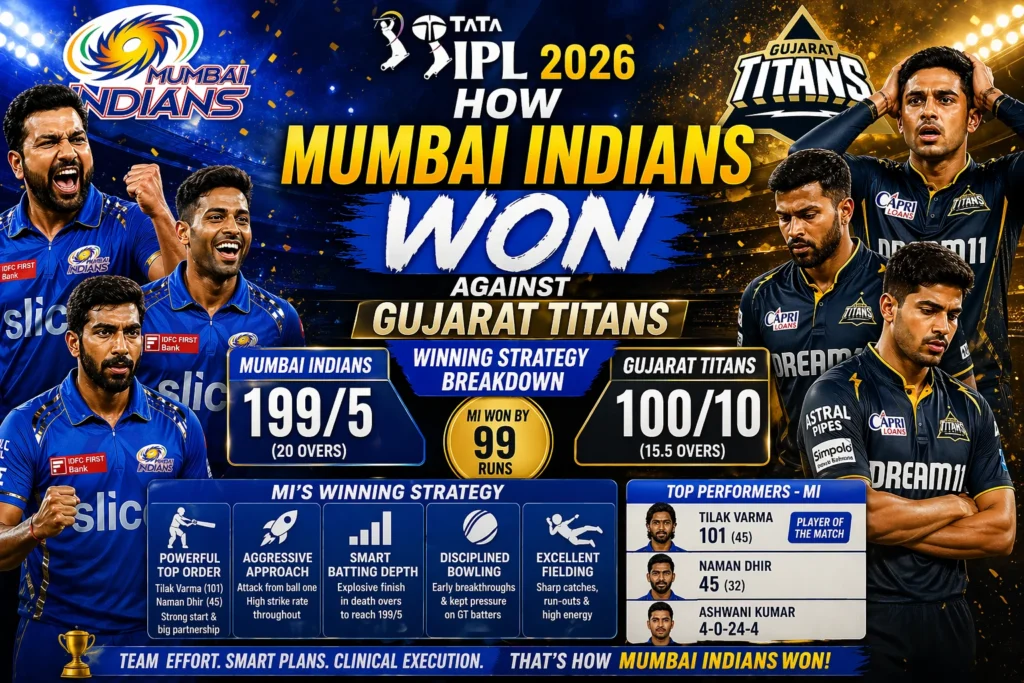
If you just look at the scoreline, it feels like a one-sided match. But the real story behind the MI vs GT analysis lies in how Mumbai Indians planned and executed every phase.
- 🎯 1. Batting Execution – Smart Build + Explosive Finish
- 🧠 2. Captaincy Decisions – Tactical & Calm Under Pressure
- 🎯 3. Bowling Plans – Clear Target, Ruthless Execution
- 📉 4. Pressure Game – MI Dominated Mentally
- 🤝 5. Game-Changing Factor – Timing of Impact
- ⚡ Final Tactical Summary (Quick Read)
- 🤔 So, What Can Teams Learn From This?
- 🏁 Conclusion
Let’s break down the MI winning strategy 2026 in a practical, easy-to-understand way.
If you haven’t seen the full match flow yet, start with the detailed MI vs GT scorecard and match report.
🎯 1. Batting Execution – Smart Build + Explosive Finish
Mumbai Indians didn’t start aggressively — and that’s what made their innings dangerous.
✔️ Phase-wise Batting Strategy:
Powerplay (0–6 overs):
MI played controlled cricket. Instead of taking unnecessary risks, they preserved wickets.
Middle Overs (7–15):
This is where the game was built.
Tilak Varma rotated strike, avoided dot balls, and kept the scoreboard ticking.
Death Overs (16–20):
💥 This was the masterstroke.
MI shifted gears and scored heavily in the final overs, pushing the total close to 200.
👉 Key Insight:
MI didn’t panic early. They planned for a late explosion — a common winning pattern in IPL 2026.
🧠 2. Captaincy Decisions – Tactical & Calm Under Pressure
One of the biggest reasons behind how MI won vs GT was smart on-field decisions.
🔑 Key Captaincy Moves:
- Bowling changes at the right time
Bowlers were rotated exactly when pressure was needed. - Attacking field placements early
Slips and catching positions forced Gujarat Titans batters into mistakes. - Backing key players
Instead of constant changes, MI trusted their main bowlers to deliver.
👉 In T20 cricket, panic leads to losses. MI stayed calm — GT didn’t.
🎯 3. Bowling Plans – Clear Target, Ruthless Execution
Mumbai Indians didn’t just bowl — they executed a proper plan.
🔥 MI Bowling Strategy:
✔️ Against Top Order
Focus: Early wickets
Result: GT lost key batters in the powerplay
✔️ Middle Overs Control
Slower balls + tight lines
No easy boundaries
✔️ Death Overs Perfection
Yorkers + variations
No loose deliveries
👉 GT never got momentum because MI never allowed it.
The strategy becomes clearer when you look at the standout player performances from the match.
📉 4. Pressure Game – MI Dominated Mentally
This is something most people ignore in MI vs GT analysis.
- MI kept scoreboard pressure high
- Required run rate kept increasing
- GT batters were forced into risky shots
👉 Result? Wickets fell consistently.
🤝 5. Game-Changing Factor – Timing of Impact
Here’s the biggest difference:
| Factor | Mumbai Indians | Gujarat Titans |
|---|---|---|
| Big Runs | Late overs | Scattered |
| Wickets Lost | Late | Early |
| Momentum | Controlled | Lost early |
👉 MI didn’t just play better — they played better at the right time.
You can also explore the historical MI vs GT rivalry stats to understand how this win fits in the bigger picture.
⚡ Final Tactical Summary (Quick Read)
If you’re looking for a shortcut to understand MI winning strategy 2026, here it is:
✔️ Preserve wickets early
✔️ Accelerate in death overs
✔️ Take early wickets while bowling
✔️ Control middle overs
✔️ Maintain pressure consistently
🤔 So, What Can Teams Learn From This?
Let me ask you:
👉 Is scoring fast from ball one always the best strategy?
👉 Or is timing your attack more important?
Mumbai Indians answered that perfectly in this match.
🏁 Conclusion
The MI vs GT analysis clearly shows that Mumbai Indians didn’t rely on luck — they followed a structured plan:
- Smart batting phases
- Disciplined bowling
- Strong captaincy decisions
👉 That’s exactly how MI won vs GT — not just by scoring runs, but by controlling the entire game.