
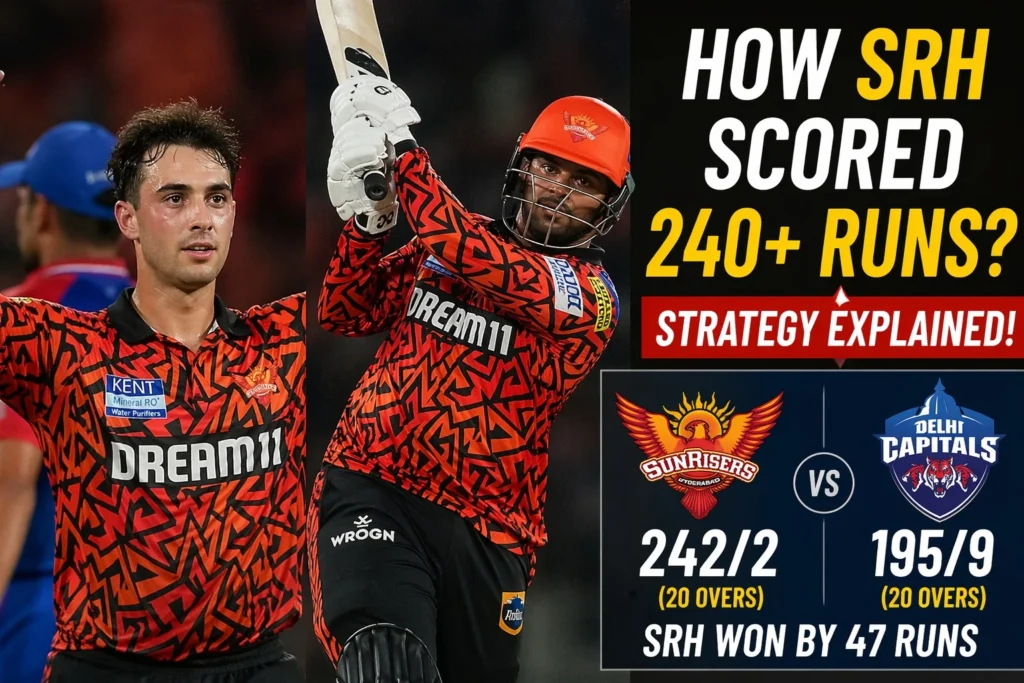
Scoring 240+ in a T20 match isn’t luck — it’s planning, execution, and perfect timing.
In the Indian Premier League 2026 clash between Sunrisers Hyderabad and Delhi Capitals, SRH didn’t just bat well… they outplayed DC in every phase of the game.
- Match Snapshot – What Actually Happened?
- Phase 1: Powerplay Strategy (Overs 1–6) – Smart, Not Crazy
- Phase 2: Middle Overs Strategy (Overs 7–15) – Game Acceleration 🚀
- Phase 3: Death Overs Strategy (Overs 16–20) – Maximum Damage 💥
- Where Delhi Capitals Lost the Game
- The Real Strategy Behind 240+ Scores (Simple Breakdown)
- What Students Can Learn From This Strategy 🎯
- Why This Match Matters in IPL 2026
- Final Thoughts
If you’re wondering how teams cross 240 in modern T20 cricket, this breakdown will give you a clear, student-friendly explanation — from powerplay to death overs strategy.
👉 And if you want a quick summary later, you can always come back and read Blog Viro 😉
👉 To understand where it all started, read the full SRH vs DC match summary here.
Match Snapshot – What Actually Happened?
SRH Total: 242/2
Key Performer: Abhishek Sharma (135*)
Result: SRH won by 47 runs
This massive score wasn’t random. It was built step-by-step with a clear strategy across all 20 overs.
Experts also pointed out that poor bowling decisions and lack of control in key moments hurt DC badly, especially when part-time bowlers were used under pressure.
👉 This strategy worked because of one key innings—explore Abhishek Sharma’s 135-run knock.
Phase 1: Powerplay Strategy (Overs 1–6) – Smart, Not Crazy
Most people think teams score big by attacking from ball one.
SRH did the opposite.
What SRH Did Right:
- Played risk-free cricket early
- Focused on strike rotation
- Targeted only loose balls
This controlled approach helped them build a strong base without losing wickets, which is crucial in T20.
👉 According to match analysis, SRH’s top order is naturally aggressive but chose a measured start to avoid early collapse.
Why This Worked:
- Preserved wickets for later overs
- Built pressure on bowlers instead
- Set the platform for explosion
👉 Lesson: You don’t need to go fast early — you need to go smart.
👉 Want numbers behind this strategy? Check the detailed scorecard and match stats.
Phase 2: Middle Overs Strategy (Overs 7–15) – Game Acceleration 🚀
This is where SRH completely changed the match.
Key Turning Point:
Abhishek Sharma shifted gears and started attacking spinners.
What Happened:
- Spinners like Kuldeep Yadav were targeted
- Boundaries came regularly
- Run rate jumped rapidly
Reports show SRH crossed 240 largely due to aggressive middle-overs hitting, especially through sixes and boundaries.
Tactical Moves:
- Picked weaker bowlers
- Used sweep & lofted shots smartly
- Maintained strike rotation (no dot-ball pressure)
👉 This phase turned a good score into a match-winning score.
Phase 3: Death Overs Strategy (Overs 16–20) – Maximum Damage 💥
Most teams slow down at the end.
SRH? They finished strong.
What SRH Did:
- Used fresh hitters like Heinrich Klaasen
- Targeted yorker misses
- Focused on boundary percentage
Even though Abhishek slowed slightly, other batters accelerated, ensuring the total crossed 240.
👉 This shows a key T20 principle:
Finish strong, even if your set batter slows down.
Where Delhi Capitals Lost the Game
Let’s be real — strategy isn’t one-sided.
DC made mistakes too.
Major Errors:
- Poor bowling rotation
- Using part-time bowlers in key overs
- Lack of pressure in the middle phase
Experts criticized DC’s decision-making, especially bowling choices during crucial overs.
👉 Once SRH crossed 200, the game was already slipping away.
The Real Strategy Behind 240+ Scores (Simple Breakdown)
If you want to understand it like a pro, remember this:
✅ Formula for 240+ in T20:
- Powerplay: 50–60 runs, 0–1 wickets
- Middle Overs: 90–110 runs (main acceleration)
- Death Overs: 70–80 runs (finish strong)
SRH followed this almost perfectly.
What Students Can Learn From This Strategy 🎯
This isn’t just cricket — it’s life strategy.
1. Build a Strong Base
Don’t rush in the beginning — prepare first.
2. Pick the Right Moment
Timing matters more than speed.
3. Adapt Quickly
SRH changed gears exactly when needed.
4. Team Effort Wins
Even after a big innings, finishers made the difference.
Why This Match Matters in IPL 2026
This wasn’t just a win.
- SRH moved up the points table
- Showed one of the best batting templates
- Proved that strategy > aggression
Their 242-run total became one of the standout performances of the season, driven by smart planning and execution.
👉 Missed watching it live? Find official streaming details and replay options here.
Final Thoughts
The “How SRH Scored 240+ Runs” story is not about hitting every ball for six.
It’s about:
- Reading the game
- Controlling phases
- Executing plans perfectly
Next time you watch a match, don’t just look at runs.
Ask yourself:
👉 Which phase decided the game?
And if you ever feel confused about match strategies…
👉 Just come back and read Blog Viro 😄
❓ FAQs
1. How did SRH score 240+ runs against DC in IPL 2026?
SRH used a phased strategy—steady powerplay, aggressive middle overs, and explosive death overs.
2. Who was the key player in SRH’s 240+ score?
Abhishek Sharma played a crucial role with his 135-run innings.
3. What is the ideal powerplay score in T20 cricket?
Around 50–60 runs with minimal wickets is considered ideal.
4. Why did Delhi Capitals lose the match?
Poor bowling decisions and lack of control in middle overs cost them the game.
5. What can beginners learn from this match?
They can learn timing, strategy, patience, and decision-making under pressure.