Introduction: The Smartphone War No One Saw Coming
Let me start with a bold prediction.
- Introduction: The Smartphone War No One Saw Coming
- What We Know So Far (Real Data, No Fake News)
- The Context: Why OpenAI Needs Its Own Phone
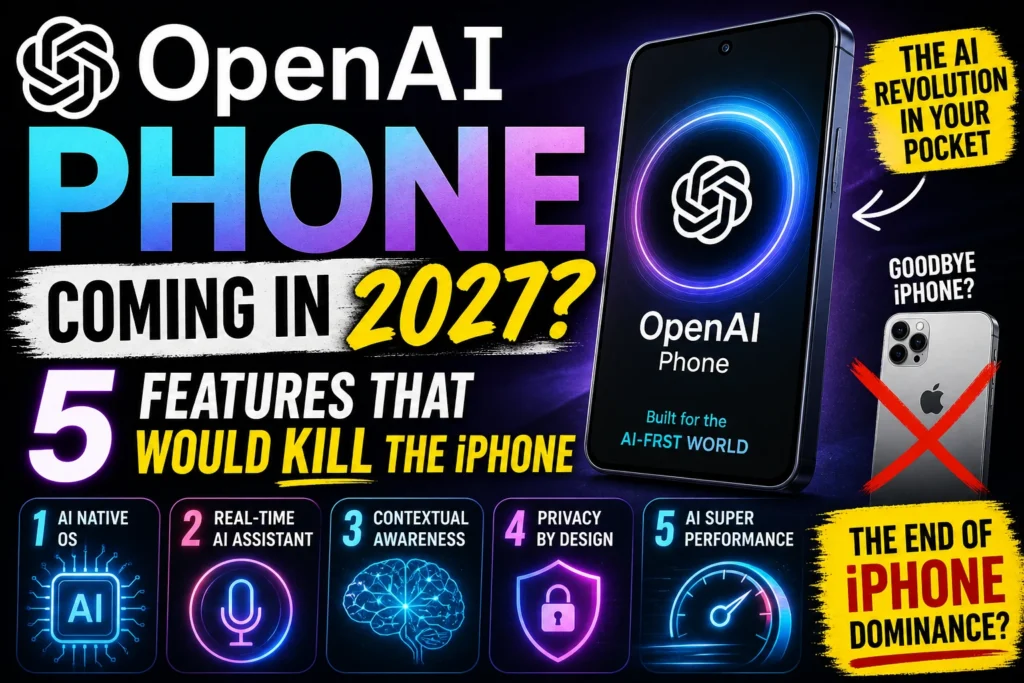
- Feature #1: No Apps – Just AI Agents
- Feature #2: Real-Time Context Awareness
- Feature #3: Custom AI Chip Built with Qualcomm and MediaTek
- Feature #4: Seamless Integration with Jony Ive's Wearable
- Feature #5: Direct ChatGPT Subscription Bundling
- The Roadmap: When Can You Buy One?
- The Risks: Why It Could Still Fail
- Frequently Asked Questions
- My Final Take
The biggest threat to Apple’s iPhone might not come from Samsung or Google.
It might come from a company that has never built a phone before – OpenAI.
You know OpenAI. The company behind ChatGPT. The AI tool that over 900 million people use every single week . Now, according to a new report from renowned analyst Ming-Chi Kuo, OpenAI is reportedly building its own smartphone . And this is not just another Android phone with a ChatGPT sticker on it.
This is something completely different. The OpenAI phone is rumored to replace apps with AI agents . No more scrolling through a home screen full of icons. No more downloading 50 different apps for 50 different tasks. Just you and an AI that does everything for you.
Before I explain these 5 features, let me quickly address the elephant in the room. Most AI hardware has failed. I recently wrote a detailed breakdown of why the Humane AI Pin and Rabbit R1 crashed and burned, and what OpenAI learned from their mistakes.
In this blog, I will break down 5 features of the rumored OpenAI phone that could actually make people leave their iPhones behind.
What We Know So Far (Real Data, No Fake News)
Before I jump into the features, let me give you the facts. Everything here is based on real reports from April 2026.
The Source: Who is Ming-Chi Kuo?
Ming-Chi Kuo is a well-known analyst at TF International Securities. He has a long history of accurately predicting Apple’s hardware plans. When Kuo speaks, the tech industry listens .
On April 26, 2026, Kuo posted on X (formerly Twitter) that OpenAI is co-developing a smartphone chip with Qualcomm and MediaTek .
The Partners
| Partner | Role |
|---|---|
| Qualcomm | Chip development |
| MediaTek | Chip development |
| Luxshare | Manufacturing and system co-design |
Luxshare is particularly interesting. They currently manufacture iPhones for Apple. So OpenAI is using Apple’s own supply chain partner .
The Timeline
Late 2026 / Early 2027: Final specifications and suppliers to be confirmed
2028: Mass production expected to begin
The Projected Scale
Kuo reportedly expects shipments of 300 to 400 million units per year if demand matches internal expectations . For comparison, Apple ships around 200-250 million iPhones per year.
Yes, OpenAI is thinking that big.
The Context: Why OpenAI Needs Its Own Phone
Before I list the features, let me explain why OpenAI is doing this.
Reason 1: Apple and Google Said No
OpenAI wanted to integrate ChatGPT deeply into iPhones and Android phones. But Apple chose Google Gemini as its foundation AI partner instead .
Apple’s reasoning? OpenAI is too centralized. Too cloud-dependent. Apple wanted a partner willing to be “invisible, customizable, and infrastructure-first” . That partner became Google Gemini. So OpenAI got locked out of the iPhone’s core AI.
This decision by Apple is not a small detail. It is the entire reason OpenAI is building its own phone. I have explained the full story of why Apple rejected OpenAI and what it means for the future of both companies.
Reason 2: The “App” Model is Limiting
Right now, ChatGPT lives inside Apple’s App Store and Google’s Play Store. That means OpenAI has to follow their rules. Their restrictions. Their 30% commission on payments.
By building its own phone, OpenAI bypasses both Apple and Google completely .
Reason 3: Previous AI Hardware Failed – But OpenAI Is Different
You might remember the Humane AI Pin and the Rabbit R1. Both promised to replace your smartphone. Both failed miserably .
The Humane AI Pin cost 700plusa700plusa24/month subscription. It overheated. The laser projector was “crap” according to The Verge. It was discontinued . The Rabbit R1 was called “completely useless” by users. Battery died in 4 hours. Only 5% of buyers continued using it after five months .
So why will OpenAI succeed where others failed?
Because OpenAI has 900 million weekly active users already . Humane and Rabbit had zero users before launch. OpenAI has a built-in audience. That is the difference.
Feature #1: No Apps – Just AI Agents
This is the biggest feature. The one that could truly change everything.
How Your Phone Works Today
Right now, if you want to book a flight, here is what you do:
Open your browser or an app like MakeMyTrip
Search for flights
Compare prices
Enter your details
Make payment
That is 5 steps. Multiple apps. Multiple logins.
How the OpenAI Phone Could Work
According to Kuo, the OpenAI phone would replace apps with AI agents that handle tasks directly . You simply say: “Book me a flight to Delhi next Friday, economy class, under ₹10,000.” The AI agent handles everything in the background. It checks multiple airlines. Compares prices. Books the ticket. Adds it to your calendar.
Zero apps. Zero taps. One conversation.
What This Means for Apple
Apple’s entire business is built on the App Store. Apple takes a 15-30% cut of every app purchase and in-app payment. If apps become irrelevant, that revenue disappears .
This is why Apple is scared.
Feature #2: Real-Time Context Awareness
Your current smartphone is reactive. You have to tell it what to do. Every time.
The OpenAI phone could be proactive.
How It Would Work
Kuo’s report says the phone would be designed to “continuously understand users’ context” . This means:
Location context: The phone knows you are at the airport and automatically shows your boarding pass
Time context: The phone knows you have a meeting in 10 minutes and suggests leaving now due to traffic
Conversation context: You mention a restaurant to a friend on a call, and the phone saves it to your “want to go” list
Apple and Google are working on similar features. But they are limited by privacy restrictions. OpenAI could be more aggressive because it controls both the hardware and the software .
Feature #3: Custom AI Chip Built with Qualcomm and MediaTek
This is the technical advantage that no one is talking about enough.
The Apple Silicon Lesson
Apple designs its own chips (A-series and M-series). That gives Apple two huge advantages:
Performance: The chip is optimized specifically for Apple’s software
Battery life: No wasted power on unnecessary features
OpenAI is copying this playbook.
What We Know About the Chip
OpenAI is working with Qualcomm and MediaTek to co-develop a custom smartphone chip . This chip would be designed specifically for running AI models efficiently. Kuo says the chip would run a mix of on-device and cloud inference . Simple tasks (like setting an alarm) happen on the device. Complex tasks (like writing an email) use the cloud.
This hybrid approach gives you:
Speed for basic commands
Power for complex requests
Privacy because your data stays on the device when possible
Feature #4: Seamless Integration with Jony Ive’s Wearable
This is where the OpenAI ecosystem story gets interesting.
Who is Jony Ive?
Jony Ive was Apple’s Chief Design Officer for over 20 years. He designed the iMac, the iPod, the iPhone, and the iPad. He is arguably the most successful industrial designer in history. In May 2025, OpenAI acquired Jony Ive’s hardware startup io for $6.4 billion . The first product from this partnership is expected in the second half of 2026 .
What Is That First Product?
Reports suggest it will be a wearable device – possibly AI-powered earbuds codenamed “Sweetpea” . Sam Altman described it as bringing “the delight, wonder and creative spirit that I first felt using an Apple Computer 30 years ago” .
How This Connects to the Phone
Imagine this ecosystem:
The wearable (earbuds or glasses) handles quick voice commands
The phone handles complex, multi-step tasks
Both devices share context seamlessly
You ask your earbuds: “What’s my schedule today?”
The earbuds pull the answer from your phone. You ask your phone: “Remind me to call Mom when I get home.”
The phone syncs that reminder to your earbuds. Apple has this with AirPods and iPhone. Google is building this with Pixel Buds and Pixel phones. OpenAI wants the same. But OpenAI has one advantage: ChatGPT is already the most famous AI in the world .
Feature #5: Direct ChatGPT Subscription Bundling
Let’s talk about money.
The Current Model
Today, you can pay $20/month for ChatGPT Plus. That gives you access to GPT-4 and other advanced features. OpenAI has over 50 million paid subscribers .
The New Model with a Phone
Imagine OpenAI sells the phone for $999 but includes:
1 year of ChatGPT Plus for free
Priority access to new AI models
Exclusive features only available on OpenAI hardware
This is exactly what Apple does with iCloud+. Apple gives you free iCloud storage when you buy an iPhone. It keeps you locked into their ecosystem.
OpenAI could do the same.
The Revenue Potential
OpenAI’s annualized revenue is around $250 billion . A successful phone could add tens of billions more. More importantly, every OpenAI phone user becomes a captive customer for OpenAI’s services. They are not going to switch to Google Gemini or Claude if their phone is built around ChatGPT.
The Roadmap: When Can You Buy One?
Let me give you the timeline based on all available reports:
| Year | Milestone |
|---|---|
| Late 2026 / Early 2027 | Final specifications and suppliers confirmed |
| Second half of 2026 | First wearable product (earbuds/glasses) announced |
| 2027 | Potential launch of the wearable |
| 2028 | Mass production of the OpenAI phone begins |
So realistically, you will not see an OpenAI phone in your hands before 2028 . But the wearable could come as early as late 2026 or early 2027 .
The Risks: Why It Could Still Fail
I have painted an exciting picture. But let me also be honest about the challenges.
Changing User Behavior is Hard
For 15+ years, we have been trained to use apps. We know how to find the camera app. We know where WhatsApp is. We know how to scroll through Instagram. Replacing apps with AI agents sounds cool in theory. But will people actually trust an AI to book their flights? Pay their bills? Send messages to their boss?
Trust takes time to build.
The Hardware Graveyard is Full
Samsung, Google, Microsoft, Amazon – all have tried to build successful smartphones. Only Apple and Samsung (and maybe Google’s Pixel) have succeeded. Making great hardware is really hard. Supply chains are complex. Margins are thin. One bad launch can destroy billions of dollars.
Apple and Google Will Fight Back
Apple is not going to sit quietly. They have Google Gemini powering their AI now. They have deep integration across iOS, iPadOS, and macOS. They have 1.5 billion active iPhones in the world . Google has Android, which runs on over 3 billion devices. OpenAI is the challenger. And challengers usually lose.
OpenAI’s Financial Pressure
According to a May 2, 2026 report, OpenAI has missed several monthly revenue targets. They have not yet reached 1 billion weekly active users. There is reportedly disagreement between CEO Sam Altman (who wants an IPO in 2026) and CFO Sarah Friar (who wants to wait until 2027) . Building a smartphone costs billions. If OpenAI’s financial situation worsens, this phone project could be delayed or canceled.
Frequently Asked Questions
Q1: Is the OpenAI phone confirmed?
A: No. OpenAI has not officially announced anything. All information comes from analyst Ming-Chi Kuo’s reports. However, Kuo has a strong track record.
Q2: When will the OpenAI phone launch?
A: The earliest possible launch is 2028, according to current reports.
Q3: Will the OpenAI phone run Android?
A: Unknown. It could run a modified version of Android or an entirely new operating system.
Q4: How much will it cost?
A: No pricing information is available yet. But expect a premium price point, likely $900+.
Q5: Should I wait for the OpenAI phone instead of buying an iPhone?
A: No. The phone is at least 2 years away. If you need a phone now, buy what works for you today.
My Final Take
Here is my honest opinion.
The OpenAI phone is brilliant in theory but risky in execution. The idea of replacing apps with AI agents is genuinely revolutionary. If anyone can pull it off, it’s OpenAI – with 900 million users, Jony Ive’s design talent, and custom chips from Qualcomm. But the graveyard of AI hardware is full. Humane. Rabbit. Countless others. Building a phone is orders of magnitude harder than building a chatbot. Will the OpenAI phone kill the iPhone? Probably not in 2028. But by 2030? By 2032? Apple should be worried. Not today. But tomorrow?
The secret weapon behind OpenAI’s hardware plans is Jony Ive. I have written a complete breakdown of his $6.5 billion deal with OpenAI and what he is building.”