Introduction: The AI Hardware Graveyard
Let me tell you a story.
- Introduction: The AI Hardware Graveyard
- What Was the Humane AI Pin?
- What Was the Rabbit R1?
- The Failure by the Numbers
- Reasons Why Both Failed
- What Jony Ive Said About These Failures
- Rabbit's Founder Responded
- The Humane Pin Became E-Waste
- What OpenAI Is Doing Differently
- What OpenAI Still Needs to Get Right
- The Final Verdict
- My Final Thoughts
- Frequently Asked Questions
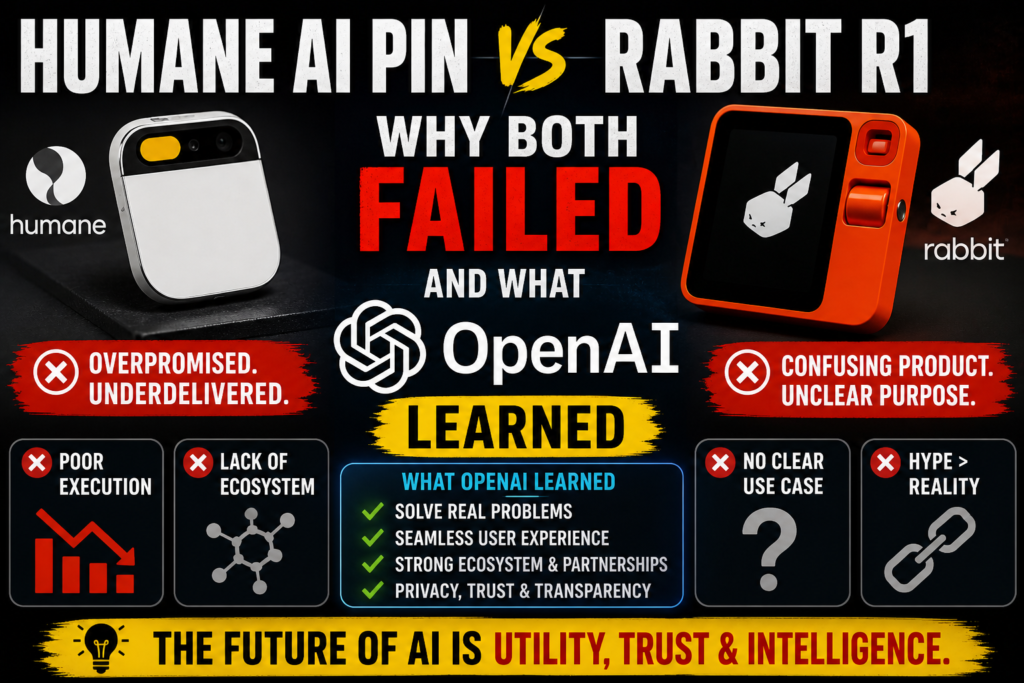
In early 2024, two ambitious startups promised to change how we interact with technology forever. They said their devices would replace smartphones. No more tapping on screens. No more downloading apps. Just you, a small gadget, and artificial intelligence doing everything for you. Those devices were the Humane AI Pin and the Rabbit R1.
The hype was enormous. Tech blogs called them “the future.” Millions of people watched their launch videos. Pre-orders sold out in days.
This history is important because OpenAI is now building its own AI hardware. In fact, there are rumors of an OpenAI phone coming by 2027 with features that could directly challenge the iPhone. Understanding why Humane and Rabbit failed helps us predict whether OpenAI will succeed.
Fast forward to 2026. One device is dead – discontinued, turned into electronic waste. The other is dying – barely anyone uses it, and the company is struggling to survive . What went wrong? And more importantly – what can OpenAI learn as it prepares to launch its own AI hardware with Jony Ive?This blog will answer both questions.
I will break down:
What the Humane AI Pin and Rabbit R1 actually were
Why they failed (5 specific reasons)
The shocking sales numbers no one talks about
What OpenAI is doing differently
Let me start from the beginning.
What Was the Humane AI Pin?
The Promise
The Humane AI Pin was launched in late 2023 by Humane – a startup founded by former Apple engineers Imran Chaudhri and Bethany Bongiorno .
The vision was bold. No screen. No apps. Just a small square device you clip onto your shirt. It had:
A laser projector that displayed information on your palm
A voice assistant powered by AI
A camera for recognizing objects
A 700pricetag∗∗plusa∗∗700pricetag∗∗plusa∗∗24/month subscription
The founders said it would free you from smartphone addiction. No more looking down at screens. Just talk to the Pin, and it would handle everything.
What Users Actually Got
The reality was very different.
The Laser Projector Was Terrible
The Verge called the 720p resolution “crap” . You could barely read anything on your palm in sunlight. One reviewer said it was like trying to use a calculator watch from the 1980s.
It Overheated Constantly
The device was small and dense. There was no space for proper cooling. Within minutes of use, the Pin became hot – remember, this thing sits on your chest . Users reported burning sensations.
The Battery Lasted 2-3 Hours
With continuous use, the Pin died before lunch. The charging case helped, but that meant carrying an extra accessory .
Voice Responses Took 10 Seconds
Humane promised instant AI assistance. Instead, users waited up to 10 seconds for a response . Imagine asking “what’s the weather?” and standing there for 10 seconds waiting for an answer.
The Subscription Was a Dealbreaker
700forthedevice.Then700forthedevice.Then24 every month just to keep it working. That is 288peryear.Overtwoyears,youpaidalmost288peryear.Overtwoyears,youpaidalmost1,300 for a device that barely worked.
What Was the Rabbit R1?
The Promise
The Rabbit R1 launched in early 2024. It was created by Rabbit, a startup founded by Jesse Lyu.
Unlike the Humane Pin, the Rabbit R1 had a small screen (2.88 inches). It looked like a colorful, cute gadget – something Teenage Engineering might have designed .
The big promise was the Large Action Model (LAM) . Rabbit claimed the R1 could:
Learn how to use any app
Perform tasks for you automatically
Eventually replace your smartphone entirely
The price was much lower: $199. No subscription. This seemed more reasonable .
What Users Actually Got
It Was Just an Android App in a Box
Here is the most damaging revelation: The Rabbit R1 was essentially an Android app running on cheap hardware. A developer discovered that the R1’s operating system was just a modified version of Android. You could install the same “Rabbit Launcher” on any Android phone .
That meant the entire device was unnecessary. Your smartphone could do the same thing.
The “Large Action Model” Didn’t Work
Rabbit promised that the R1 could learn to use Spotify, Uber, Doordash, and other apps. In reality, the LAM barely worked. It could handle a handful of pre-programmed tasks. Anything slightly outside that – failure .
Android Authority tested the Vision Mode (where the camera recognizes objects) and called it “largely useless,” rating the device 1.5 out of 5 stars .
Battery Life Was Terrible
iFixit performed a teardown of the Rabbit R1. They found a 3.45 Wh lithium-polymer battery. Their comment: “There’s room enough for a bigger battery in here… the bigger battery is definitely needed given how quickly the R1 tears through a charge” .
Users reported 4-5 hours of battery life with regular use.
MKBHD Called It “Barely Reviewable”
Marques Brownlee, the most famous tech reviewer on YouTube, said the Rabbit R1 was so unfinished at launch that he could barely review it. That is devastating for any new product .
The Failure by the Numbers
Let me give you the real data. These numbers tell the whole story.
Humane AI Pin: The Numbers
| Metric | Number |
|---|---|
| Projected first-year sales | 100,000 units |
| Actual units sold | ~10,000 units |
| Active users by June 2024 | ~8,000 |
| Active users by late 2024 | ~7,000 |
| Return rate (May-August) | More returns than purchases |
| Valuation at peak | $850 million |
| Acquisition price by HP | $116 million |
| Customer refund window | 90 days |
Key takeaway: Humane sold 90% fewer units than expected. By summer 2024, more people were returning the Pin than buying it. The company lost almost 90% of its value.
Rabbit R1: The Numbers
| Metric | Number |
|---|---|
| Units sold in first 4 days | 100,000 |
| Current status | Capital chain broken, wages owed |
| User sentiment | “Completely useless,” “paperweight” |
Key takeaway: Rabbit sold well initially because of hype. But the product failed to deliver. By late 2025, the company collapsed financially.
The 2025 AI Hardware Failure Rate
According to industry data, 85% of AI hardware startups failed in 2025 . The Humane AI Pin and Rabbit R1 were not exceptions. They were the leaders of a graveyard full of failed gadgets.
Reasons Why Both Failed
Now let me analyze why these devices failed. Understanding this is key to knowing what OpenAI must do differently.
This is also why Apple’s decision to stick with Google Gemini matters. Apple believes in the current smartphone model. OpenAI wants to replace it. I have written about whether Apple made a $100 billion mistake by choosing Google over OpenAI.
They Tried to Replace Something That Already Works
This is the biggest mistake.
Your smartphone is really good at what it does. It has a bright, high-resolution screen. It has fast processors. It has 5G connectivity. It has thousands of apps. It fits in your pocket. And you already own it.
Why would anyone pay 200−200−700 for a device that does less than their phone?
One reviewer put it perfectly: “The Rabbit R1 is a chopped smartphone” . GPT-4o and Google Gemini already do everything these devices promised – and they run on phones you already have .
OpenAI’s lesson: Don’t try to replace the smartphone completely. Work alongside it.
The Software Was Unfinished at Launch
Both devices launched with broken promises.
The Humane Pin’s AI assistant was slow and unreliable. The laser projector was barely readable. The Rabbit R1’s “Large Action Model” barely worked.
Marques Brownlee said the Rabbit R1 was “barely reviewable.” David Pierce of The Verge said the Humane Pin “doesn’t work” .
When you launch a product, it must work on day one. Not in six months. Not “eventually.” Day one.
OpenAI’s lesson: Do not launch until the software is truly ready.
Hardware Limitations Made Them Unusable
Small devices have small batteries. Small batteries mean short battery life. Short battery life means people stop using the device.
The Humane Pin overheated. The Rabbit R1 died in 4 hours. These are fundamental hardware problems that cannot be fixed with software updates .
iFixit’s teardown showed both devices were well-engineered internally. But good engineering cannot overcome the laws of physics. Small devices will always have battery and heat limitations.
OpenAI’s lesson: If you build hardware, accept the physical constraints. Or choose a different form factor.
They Tried to Do Too Much
According to industry analysis, failed AI hardware products “often try to solve too many problems” .
The Humane Pin promised to replace your phone, your watch, your voice assistant, and your camera. It failed at everything.
The Rabbit R1 wanted to “solve all problems for all people but ended up solving none of them well” .
Successful products do one thing exceptionally well. The iPhone was not the first smartphone. But it did touchscreens better than anyone. Google Search was not the first search engine. But it did relevance better than anyone.
OpenAI’s lesson: Focus on a single use case. Master it. Then expand.
The Subscriptions Were Insulting
Humane charged 700forthedevice∗∗AND∗∗700forthedevice∗∗AND∗∗24 per month to use it.
That is like buying a car and then paying monthly to turn the engine on.
Customers hated this. Many reviews mentioned the subscription as a dealbreaker . The device itself was expensive. Adding a mandatory monthly fee felt like greed, not value.
OpenAI’s lesson: If you charge a premium for hardware, include the software. Do not nickel-and-dime your early adopters.
What Jony Ive Said About These Failures
In May 2025, Jony Ive – the legendary designer behind the iMac, iPod, iPhone, and iPad – commented publicly on the Humane AI Pin and Rabbit R1.
His words were brutal.
“Those were very poor products,” Ive said. “There has been an absence of new ways of thinking expressed in products.”
Think about that. Jony Ive is one of the most polite, diplomatic people in tech. For him to call products “very poor” is extraordinary.
What did he mean by “absence of new ways of thinking”?
Ive was saying that these devices copied old ideas. A screen on your shirt? That’s not new. A small Android device in a cute box? That’s not new. These products did not reimagine how humans interact with computers. They just shrunk existing ideas.
This is the core critique: Humane and Rabbit did not ask the fundamental question – “What new behavior does this enable?” Instead, they asked “How can we make existing behaviors smaller?”
OpenAI’s lesson: True innovation is not about miniaturization. It is about rethinking the relationship between humans and computers.
Rabbit’s Founder Responded
Jesse Lyu, founder of Rabbit, responded to Jony Ive’s comments.
He called Ive his “hero” .
But he disagreed with being compared to Humane. Lyu said: “We don’t like to be put side by side with Humane, a company that stopped trying, got acquired, and shut down.”
Lyu acknowledged that the Rabbit R1’s launch was problematic. But he said the team continues to improve the product. Rabbit has since added:
A memory journal feature for AI context
Free access to “Intern” – an AI-native operating system
rabbitOS 2.0 with multi-agent coordination
Is Rabbit recovering? Unlikely. The capital chain is broken. The brand reputation is damaged. But Lyu deserves credit for trying to fix things.
The Humane Pin Became E-Waste
The ending for Humane AI Pin is particularly sad.
When customers returned their Pins, Humane could not refurbish them. There was a T-Mobile limitation that made it “impossible (for now) for Humane to reassign a Pin to a new user once it’s been assigned to someone” .
That means every returned Pin became electronic waste. The company could not resell it. Could not recycle it. Could not donate it.
One Reddit user described a haunting image: A warehouse full of returned Pins, slowly beeping as their batteries died, waiting for a solution that never came .
In February 2025, HP acquired Humane for 116million–afractionofits116million–afractionofits850 million peak valuation. The AI Pin was discontinued immediately .
What OpenAI Is Doing Differently
Now for the important question: What can OpenAI learn from these failures?
Based on reports and OpenAI’s public statements, here are 5 key differences.
OpenAI Has 900 Million Users Already
Humane and Rabbit launched with zero existing customers. They had to build trust and adoption from nothing.
OpenAI has 900 million weekly active ChatGPT users . That is a massive built-in audience. If OpenAI launches hardware, millions of people will try it immediately.
Why this matters: Critical mass solves many problems. More users mean more feedback. More feedback means faster improvement.
OpenAI Owns the AI Model
Both Humane and Rabbit relied on third-party AI models. They had limited control over capabilities and performance.
OpenAI builds its own models. GPT-4o and future models are designed specifically for OpenAI’s hardware vision .
Why this matters: Full stack control means optimization. OpenAI can design hardware and software together, just like Apple does with the iPhone.
Jony Ive Is Designing It
Neither Humane nor Rabbit had Jony Ive.
Ive is not just a designer. He is someone who thinks deeply about human-computer interaction. He asks: “What is the essence of this product? What new behavior does it enable?”
The OpenAI device (expected in late 2026) is Ive’s chance to answer the question he posed about Humane and Rabbit: “There has been an absence of new ways of thinking expressed in products.”
Ive wants to introduce new ways of thinking .
Why this matters: Good design is not about aesthetics. It is about reimagining what a product can be.
Custom Chip for AI Workloads
The Humane Pin and Rabbit R1 used off-the-shelf processors. They were not optimized for AI.
OpenAI is co-developing a custom smartphone chip with Qualcomm and MediaTek . This chip is designed specifically for running AI models efficiently.
Why this matters: Custom silicon means faster responses, better battery life, and unique capabilities that competitors cannot copy.
No Subscription for Hardware (Likely)
OpenAI has not announced pricing. But given the backlash against Humane’s subscription, it is unlikely OpenAI will repeat that mistake.
The more likely model: Pay for the hardware once. ChatGPT Plus ($20/month) remains optional for premium features .
Why this matters: Removing friction increases adoption.
What OpenAI Still Needs to Get Right
Let me be honest. Success is not guaranteed.
Here is what OpenAI must still figure out:
1: What Is the Use Case?
“AI assistant on your body” is not a use case. It is a category.
OpenAI needs to answer: What specific problem does this solve better than a phone?
The iPhone solved “existing phones are hard to use.” The iPod solved “carrying your music library is annoying.”
What does OpenAI solve?
2: How Do You Avoid the “Why Not Just Use My Phone” Problem?
Every AI hardware reviewer asks the same question: “Why is this a separate device?”
If the answer is not compelling, people will not buy it.
3: Can Battery Life Be Solved?
Small devices have small batteries. That is physics.
If OpenAI’s device lasts less than a full day, people will leave it at home.
4: Will Apps Become Obsolete?
OpenAI’s vision is to replace apps with AI agents . That sounds great. But apps have had 15+ years of refinement. AI agents are new and unproven.
Can OpenAI really replace the functionality of Uber, Spotify, WhatsApp, and Google Maps with voice commands alone? That is a massive challenge.
The biggest difference no one is talking about? OpenAI hired Jony Ive. The man who designed the iPhone, the iPod, and the Apple Watch is now leading OpenAI’s hardware design. I have written a detailed blog about his $6.5 billion deal with OpenAI
The Final Verdict
Let me summarize everything in one table.
| Failure Factor | Humane AI Pin | Rabbit R1 | OpenAI’s Approach |
|---|---|---|---|
| Tried to replace phone | Yes | Yes | Unclear – likely complementary |
| Unfinished software at launch | Yes | Yes | Expected to delay until ready |
| Hardware limitations (battery/heat) | Severe | Moderate | Custom chip may help |
| Tried to do too much | Yes | Yes | Jony Ive focused on “new thinking” |
| Mandatory subscription | Yes ($24/mo) | No | Unlikely |
| Existing user base | 0 | 0 | 900 million |
| Top designer | Former Apple engineers | Teenage Engineering | Jony Ive |
My Final Thoughts
The Humane AI Pin and Rabbit R1 will be remembered as cautionary tales.
They prove that hype is not enough. Good marketing is not enough. Even good intentions are not enough.
To succeed in AI hardware, you need:
A compelling use case that a phone cannot replicate
Finished software that works on day one
Adequate battery life and thermal management
A price that reflects real value
Trust that you will not abandon your customers
OpenAI has advantages that Humane and Rabbit did not: 900 million users, the world’s best AI models, Jony Ive’s design genius, and a custom chip strategy.
But advantages do not guarantee success.
The question is not “Can OpenAI build a device?” They clearly can.
The question is: Can OpenAI build a device that makes people say “I need this” instead of “Why not just use my phone?”
We will find out in late 2026 or 2027.
Until then, the AI hardware graveyard has two new headstones. Let us hope OpenAI learns from them.
Frequently Asked Questions
Q1: Is the Humane AI Pin still available?
A: No. HP acquired Humane in February 2025 and discontinued the AI Pin immediately .
Q2: Is the Rabbit R1 still working?
A: Yes, the device still functions. But the company is struggling financially and may not survive .
Q3: Could I still buy a Rabbit R1?
A: Possibly from third-party sellers. But do not expect software updates or customer support.
Q4: Did anyone actually like these devices?
A: A very small number of users. Most reviews were negative. The return rates were extremely high.
Q5: What is OpenAI launching and when?
A: A wearable AI device designed with Jony Ive, expected in late 2026 or 2027. An “agent phone” is expected in 2028 .