Introduction: The Comeback of the Century
Let me ask you a question.
- Introduction: The Comeback of the Century
- Who Is Jony Ive? (For Those Who Don’t Know)
- The $6.5 Billion Acquisition of io
- What Is OpenAI Building with Jony Ive?
- The Internal Struggles – It’s Not All Smooth
- Why John Sculley (Former Apple CEO) Believes in Ive
- What Ive Said About the Mission
- The Product Timeline Summary
- The Case For and Against Jony Ive’s Success
- My Final Take
- Frequently Asked Questions
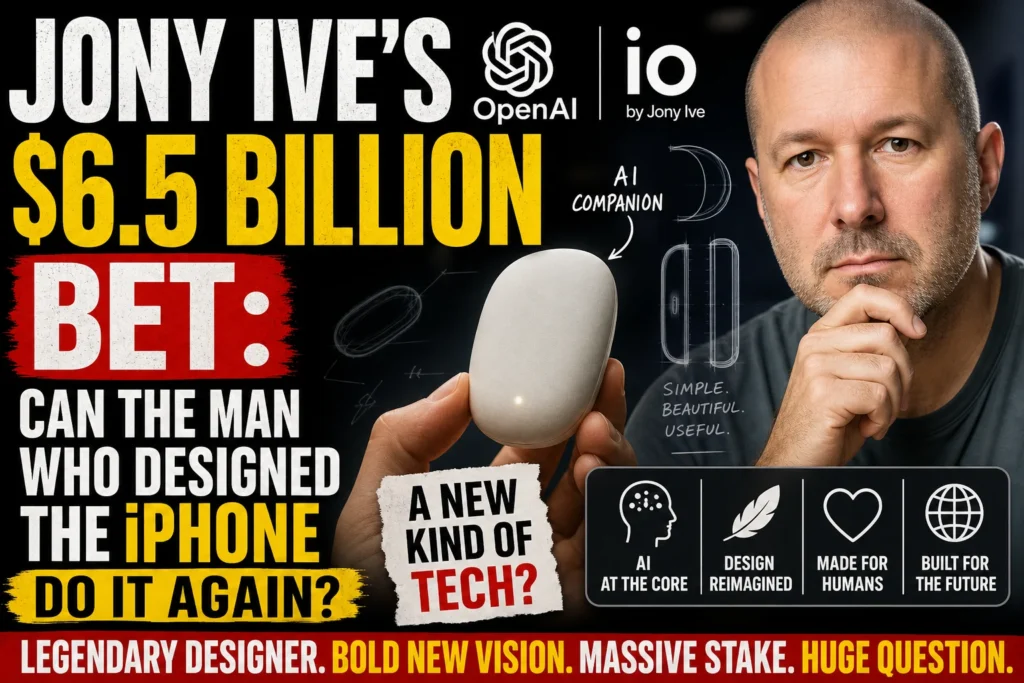
Who is the most successful hardware designer of the past 30 years? Think about it. The iMac. The iPod. The iPhone. The iPad. The MacBook Air. The Apple Watch. AirPods. All of these devices were designed by one person. His name is Jony Ive. From 1992 to 2019, Ive was the soul of Apple’s design. He was Steve Jobs’s closest creative partner. Together, they saved Apple from bankruptcy and turned it into the most valuable company on Earth. Then, in 2019, Ive left Apple to start his own creative agency called LoveFrom. For five years, people wondered: What is Jony Ive doing? Will he ever build another great product? In May 2025, we got the answer. OpenAI acquired Ive’s hardware startup io for $6.5 billion . Ive joined OpenAI as Chief Creative Officer, leading all hardware and software design . The mission? Build the first great AI hardware product – a device that could be as revolutionary as the iPhone was in 2007. But here is the problem. The AI hardware track record is terrible. Humane AI Pin failed. Rabbit R1 failed. Google Glass failed. Microsoft HoloLens failed. Samsung Galaxy Gear failed.
Can Jony Ive break the curse? This blog will tell you everything about Ive’s $6.5 billion bet with OpenAI. I will cover:
Who is Jony Ive and why does he matter?
The $6.5 billion acquisition of io
What is OpenAI building with Ive?
The internal struggles and team tensions
Can he do it again? The case for and against
This $6.5 billion bet is part of a much bigger plan. OpenAI is reportedly building a smartphone that could launch by 2028. I have written about the 5 features of that rumored phone that could make it a true iPhone killer.
Who Is Jony Ive? (For Those Who Don’t Know)
If you use a smartphone, you have Jony Ive to thank.
The Early Years
Sir Jonathan Paul Ive was born in 1967 in London, England. His father was a silversmith and teacher. Young Jony grew up around tools, materials, and the craft of making physical objects. He studied industrial design at Newcastle Polytechnic. Even in college, his work stood out. One of his student projects won an award from the Royal Society of Arts.
In 1992, Ive joined Apple. At the time, Apple was dying. The company was losing money. The products were ugly, confusing, and overpriced.
The Steve Jobs Partnership
In 1997, Steve Jobs returned to Apple. Jobs was looking for talent. He walked into Apple’s design studio and saw Ive’s work. Jobs later told his biographer Walter Isaacson: “He gets it not just as a designer but as a businessperson and a retailer. He cares about every part of the experience. He is the smartest designer I have ever worked with.”
What Jobs saw in Ive was not just drawing skills. It was a philosophy. Ive believed that design is not about how something looks. It is about how something works.
The Product Run That Changed History
Here is the list of products Ive designed at Apple :
| Year | Product | Why It Matters |
|---|---|---|
| 1998 | iMac | Saved Apple from bankruptcy. First computer that looked friendly. |
| 2001 | iPod | Made digital music simple. “1,000 songs in your pocket.” |
| 2007 | iPhone | Reinvented the phone. No keyboard. Just a screen. |
| 2010 | iPad | Created the tablet category. |
| 2013 | Mac Pro | The “trash can” design – controversial but iconic. |
| 2015 | Apple Watch | First successful smartwatch. |
| 2016 | AirPods | Made wireless earbuds mainstream. |
This is the most successful product run in technology history. No other designer has come close.
The Apple Watch and AirPods: Two Wearables That Worked
Here is something most people forget: Ive has already cracked the wearable code .
Ive has publicly criticized the Humane AI Pin and Rabbit R1. He called them ‘very poor products.’ I have written a complete analysis of exactly why those devices failed and what Ive is doing differently.
When the Apple Watch launched in 2015, critics called it a failure. It was slow. The interface was confusing. Battery life was poor.
But Ive and his team kept iterating. Today, the Apple Watch is the best-selling smartwatch in the world . It found its purpose: fitness tracking, health monitoring, and notifications.
Same with AirPods. When they launched in 2016, people mocked them. They looked like toothbrushes. They were expensive. Everyone said they would fall out of your ears. Today, AirPods are a $20 billion business . They are everywhere. Ive understood something others did not: removing the headphone jack forced the wireless future. It was painful. But it worked. This matters because OpenAI’s first device is rumored to be audio-focused . AirPods were audio-focused. Ive knows this territory.
Why He Left Apple
In 2019, after 27 years, Ive left Apple. He started LoveFrom, a creative collective. The name was a nod to his philosophy: Design should be built with love, not just for profit.
Apple remained a client. But Ive was free to work on other projects – including, eventually, with OpenAI.
The $6.5 Billion Acquisition of io
Now let me tell you about the deal that shocked the tech world.
What Is io?
io was Jony Ive’s AI hardware startup. It was founded in 2024 and incubated inside LoveFrom . The team was small – about 55 people .but look at who those 55 people were:
| Person | Previous Role |
|---|---|
| Jony Ive | Former Apple Chief Design Officer |
| Evans Hankey | Former Apple Industrial Design head (replaced Ive) |
| Tang Tan | Former Apple iPhone and Watch design lead |
| Scott Cannon | Former Apple hardware engineer |
This was not just any startup. This was a reunion of Apple’s design dream team .
The Secret Two-Year Collaboration
Here is what makes this deal unusual.
Openai and Ive had been working together in secret for two years before the acquisition . Their first conversations were not about hardware. They were about how to improve ChatGPT’s interface. Ive was advising OpenAI on design. OpenAI was advising Ive on AI. The relationship grew. In 2024, OpenAI’s venture fund invested in io, taking a 23% stake . By May 2025, OpenAI decided to buy the rest.
The Price: $6.5 Billion
The acquisition valued io at approximately $6.5 billion . For context:
OpenAI had previously acquired Windsurf (AI coding tool) for $3 billion
Humane AI Pin’s peak valuation was $850 million
Rabbit R1’s peak valuation was around $400 million
OpenAI paid more than 10x what Humane was ever worth.
Why so much? Because OpenAI was not just buying a team. They were buying Jony Ive’s design philosophy and 55 of the best hardware engineers in the world .
What Ive Got
As part of the deal, Ive joined OpenAI as Chief Creative Officer . He oversees:
All hardware design
All software interface design
The new hardware division within OpenAI
In OpenAI’s public announcement, CEO Sam Altman wrote a letter that I have to quote:
“I hope we can bring the delight, wonder, and creative spirit that I first felt using an Apple Computer 30 years ago.”
Altman was referencing the first time he used a Mac. That feeling of magic. That is what he wants OpenAI hardware to create.
What Jony Ive Said
Ive gave an interview about why he joined OpenAI. His words were powerful:
“This is a cosmic-level goal. We want to create products that elevate humanity.”
But he also had sharp criticism for existing AI hardware. He called the Humane AI Pin and Rabbit R1 “very poor products” .
His reason? “There has been an absence of new ways of thinking expressed in products.”
Ive was saying that Humane and Rabbit did not reinvent anything. They just made existing ideas smaller and put them in weird packages. That is not innovation. That is miniaturization.
Ive wants to do something truly new.
What Is OpenAI Building with Jony Ive?
Now for the exciting part. What is actually coming?
The Official Timeline
At the World Economic Forum in Davos (January 2026), OpenAI’s Global Affairs Officer Chris Lehane confirmed:
OpenAI is targeting the second half of 2026 to launch its first AI hardware device .
Lehane said: “We are on the track to launch in the second half of 2026. That is the most likely time point, though it still depends on progress.”
So the launch is less than 6 months away from today (May 2026).
The Manufacturing Partner: Foxconn
Multiple reports confirm that OpenAI has chosen Foxconn (Hon Hai) to manufacture the first device .
Why Foxconn? Two reasons:
Foxconn manufactures iPhones for Apple. They have the highest quality standards in the industry.
Location. OpenAI reportedly wanted to avoid manufacturing in China. Foxconn will produce the device in Vietnam instead .
The first-year production target is massive: 40 to 50 million units . To put that in perspective: Apple sells 200-250 million iPhones per year. OpenAI is aiming for 1/5th of that in year one. That is extremely ambitious.
The Device: What We Know (and Don’t Know)
OpenAI and Ive have been secretive. But multiple reports give us clues.
It Will Be Audio-First
According to The Information, OpenAI has unified its engineering, product, and research teams to overhaul audio models for this device .
The new audio model can:
Produce more natural-sounding speech
Manage interruptions like a real conversation
Allow the AI to speak while the user is talking (current models cannot do this)
Ive reportedly favors an audio-first design approach to address smartphone addiction . Instead of staring at a screen, you talk to the device.
Possible Form Factors
Reports suggest multiple possibilities :
| Form Factor | Likelihood | Source |
|---|---|---|
| Screenless wearable (pin/clip) | Medium | Early rumors |
| Smart glasses | Medium | Multiple reports |
| Audio earbuds/headphones | High | Latest reports |
| Smart speaker with camera | Medium | Some reports |
The most recent reports (January-February 2026) suggest the first product may be AI audio earbuds or headphones . This makes sense because:
Ive designed AirPods
Audio is less risky than glasses
OpenAI’s audio models are ready
What It Is NOT
Ive has been clear: This is not a smartphone and not glasses . He called it a “third category” of device – something new.
The Smart Speaker Rumor
There is another possibility. According to The Information (February 2026), OpenAI may also be building a smart speaker with a camera .
The reported features include:
A camera that recognizes objects on your desk
Face ID-like facial recognition for secure shopping
Ability to understand conversations between multiple people
Price point: 200−200−300
This would compete with Amazon Echo, Google Nest, and Apple’s rumored AI home device.
The Family of Devices
One report suggests OpenAI is planning a family of devices, not just one product . Possible lineup:
A wearable (earbuds or pendant)
Smart glasses
A home speaker
This is similar to how Apple launched the iPhone, then iPad, then Watch, then AirPods. Start with one hero product, then expand.
The Software Vision: No Apps, Just AI Agents
Ive has hinted at the software philosophy. In a conversation with Sam Altman, he said:
“We haven’t figured out what the equivalent of the graphical user interface is for AI. But we will find the answer.”
Today, we use icons, folders, and menus. Ive believes AI will replace all of that. You won’t open an app. You will just talk to the device, and it will perform tasks using AI agents.
This is exactly what the “OpenAI phone” concept imagines – but the first device may be audio-only, so more limited in scope.
The Internal Struggles – It’s Not All Smooth
I have to be honest. Not everything is perfect.
The LoveFrom Tensions
According to reports from February 2026, there is friction between OpenAI and Ive’s design firm LoveFrom .
How is the relationship structured?
LoveFrom provides creative and design services to OpenAI (industrial design, user interface, user experience)
LoveFrom also remains an independent company
OpenAI’s internal hardware team handles development and engineering
The problem? OpenAI employees complain that LoveFrom is too slow at revising designs. They also say LoveFrom does not share its development process openly – even with other OpenAI teams .
This creates delays. The hardware team cannot build what they have not seen. The design team cannot finalize without engineering input.
This is actually normal for complex product development. Apple had the same tensions between design and engineering. But it is worth noting.
The Technical Headaches
Beyond team dynamics, there are real technical challenges .
The “Always Listening” Problem
For a voice-first device to work, it needs to be always listening. But:
When should it speak? Not every time someone says a word.
How does it know you are talking to it vs. someone else?
How does it avoid “hallucinating” – responding when it shouldn’t?
Ive’s team has reportedly struggled to calibrate this. One internal source told the Financial Times: “The team could not calibrate it such that it speaks only when useful.”
Battery Life
A small wearable has a small battery. Running AI models locally drains that battery fast. Running them in the cloud requires constant connectivity.
Balancing compute, power, and size is not trivial .
Privacy
An always-listening, always-watching device raises serious privacy concerns. If the device has a camera (reports suggest it might), people will worry about being recorded .
Ive and OpenAI must convince users that their data is safe. That is a hard sell after the Humane Pin’s privacy scandals.
The Skepticism
Not everyone believes Ive can succeed.
The wearables graveyard is full of brilliant people who failed . Google Glass had Google’s billions. It failed. Microsoft HoloLens had Microsoft’s engineering. It failed. Humane had $240 million in funding. It failed. Rabbit had hype. It failed.
Why will Ive be different?
The optimists say: Because Ive has already succeeded twice with wearables (Apple Watch and AirPods) . He understands what others miss: people will not wear ugly devices. People will not wear devices that do not solve real problems.
The pessimists say: Even Apple struggled to make smart glasses work. Apple has been reportedly working on AR glasses for years with nothing to show . If Apple cannot do it, can Ive do it without Apple?
Why John Sculley (Former Apple CEO) Believes in Ive
Not everyone is skeptical. One important voice is John Sculley.
Who is John Sculley? He was Apple’s CEO from 1983 to 1993. He famously hired Steve Jobs. Then he famously fired Steve Jobs. It is a complicated legacy.
But Sculley knows Apple’s inner workings better than almost anyone alive.
At the Zeta Live conference (October 2025), Sculley was asked about Ive and OpenAI. His answer was surprising .
Sculley said:
“He’s the one who actually designed and built the iMac, the iPod, the iPhone, and the iPad. If there’s anyone who is probably going to be able to bring that dimension to the LLM, in this case OpenAI, it’s probably going to be Jony Ive, working with Sam Altman.”
Sculley also said something bold: OpenAI is “the first real competitor” Apple has faced “in many decades” .
Why? Because Apple’s strength is apps. OpenAI’s vision replaces apps with AI agents. If that happens, Apple’s entire business model is threatened .
Sculley concluded:
“In the agentic era, we don’t need a lot of apps. It can all be done with smart agents.”
Coming from a former Apple CEO, that is a warning sign for Cupertino.
What Ive Said About the Mission
Let me share Ive’s own words about why he is doing this.
In a conversation at OpenAI DevDay (October 2025), Ive discussed the mission .
He said the hardware his team is developing aims to address problems that smartphones and tablets have created .
What problems?
Smartphone addiction (staring at screens for hours)
Constant distractions (notifications pulling you away)
Isolation (staring at a screen instead of talking to people next to you)
Ive believes an audio-first, screenless AI device could solve these problems. It would be a companion, not a distraction .
He also talked about “righting the wrongs” of past consumer gadgets . That is a heavy responsibility to take on.
But if anyone can do it, Ive might be the one.
The Product Timeline Summary
Let me put everything in one clear timeline based on all reports.
| Date | Event |
|---|---|
| 2024 | io founded by Jony Ive |
| 2024 (mid) | OpenAI invests in io, takes 23% stake |
| May 2025 | OpenAI acquires io for $6.5 billion |
| May 2025 | Ive joins OpenAI as Chief Creative Officer |
| Oct 2025 | Ive and Altman discuss device at OpenAI DevDay |
| Jan 2026 | Davos: OpenAI confirms late-2026 launch target |
| Feb 2026 | Reports of smart speaker with camera emerge |
| Late 2026 | First device expected to launch |
| 2027 | Potential second device (smart glasses or speaker) |
| 2028 | OpenAI smartphone (Agent Phone) expected |
As of today (May 3, 2026): We are approximately 6 months away from the official launch .
The Case For and Against Jony Ive’s Success
Let me give you both sides.
The Case FOR Success
1. Ive Has Done It Before
No one has a better track record. iMac, iPod, iPhone, iPad, Apple Watch, AirPods. That is not luck. That is a design philosophy that works .
2. OpenAI Has 900 Million Users
Unlike Humane or Rabbit, OpenAI does not need to convince people to try AI. 900 million people already use ChatGPT every week. If OpenAI puts that AI into hardware, millions will buy it automatically.
3. The Timing Is Right
As Google co-founder Sergey Brin admitted, Google Glass was “a decade ahead” of AI capabilities . Now, AI is finally ready. Large language models can understand natural conversation. Multimodal AI can see and hear. The technology exists.
4. Meta’s Ray-Ban Glasses Are Selling
Proof that wearables can work: Meta’s Ray-Ban smart glasses have sold 2 million units and Meta plans to produce 10 million annually by 2026 . People will wear smart glasses if they look normal and work well.
5. The Team Is Stacked
55 former Apple hardware engineers. The people who built the iPhone, Watch, and AirPods. There is no better hardware team outside of Apple itself.
The Case AGAINST Success
1. The Wearables Graveyard Is Full
Google Glass. Microsoft HoloLens. Samsung Galaxy Gear. Humane AI Pin. Rabbit R1. Even Amazon’s Echo glasses failed. Money, talent, and hype do not guarantee success .
2. Apple Couldn’t Do Smart Glasses
If Apple has been working on AR glasses for years with nothing to show, that suggests the problem is not design. It is physics and battery life. Some problems cannot be designed away .
3. Internal Tensions Are Real
OpenAI and LoveFrom reportedly have friction. Design is slow. Communication is poor. This could delay the product or hurt quality .
4. The “Always Listening” Problem May Be Unsolvable
Getting an AI to know when to speak and when to shut up is genuinely hard. If the device is annoying – speaking at the wrong time, misunderstanding commands – people will stop using it .
5. Privacy Concerns Are Serious
A device that is always listening and watching will creep people out. OpenAI needs to convince users their data is safe. After Humane’s privacy failures, that is an uphill battle.
My Final Take
I am cautiously optimistic.
Here is why. Jony Ive is not a regular designer. He has spent 30 years thinking about how humans interact with computers. He understands that good design is invisible. You do not notice it. You just use it and it works.
Most AI hardware fails because it is trying too hard to be futuristic. The Humane Pin was a square on your shirt. The Rabbit R1 was a bright orange brick. They looked weird. People felt weird wearing them. Ive’s genius is making technology feel normal. The iPhone did not have a keyboard – that was radical at the time. But it felt so natural that within two years, everyone copied it. If anyone can make an AI wearable feel normal, it is Ive. But. The technical challenges are real. Battery life. Latency. The “always listening” problem. Privacy. These are not design problems. They are engineering problems. And Ive cannot design his way out of physics. The most likely outcome? The first device will be good, not great. It will be beautifully designed. The audio quality will be excellent. The AI integration will be impressive. But it will have issues – battery life, occasional misunderstandings, perhaps high price. And that is okay. The Apple Watch was not great at launch. It took 2-3 years to become the best smartwatch. The iPhone was missing copy-paste, MMS, and an App Store at launch. Great products evolve. So here is my prediction: The OpenAI + Ive device will not kill the iPhone in 2026. But it will be the first credible alternative to the smartphone since the iPhone itself launched in 2007. And by 2028 or 2029, it could be something truly special.
Jony Ive has earned the right to try. The rest of us just get to watch – and maybe buy one.
Frequently Asked Questions
Q1: When is the OpenAI and Jony Ive device launching?
A: Target is the second half of 2026, likely September or October .
Q2: How much will it cost?
A: Unknown. If it is a smart speaker, reports suggest 200−200−300 . If it is audio earbuds, probably 300−300−500.
Q3: What exactly is the device?
A: Not officially confirmed. Likely AI-powered audio earbuds or headphones. Possibly a smart speaker with camera. Not a phone and not glasses .
Q4: Will Ive’s device replace my phone?
A: Not immediately. The first device will likely be a companion to your phone, not a replacement. The “Agent Phone” is expected in 2028 .
Q5: Is OpenAI’s device better than Humane and Rabbit?
A: We don’t know yet. But Ive has publicly criticized Humane and Rabbit as “very poor products.” He is clearly trying to avoid their mistakes