Quantum computing is no longer just a futuristic idea discussed in research labs. It is rapidly becoming one of the most revolutionary technologies of the 21st century. Governments, technology companies, financial institutions, and healthcare organizations are investing billions of dollars to unlock its potential.
- What Is Quantum Computing?
- Why Are the Uses of Quantum Computing Becoming So Important?
- Top Uses of Quantum Computing Across Industries
- Uses of Quantum Computing in Healthcare
- Quantum Computing in Finance
- Quantum Computing in Artificial Intelligence
- How Is Quantum Computing Used in Scientific Research?
- Quantum Computing in Logistics and Supply Chains
- Manufacturing Applications
- Quantum Computing in Energy
- Quantum Computing in Cybersecurity
- Future Uses of Quantum Computing
- Industries Investing in Quantum Computing
- Challenges of Quantum Computing
- Featured Snippet: Key Uses of Quantum Computing
- Frequently Asked Questions (FAQs)
- Conclusion
Unlike traditional computers that process information using bits (0s and 1s), quantum computers use quantum bits, or qubits, which can exist in multiple states simultaneously. This unique capability allows them to solve highly complex problems much faster than today’s most powerful supercomputers. The growing uses of quantum computing are already transforming industries such as healthcare, finance, cybersecurity, logistics, artificial intelligence, and scientific research. While large-scale commercial adoption is still developing, companies like IBM, Google, Microsoft, Amazon, and IonQ continue to achieve major breakthroughs every year.
If you’re new to the technology, check out quantum computing for beginners before diving into its real-world applications.
In this guide, you’ll discover how quantum computing works, why it matters, and the most important industries that are expected to benefit from this groundbreaking technology.
What Is Quantum Computing?
Quantum computing is a new computing model based on the principles of quantum mechanics.
Instead of using standard binary bits, quantum computers use qubits, which can represent multiple values at the same time through properties like:
- Superposition
- Entanglement
- Quantum interference
These properties allow quantum computers to evaluate many possibilities simultaneously instead of sequentially.
Classical Computing vs Quantum Computing
| Feature | Classical Computer | Quantum Computer |
|---|---|---|
| Information Unit | Bit | Qubit |
| State | 0 or 1 | 0, 1, or both simultaneously |
| Processing | Sequential | Parallel possibilities |
| Best For | Everyday computing | Complex optimization & simulations |
| Speed | Fast | Potentially exponentially faster for specific problems |
For a complete comparison, read quantum vs classical computing.
Why Are the Uses of Quantum Computing Becoming So Important?
Many of today’s biggest challenges require enormous computational power.
Examples include:
- Drug discovery
- Climate modeling
- AI training
- Financial risk analysis
- Logistics optimization
- Cryptography
- Material science
Traditional computers often need years—or even centuries—to solve certain optimization problems. Quantum computers can potentially reduce these calculations to hours or even minutes. That is why organizations worldwide are racing to develop practical quantum systems.
Top Uses of Quantum Computing Across Industries
The Applications of Quantum Computing are expanding rapidly as hardware becomes more powerful and stable.
Some of the most promising industries include:
| Industry | Potential Impact |
|---|---|
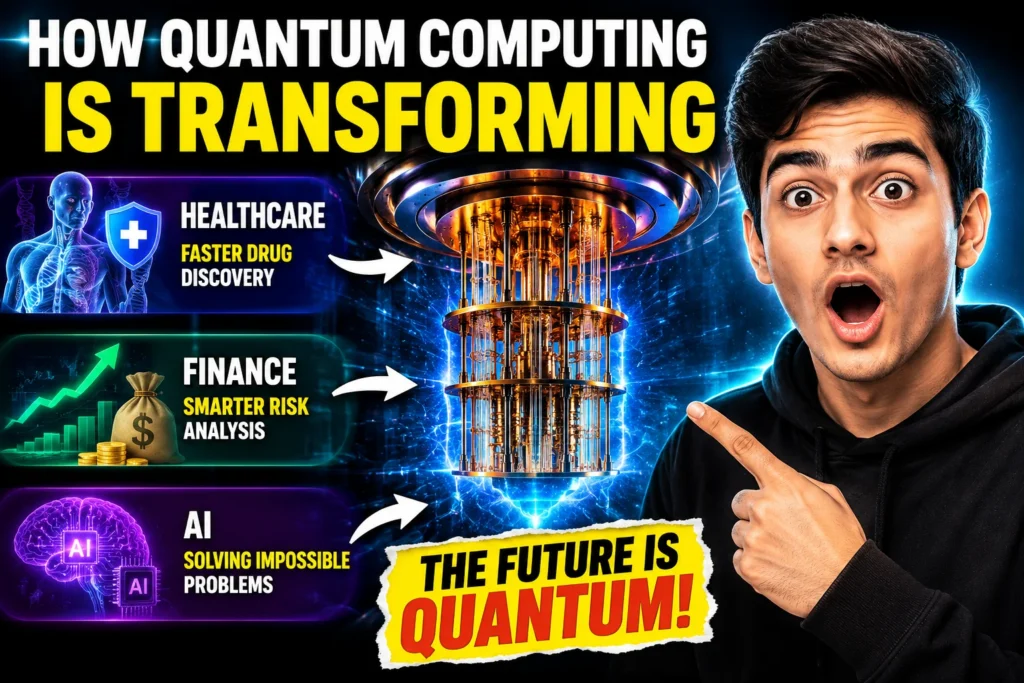
| Healthcare | Drug discovery and personalized medicine |
| Finance | Portfolio optimization and fraud detection |
| Artificial Intelligence | Faster machine learning |
| Cybersecurity | Quantum encryption and secure communication |
| Logistics | Route optimization |
| Manufacturing | Material simulation |
| Energy | Battery and fusion research |
| Climate Science | Weather and environmental modeling |
Let’s explore each in detail.
Uses of Quantum Computing in Healthcare
Healthcare is expected to become one of the biggest beneficiaries of quantum technology.
Modern medicine depends heavily on simulations, molecular analysis, and enormous datasets.
Quantum computing can significantly reduce the time required for these calculations.
Faster Drug Discovery
Developing a new medicine often takes:
- 10–15 years
- Billions of dollars
- Thousands of failed experiments
Quantum computers can simulate molecular interactions much more accurately than classical computers.
This enables researchers to:
- Discover promising compounds faster
- Reduce laboratory testing
- Lower development costs
- Improve treatment effectiveness
This is one of the most exciting Real World Applications of Quantum Computing today.
Personalized Medicine
Every patient has unique genetics.
Quantum computing can analyze:
- DNA sequences
- Medical history
- Lifestyle factors
- Biomarker data
Doctors may eventually create highly personalized treatments with greater success rates.
Medical Imaging
Hospitals generate enormous imaging datasets every day.
Quantum-enhanced algorithms could improve:
- MRI scans
- CT scans
- Cancer detection
- Early disease diagnosis
This means faster diagnosis and better patient outcomes.
Protein Folding Research
Understanding protein structures is one of biology’s biggest challenges.
Quantum computing helps scientists simulate complex proteins more accurately.
This can accelerate treatments for diseases such as:
- Alzheimer’s
- Parkinson’s
- Cancer
- Rare genetic disorders
Quantum Computing in Finance
Banks and investment firms process millions of financial calculations every second.
Quantum computing has the potential to revolutionize this industry.
Portfolio Optimization
Investment managers must balance:
- Risk
- Returns
- Market conditions
- Diversification
Quantum algorithms can analyze thousands of investment combinations much faster than traditional systems.
Risk Analysis
Financial markets constantly change.
Quantum computers can simulate countless future market scenarios.
Benefits include:
- Better forecasting
- Lower investment risk
- Improved asset allocation
Fraud Detection
Banks lose billions annually due to fraud.
Quantum-enhanced AI may improve fraud detection by recognizing unusual transaction patterns much faster than current systems.
High-Frequency Trading
Trading firms compete on milliseconds.
Quantum computing may optimize:
- Trade execution
- Market prediction
- Price modeling
Although practical implementation is still emerging, many financial institutions are actively researching these capabilities.
Quantum Computing in Artificial Intelligence
Artificial intelligence already powers:
- Chatbots
- Recommendation systems
- Self-driving vehicles
- Voice assistants
- Image recognition
Quantum computing could significantly accelerate AI development.
Faster Machine Learning
Training large AI models requires enormous computational resources.
Quantum computing could reduce:
- Training time
- Computational costs
- Model complexity
This makes it one of the most valuable Quantum Computing Use Cases.
Better Optimization
Machine learning often relies on solving optimization problems.
Quantum algorithms excel at finding optimal solutions among millions of possibilities.
Applications include:
- Recommendation engines
- Robotics
- Computer vision
- Autonomous systems
Improved Pattern Recognition
Quantum-enhanced AI may detect hidden patterns in:
- Medical data
- Financial transactions
- Satellite images
- Cybersecurity logs
This could dramatically improve prediction accuracy.
Natural Language Processing
Future AI assistants may benefit from quantum acceleration by processing massive language datasets more efficiently.
Potential improvements include:
- Faster responses
- Better translation
- More accurate summarization
- Improved reasoning
How Is Quantum Computing Used in Scientific Research?
Scientific simulations often involve billions of variables.
Quantum computing enables researchers to study:
- Chemical reactions
- Atomic interactions
- New materials
- Fusion energy
- Space exploration
Scientists can perform experiments digitally before expensive physical testing.
Quantum Computing in Logistics and Supply Chains
Large logistics companies manage millions of deliveries every day.
Quantum optimization can improve:
- Delivery routes
- Warehouse management
- Fleet scheduling
- Fuel efficiency
- Inventory planning
Companies could reduce operational costs while improving customer satisfaction.
Manufacturing Applications
Manufacturers face increasingly complex production systems.
Quantum computing may optimize:
- Factory scheduling
- Robotics
- Quality control
- Supply chain forecasting
- Material engineering
This can increase productivity while reducing waste.
Quantum Computing in Energy
Energy companies are exploring quantum computing for:
- Battery innovation
- Smart grids
- Renewable energy optimization
- Nuclear fusion simulations
- Carbon capture technologies
These advances could contribute to cleaner and more sustainable energy systems.
Quantum Computing in Cybersecurity
As quantum computing advances, it brings both opportunities and challenges to cybersecurity. While quantum computers could eventually break some of today’s encryption methods, they also pave the way for stronger and more secure communication systems.
Quantum Cryptography
Quantum cryptography uses the principles of quantum mechanics to create highly secure communication channels. One of its most promising technologies is Quantum Key Distribution (QKD), which allows encryption keys to be shared securely. If someone tries to intercept the communication, the system immediately detects the intrusion.
To understand this concept in detail, read quantum encryption explained.
Stronger Data Protection
Future quantum encryption techniques could protect:
- Online banking
- Government communications
- Healthcare records
- Military systems
- Cloud storage
- Enterprise networks
Cyber Threat Detection
Quantum-powered AI could analyze massive amounts of network traffic in real time, helping organizations:
- Detect malware faster
- Identify unusual behavior
- Prevent ransomware attacks
- Improve threat intelligence
Although fully quantum-secure systems are still under development, many organizations are already preparing for the post-quantum security era.
Future Uses of Quantum Computing
The Future Uses of Quantum Computing extend far beyond today’s applications. As hardware becomes more stable and scalable, quantum computing is expected to solve problems that are currently impossible for classical computers.
Some exciting future possibilities include:
- Climate change modeling
- Space exploration and mission planning
- Advanced robotics
- Smart city optimization
- Precision agriculture
- Autonomous transportation
- Personalized education
- Advanced weather forecasting
- Next-generation battery development
- Fusion energy research
Experts believe the next decade will see quantum computing become an essential tool across multiple industries.
Industries Investing in Quantum Computing
Quantum computing has become a strategic priority for governments and leading technology companies worldwide.
| Industry | Primary Focus |
|---|---|
| Healthcare | Drug discovery, genomics, medical imaging |
| Banking | Risk management, fraud detection, portfolio optimization |
| Artificial Intelligence | Machine learning acceleration |
| Automotive | Autonomous driving and traffic optimization |
| Aerospace | Aircraft design and simulations |
| Manufacturing | Materials science and process optimization |
| Energy | Battery research and smart grids |
| Cybersecurity | Quantum-safe encryption |
Major technology companies, startups, and research institutions continue investing billions of dollars to accelerate quantum innovation.
If you’re interested in industry competition, read ibm vs Google who will won.
Challenges of Quantum Computing
Despite its enormous potential, quantum computing is still in its early stages. Several technical challenges must be overcome before it becomes widely accessible.
Hardware Limitations
Current quantum computers require highly specialized environments, including ultra-low temperatures and advanced cooling systems. Building and maintaining these machines is expensive and technically demanding.
Error Rates
Qubits are extremely sensitive to environmental interference. Even small disturbances can introduce errors into calculations, making reliable quantum computing a major engineering challenge.
Limited Availability
Most quantum computers are currently available only through cloud platforms and research institutions. Large-scale commercial adoption will take time as the technology matures.
Skilled Workforce
There is a growing demand for professionals with expertise in quantum mechanics, computer science, mathematics, and quantum programming. Universities and companies are expanding training programs to prepare the next generation of quantum experts.
Featured Snippet: Key Uses of Quantum Computing
What are the main uses of quantum computing?
Quantum computing is used to solve highly complex problems that are difficult for classical computers. Its most important applications include:
- Drug discovery and healthcare research
- Financial modeling and risk analysis
- Artificial intelligence and machine learning
- Cybersecurity and quantum encryption
- Logistics and supply chain optimization
- Materials science and chemical simulations
- Climate modeling and weather forecasting
- Energy optimization and battery research
As quantum hardware continues to improve, these applications are expected to become more practical and widespread.
Frequently Asked Questions (FAQs)
1. What are the most important uses of quantum computing?
The most significant uses of quantum computing include healthcare research, financial optimization, artificial intelligence, cybersecurity, logistics, materials science, and climate modeling.
2. How is quantum computing used in healthcare?
Quantum computing helps researchers simulate molecular interactions, accelerate drug discovery, improve medical imaging, and support personalized medicine based on genetic data.
3. Can quantum computing improve artificial intelligence?
Yes. Quantum computing can speed up machine learning, improve optimization, analyze massive datasets more efficiently, and enhance pattern recognition for AI systems.
4. Is quantum computing already being used in finance?
Yes. Many financial institutions are researching quantum algorithms for portfolio optimization, fraud detection, risk analysis, and market simulations, although large-scale deployment is still developing.
5. Will quantum computers replace classical computers?
No. Quantum computers are designed to solve specific complex problems. Classical computers will continue to handle everyday tasks such as web browsing, office work, and general software applications.
6. Is quantum computing a threat to cybersecurity?
It has the potential to break some current encryption methods in the future. At the same time, it is driving the development of quantum-resistant encryption and more secure communication technologies.
7. Which industries will benefit the most from quantum computing?
Healthcare, finance, artificial intelligence, cybersecurity, manufacturing, logistics, energy, aerospace, and scientific research are expected to gain the greatest benefits.
Conclusion
Quantum computing is moving from theoretical research into practical innovation, opening new possibilities across industries. From discovering life-saving medicines and improving financial systems to accelerating artificial intelligence and strengthening cybersecurity, its impact is expected to grow significantly over the coming years. Although challenges such as hardware stability, error correction, and scalability remain, ongoing investments from governments, technology companies, and research organizations are driving rapid progress. As the technology matures, businesses and professionals who understand quantum computing today will be better prepared for tomorrow’s opportunities. The uses of quantum computing are no longer limited to laboratories—they are shaping the future of healthcare, finance, AI, cybersecurity, and many other sectors around the world.