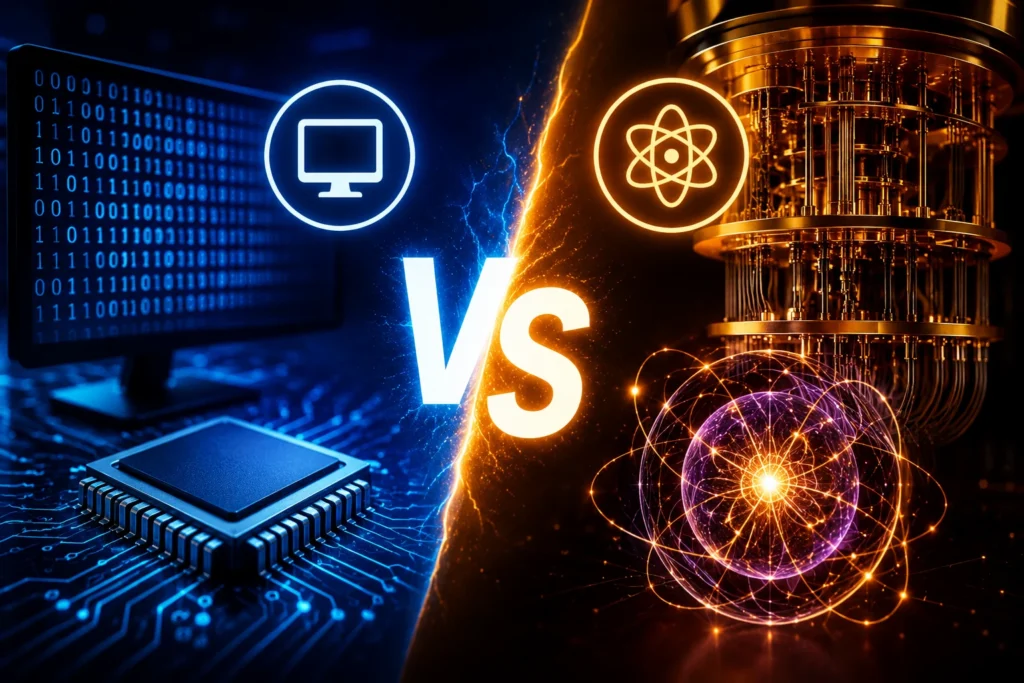
Quantum vs Classical Computing: Complete Guide for 2026
Technology is evolving faster than ever, and one topic that has captured global attention is Quantum vs Classical Computing. From artificial intelligence to cybersecurity, quantum technology is slowly changing how we think about computing power. But what exactly makes quantum computers different from the computers we use every day?
- Quantum vs Classical Computing: Complete Guide for 2026
- What Is Classical Computing?
- What Is Quantum Computing?
- Quantum Computing vs Classical Computing
- Quantum vs Classical Computing Comparison Table
- Advantages of Quantum Computing
- Limitations of Quantum Computers
- Future of Quantum Computing
- Can Quantum Computers Replace Classical Computers?
- Why Students Should Learn Quantum Computing in 2026
- Final Thoughts on Quantum vs Classical Computing
- SEO Meta Title
- Meta Description
- Suggested URL Slug
- 5 SEO-Optimized FAQs
If you’ve ever wondered why companies like IBM, Google, and Microsoft are investing billions into quantum research, you’re not alone. Students, developers, researchers, and tech enthusiasts across the world are trying to understand whether quantum computing is truly the future—or just another overhyped technology trend.
In this guide, you’ll learn:
- What classical and quantum computing actually mean
- The difference between bits and qubits
- How quantum computers work
- Real-world applications in 2026
- The advantages and limitations of quantum technology
- Whether quantum computers can replace classical systems
By the end, you’ll have a clear understanding of why quantum computing is considered one of the biggest technological revolutions of this decade.
What Is Classical Computing?
Classical computing is the traditional form of computing that powers laptops, smartphones, servers, gaming consoles, and almost every digital device we use today.
A classical computer processes information using bits. Each bit can only exist in one of two states:
- 0
- 1
Every operation performed by a computer—from opening a browser to streaming a video—is built on billions of these binary calculations happening at incredible speed.
Modern classical computers rely on silicon-based processors and follow logical operations step by step. Over decades, they have become extremely powerful. Supercomputers today can perform trillions of calculations per second.
Still, classical systems have limitations.
Some problems are so complex that even the most advanced supercomputers would need thousands or millions of years to solve them. This is where quantum computing enters the picture.
What Is Quantum Computing?
Quantum computing is an advanced form of computing based on the principles of Quantum Mechanics.
Unlike classical computers, quantum computers use qubits instead of bits.
A qubit can exist as:
- 0
- 1
- Or both at the same time
This property is called Superposition.
Superposition allows quantum computers to process multiple possibilities simultaneously, making them potentially much faster for certain complex calculations.
Another important concept is Quantum Entanglement. Entangled qubits can instantly affect one another, even across distances. This creates highly connected computational systems that classical computers cannot replicate efficiently.
Quantum computers are not designed to replace your everyday laptop. Instead, they are built for solving extremely difficult problems involving:
- Cryptography
- Drug discovery
- Weather prediction
- Financial modeling
- AI optimization
- Molecular simulation
In 2026, quantum computing is still developing, but major breakthroughs are happening quickly.
Quantum Computing vs Classical Computing
Understanding the difference between classical and quantum systems is essential because both serve different purposes.
Bits vs Qubits
The biggest difference in the debate around Quantum vs Classical Computing is how information is stored and processed.
Classical Bits
A classical bit stores one value at a time:
- 0 or 1
This creates linear processing.
Quantum Qubits
A qubit can hold multiple states simultaneously because of superposition.
This means quantum computers can analyze huge combinations of possibilities in parallel instead of sequentially.
Think about searching for a specific page in a massive library.
- A classical computer checks books one by one.
- A quantum computer can evaluate many possibilities at once.
That’s why quantum systems can dramatically outperform traditional machines in specialized tasks.
Processing Speed Comparison
Quantum computers are not universally faster than classical systems. That’s an important point many articles miss.
For normal activities like:
- Browsing the internet
- Watching YouTube
- Using Microsoft Word
- Playing games
Classical computers remain more efficient.
However, for highly complex mathematical or optimization problems, quantum systems can achieve extraordinary performance.
One of the most famous examples is Shor’s algorithm, which can factor large numbers exponentially faster than classical methods. This has massive implications for encryption and cybersecurity.
Another breakthrough is Grover’s algorithm, which improves database searching efficiency.
These algorithms are major reasons why governments and tech companies are heavily investing in quantum research.
The term quantum supremacy became globally popular when Google claimed its quantum processor solved a calculation in minutes that would take traditional supercomputers thousands of years.
Although experts debated the claim, it marked a historic milestone in computing.
Real-World Applications
Quantum computing is no longer limited to research labs. In 2026, several industries are actively experimenting with practical applications.
Healthcare and Drug Discovery
Quantum simulation helps researchers analyze molecular structures much faster than classical methods.
This could accelerate:
- Vaccine development
- Cancer research
- Personalized medicine
Cybersecurity and Encryption
Quantum computers may eventually break traditional encryption systems.
That’s why governments and enterprises are rapidly investing in quantum cryptography and post-quantum security systems.
This topic closely connects with AI-Powered Cyber Attacks and modern Cybersecurity Trends in 2026, where AI and quantum technologies are reshaping digital defense strategies.
Artificial Intelligence
Quantum computing could dramatically improve machine learning optimization and neural network training.
Experts believe the future of AI may combine:
- Quantum computing
- Edge computing
- Generative AI
- Advanced cloud infrastructure
This is why discussions around Generative AI Trends often include quantum acceleration as a future possibility.
Finance
Banks and investment firms use quantum systems for:
- Risk analysis
- Fraud detection
- Portfolio optimization
- Market prediction
Logistics and Supply Chains
Companies can optimize delivery routes and resource management much faster using quantum algorithms.
Climate and Weather Prediction
Quantum simulation may help scientists create more accurate climate models.
Quantum vs Classical Computing Comparison Table
| Feature | Classical Computing | Quantum Computing |
|---|---|---|
| Data Unit | Bit | Qubit |
| States | 0 or 1 | 0, 1, or both |
| Processing Style | Sequential | Parallel possibilities |
| Speed | Fast for normal tasks | Extremely fast for specific problems |
| Stability | Highly stable | Sensitive to environmental noise |
| Hardware | Silicon chips | Quantum processors |
| Real-World Usage | Everyday computing | Specialized research and optimization |
| Security Impact | Current encryption | Potential encryption disruption |
Advantages of Quantum Computing
Quantum computing offers enormous possibilities that could transform multiple industries over the next decade.
Massive Computational Power
Quantum systems can process extremely complex calculations far beyond classical capabilities.
This could revolutionize scientific research and advanced simulations.
Faster Problem Solving
Optimization tasks involving millions of variables can potentially be solved much faster.
Industries like logistics, healthcare, and finance are especially interested in this advantage.
Advanced Quantum Simulation
Quantum systems are naturally suited for modeling molecules and chemical reactions.
This opens opportunities in:
- Material science
- Pharmaceutical research
- Energy development
Improved AI Capabilities
Quantum-enhanced AI could improve:
- Pattern recognition
- Language models
- Data analysis
- Decision-making systems
This is one reason quantum technology appears in many reports about the Top 10 Emerging Technology Trends in 2026.
Quantum Networking
Researchers are also exploring quantum networking, which could create ultra-secure communication systems using quantum principles.
Limitations of Quantum Computers
Despite all the excitement, quantum computing still faces serious challenges.
High Error Rates
Qubits are extremely sensitive to external disturbances like temperature and electromagnetic interference.
Even tiny disruptions can create calculation errors.
Expensive Infrastructure
Quantum computers require advanced cooling systems operating near absolute zero temperatures.
This makes them incredibly expensive to build and maintain.
Limited Practical Availability
Most quantum systems are still experimental.
Platforms like:
- IBM Quantum
- Google Quantum AI
- Microsoft Azure Quantum
allow cloud-based access, but widespread commercial usage remains limited.
Major Quantum Platforms in 2026
Programming Complexity
Quantum programming requires deep knowledge of:
- Mathematics
- Physics
- Quantum mechanics
- Specialized algorithms
The learning curve is much steeper than traditional software development.
Future of Quantum Computing
The future of quantum computing looks incredibly promising, but realistic expectations are important.
Experts predict that quantum systems will work alongside classical computers rather than replacing them completely.
By 2030 and beyond, we may see quantum technology transforming:
- Artificial intelligence
- Cybersecurity
- Financial modeling
- Drug discovery
- Cloud computing
- Scientific research
Large cloud providers are already integrating quantum services into enterprise platforms. This aligns closely with the Future of Cloud Computing, where hybrid systems combining classical AI infrastructure with quantum acceleration may become common.
Governments worldwide are also increasing investments in quantum innovation and national research programs because of the strategic importance of the technology.
Universities are rapidly expanding quantum computing education programs, creating exciting opportunities for students entering the tech industry.
Can Quantum Computers Replace Classical Computers?
Probably not completely.
This is one of the biggest misconceptions surrounding Quantum vs Classical Computing.
Quantum computers are excellent for specialized tasks involving:
- Complex optimization
- Simulation
- Cryptography
- Advanced mathematics
But classical computers remain superior for daily computing activities because they are:
- Affordable
- Stable
- Energy-efficient
- Practical
In the future, the most likely scenario is a hybrid ecosystem where classical and quantum systems work together.
Think of quantum computers as highly specialized problem-solving machines rather than replacements for laptops or smartphones.
Why Students Should Learn Quantum Computing in 2026
If you’re a student, this field offers huge long-term opportunities.
Quantum technology is still in its early stages, which means early learners could gain a major career advantage.
Popular career paths include:
- Quantum software development
- Quantum research
- Quantum cybersecurity
- Quantum networking
- AI and quantum integration
- Cloud quantum engineering
You don’t need a PhD to start learning.
Begin with:
- Basic quantum mechanics
- Python programming
- Linear algebra
- Quantum algorithms
- Cloud quantum platforms
Many companies now provide free educational resources and beginner quantum labs online.
Final Thoughts on Quantum vs Classical Computing
The discussion around Quantum vs Classical Computing is more than just a comparison between two technologies. It represents the next major evolution in human computing power.
Classical computers built the digital world we live in today. Quantum computers could reshape the future by solving problems that currently seem impossible.
While the technology is still developing, the momentum behind quantum innovation is undeniable. Major companies, governments, and universities are investing heavily because the potential rewards are enormous.
For students and future tech professionals, understanding quantum computing today could open doors to some of the most exciting careers of the next decade.
The quantum era may not fully replace classical computing—but it will almost certainly redefine what computers can achieve.
SEO Meta Title
Quantum vs Classical Computing: Key Differences, Applications & Future in 2026
Meta Description
Learn quantum vs classical computing, qubits vs bits, applications, quantum supremacy, advantages, limitations, and future trends in 2026.
Suggested URL Slug
quantum-vs-classical-computing
5 SEO-Optimized FAQs
What is the difference between quantum computing and classical computing?
Classical computing uses bits that exist as either 0 or 1, while quantum computing uses qubits that can exist in multiple states simultaneously using superposition.
What are qubits in quantum computing?
Qubits are the basic units of quantum information. Unlike classical bits, qubits can represent multiple states at the same time.
What is quantum supremacy?
Quantum supremacy refers to a point where a quantum computer performs a calculation faster than the most advanced classical supercomputer.
Can quantum computers break encryption?
Yes, powerful quantum computers could potentially break traditional encryption systems using algorithms like Shor’s algorithm, which is why post-quantum cryptography is becoming important.
Is quantum computing the future?
Quantum computing is expected to play a major role in future technologies like AI, cybersecurity, cloud computing, and scientific simulation, although classical computers will still remain essential.