
Introduction
As cyber threats become more sophisticated and quantum computers continue to evolve, traditional encryption methods are facing an uncertain future. Today’s most widely used encryption algorithms protect everything from online banking and cloud storage to government communications. However, powerful quantum computers could eventually break many of these systems in a fraction of the time required by classical computers.
- Introduction
- What Is Quantum Encryption?
- Why Traditional Encryption May Not Be Enough
- Quantum Encryption vs Classical Encryption
- How Quantum Encryption Works
- What Is Quantum Key Distribution (QKD)?
- BB84 Protocol Explained
- Advantages of Quantum Encryption
- Industries That Will Benefit Most
- Current Challenges of Quantum Encryption
- Post-Quantum Cryptography vs Quantum Encryption
- Real-World Applications of Quantum Encryption
- How Businesses Can Prepare for the Quantum Era
- Common Myths About Quantum Encryption
- The Future of Quantum Encryption
- Frequently Asked Questions (FAQs)
- Conclusion
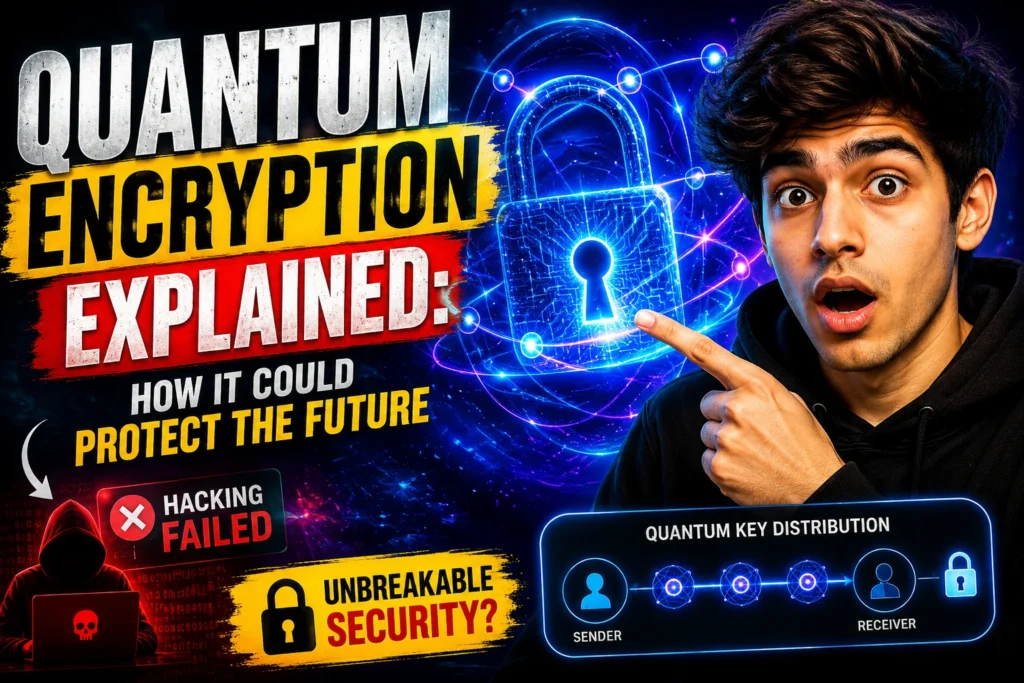
This is where Quantum Encryption Explained becomes one of the most important topics in cybersecurity. Unlike conventional encryption that depends on complex mathematical problems, quantum encryption uses the laws of quantum physics to secure information. It offers a fundamentally different approach that could make sensitive communications far more resistant to cyberattacks.
Whether you’re a student, IT professional, cybersecurity enthusiast, or simply curious about emerging technologies, understanding quantum encryption is becoming increasingly valuable. This guide explains what quantum encryption is, how it works, why organizations are investing in it, and how it could reshape digital security in the coming decades.
If you’re new to quantum technologies, start with quantum computing for beginners before exploring encryption concepts in greater depth.
What Is Quantum Encryption?
Quantum encryption is a cybersecurity technique that uses principles of quantum mechanics to protect data during transmission. Instead of relying only on mathematical algorithms, it uses quantum particles—typically photons—to generate and distribute encryption keys securely.
One of the biggest advantages of quantum encryption is that any attempt to intercept the communication changes the quantum state of the particles. This immediately alerts both parties that someone has tried to eavesdrop on the transmission.
Unlike traditional encryption, which assumes attackers have limited computing power, quantum encryption is designed around the physical laws of nature.
Key Characteristics
- Uses quantum mechanics instead of mathematical complexity alone
- Detects interception attempts instantly
- Provides highly secure key exchange
- Suitable for long-term protection of sensitive data
- Forms the foundation of future quantum-safe communications
Why Traditional Encryption May Not Be Enough
Today’s encryption standards such as RSA and ECC depend on mathematical problems that are extremely difficult for classical computers to solve.
However, quantum computers are expected to solve these problems much faster using specialized quantum algorithms. Once sufficiently powerful quantum machines become available, encrypted information stored today could potentially be decrypted in the future.
This challenge has accelerated research into Post-Quantum Cryptography, Quantum Key Distribution (QKD), and other quantum-safe security technologies.
Organizations in banking, healthcare, defense, cloud computing, and government sectors are already preparing for this transition.
Quantum Encryption vs Classical Encryption
| Feature | Classical Encryption | Quantum Encryption |
|---|---|---|
| Security Basis | Mathematical algorithms | Laws of quantum physics |
| Key Distribution | Internet protocols | Quantum Key Distribution |
| Eavesdropping Detection | Usually impossible | Immediate detection |
| Vulnerable to Quantum Computers | Yes (many algorithms) | Designed to resist interception |
| Future Readiness | Limited | Very High |
Understanding the difference between the two helps explain why quantum encryption is viewed as one of the most promising cybersecurity technologies.
For a broader understanding of next-generation computing, read quantum vs classical computing.
How Quantum Encryption Works
Instead of sending secret keys through traditional channels, quantum encryption sends them using individual photons.
Each photon carries quantum information called a quantum bit or qubit. Due to the principles of quantum mechanics, measuring these photons changes their state.
If an attacker tries to intercept the transmission:
- The photons are disturbed.
- The sender and receiver detect unusual error rates.
- The compromised key is discarded.
- A new secure key is generated.
This process ensures that secret keys remain confidential before encrypted communication begins.
What Is Quantum Key Distribution (QKD)?
Quantum Key Distribution (QKD) is the most widely implemented form of quantum encryption.
Its purpose is simple:
It allows two parties to generate and share a secret encryption key while ensuring that any interception attempt is immediately detected.
QKD does not encrypt the message itself. Instead, it securely distributes the encryption keys that are later used with conventional encryption algorithms.
Benefits of QKD
- Extremely secure key exchange
- Detects eavesdroppers automatically
- Supports high-value communications
- Ideal for financial institutions and governments
- Future-ready cybersecurity technology
BB84 Protocol Explained
The BB84 Protocol is the world’s first practical Quantum Key Distribution protocol.
Developed in 1984 by Charles Bennett and Gilles Brassard, it remains the foundation of modern quantum communication research.
How BB84 Works
- The sender transmits photons using randomly selected quantum states.
- The receiver randomly measures each photon.
- Both compare measurement bases over a public channel.
- Incorrect measurements are discarded.
- The remaining bits become the shared secret key.
- Error checking reveals whether interception occurred.
Because observing quantum particles changes them, any attacker leaves detectable evidence.
This unique property makes BB84 fundamentally different from traditional key exchange methods.
Advantages of Quantum Encryption
Quantum encryption offers several advantages over conventional security methods.
Superior Security
Its security comes from the laws of physics rather than computational difficulty.
Eavesdropping Detection
Unauthorized access attempts are immediately noticeable.
Future-Proof Protection
Quantum encryption is designed with future quantum computers in mind.
Long-Term Data Security
Sensitive information such as military communications, financial transactions, and healthcare records can remain protected for decades.
Trustworthy Communications
Organizations gain confidence that encryption keys have not been intercepted.
Industries That Will Benefit Most
Several industries are expected to adopt quantum encryption first.
| Industry | Use Cases |
| Banking | Secure financial transactions |
| Government | Classified communications |
| Healthcare | Patient data protection |
| Defense | Military communications |
| Cloud Computing | Secure cloud infrastructure |
| Telecommunications | Protected data transmission |
| Research | Scientific collaboration |
Cloud providers and technology companies are investing heavily in quantum-safe infrastructure as quantum computing advances.
Learn more about the industry’s leaders in top quantum computing companies.
Current Challenges of Quantum Encryption
Despite its enormous potential, quantum encryption still faces several practical challenges.
Infrastructure Costs
Deploying quantum communication networks requires specialized optical equipment, quantum transmitters, and dedicated hardware that can be expensive for many organizations.
Distance Limitations
Quantum signals weaken over long distances. Although satellite-based quantum communication and quantum repeaters are improving this limitation, widespread global deployment is still developing.
Integration with Existing Systems
Most businesses rely on traditional networking infrastructure. Integrating Quantum Key Distribution with current security systems requires careful planning and investment.
Limited Commercial Availability
While several pilot projects are already operational, large-scale commercial quantum encryption networks are still in their early stages.
Post-Quantum Cryptography vs Quantum Encryption
Many people assume Post-Quantum Cryptography (PQC) and quantum encryption are the same, but they solve the quantum security challenge in different ways.
Post-Quantum Cryptography refers to new cryptographic algorithms designed to resist attacks from both classical and quantum computers. Unlike Quantum Key Distribution (QKD), PQC does not require quantum hardware and can be deployed on existing networks.
Quantum encryption, on the other hand, uses the laws of quantum mechanics to securely exchange encryption keys. It provides an additional layer of security by making eavesdropping physically detectable.
| Feature | Post-Quantum Cryptography | Quantum Encryption |
|---|---|---|
| Uses Quantum Hardware | No | Yes |
| Works on Existing Networks | Yes | Limited |
| Detects Eavesdropping | No | Yes |
| Security Based On | Advanced Mathematics | Quantum Physics |
| Deployment Cost | Lower | Higher |
| Best For | Internet-wide adoption | High-security communications |
Rather than replacing each other, these technologies are expected to work together to build future-proof cybersecurity systems.
Real-World Applications of Quantum Encryption
Although still developing, quantum encryption is already being tested and deployed in several industries.
Banking and Financial Services
Banks handle billions of sensitive transactions every day. Quantum encryption can secure payment systems, interbank communications, and customer information against future quantum attacks.
Government and Defense
National security agencies require highly secure communication channels. Quantum encryption helps protect classified information, military operations, and diplomatic communications.
Healthcare
Hospitals and healthcare providers manage confidential patient records. Quantum-safe encryption can protect electronic health records and secure communication between healthcare systems.
Cloud Computing
Cloud service providers store massive amounts of sensitive business data. Quantum encryption helps secure cloud infrastructure and data transfers against future threats.
As cloud technologies continue evolving, organizations should also understand the ibm vs Google who will won race, as both companies are making major investments in quantum computing research.
Telecommunications
Telecommunication companies are exploring Quantum Key Distribution over fiber-optic networks to secure internet backbones and critical communication infrastructure.
Critical Infrastructure
Power grids, transportation systems, water utilities, and smart cities increasingly depend on secure digital networks. Quantum encryption could become essential for protecting these critical systems.
How Businesses Can Prepare for the Quantum Era
Organizations do not need to wait until large-scale quantum computers become available. Preparing today reduces future security risks.
Here are practical steps businesses can take:
- Identify sensitive data that requires long-term protection.
- Audit existing encryption methods.
- Monitor developments in Post-Quantum Cryptography standards.
- Begin testing quantum-safe encryption solutions.
- Train IT and cybersecurity teams on quantum technologies.
- Develop a migration roadmap for future cryptographic upgrades.
- Work with vendors offering quantum-ready security solutions.
Businesses that start planning early will be better positioned to protect customer data and maintain regulatory compliance.
Common Myths About Quantum Encryption
Myth 1: Quantum Encryption Makes Data Impossible to Hack
No technology is completely unbreakable. Quantum encryption greatly improves security during key exchange, but endpoint security, software vulnerabilities, and human error still matter.
Myth 2: It Will Replace All Current Encryption
Traditional encryption will continue to play a major role. Future security systems will likely combine classical encryption, Post-Quantum Cryptography, and Quantum Key Distribution.
Myth 3: Only Governments Need It
While governments are early adopters, industries such as finance, healthcare, cloud computing, telecommunications, and large enterprises are also investing in quantum-safe technologies.
Myth 4: Quantum Encryption Is Available Everywhere
Although commercial solutions exist, global deployment remains limited due to infrastructure costs and technological challenges.
The Future of Quantum Encryption
The next decade is expected to transform cybersecurity. Researchers are developing faster quantum communication networks, satellite-based Quantum Key Distribution, quantum internet technologies, and globally accepted post-quantum standards.
Some expected developments include:
- Wider adoption of Quantum Key Distribution.
- Integration of Post-Quantum Cryptography into everyday applications.
- More affordable quantum communication hardware.
- Secure quantum cloud services.
- Quantum internet research reaching commercial deployment.
- International cybersecurity standards focused on quantum-safe encryption.
As quantum computers become more capable, organizations that prepare early will gain a significant security advantage.
Frequently Asked Questions (FAQs)
1. What is quantum encryption in simple terms?
Quantum encryption is a method of securing communication using the principles of quantum mechanics. It allows encryption keys to be exchanged in a way that reveals if someone tries to intercept them.
2. How does Quantum Key Distribution (QKD) work?
QKD uses quantum particles, usually photons, to exchange encryption keys. If an attacker attempts to observe the particles, their quantum state changes, alerting both communicating parties.
3. What is the BB84 Protocol?
The BB84 Protocol is the first practical Quantum Key Distribution protocol. It enables two parties to create a shared secret key while detecting any eavesdropping attempts.
4. Is quantum encryption better than classical encryption?
Quantum encryption offers stronger protection for key distribution because it is based on the laws of physics. However, it is expected to complement rather than completely replace classical encryption.
5. What is Post-Quantum Cryptography?
Post-Quantum Cryptography consists of encryption algorithms designed to remain secure against attacks from future quantum computers while running on today’s hardware.
6. Which industries will benefit most from quantum encryption?
Industries handling sensitive information—including finance, healthcare, government, defense, cloud computing, and telecommunications—are expected to benefit the most.
7. Will quantum computers break current encryption?
Large-scale quantum computers could eventually break many widely used public-key encryption algorithms. This is why governments and businesses are actively adopting quantum-safe security solutions.
8. Should businesses prepare for quantum-safe encryption now?
Yes. Organizations with sensitive long-term data should begin evaluating quantum-safe technologies and migration strategies well before large-scale quantum computing becomes mainstream.
Conclusion
Quantum computing is reshaping the future of digital security, and encryption must evolve alongside it. Traditional cryptographic systems have protected the internet for decades, but advances in quantum computing are creating new challenges that require new solutions. Quantum encryption introduces a revolutionary approach by using the laws of physics rather than relying solely on mathematical complexity. Combined with Post-Quantum Cryptography, it forms the foundation of a more secure digital future.
Although widespread adoption will take time, governments, technology companies, financial institutions, and cloud providers are already investing heavily in quantum-safe infrastructure. Organizations that begin preparing today will be better equipped to protect sensitive information for years to come.