
Introduction
Quantum computing is no longer a futuristic concept limited to research labs. It is becoming one of the most exciting technologies shaping the future of computing, artificial intelligence, cybersecurity, medicine, and finance. Governments, universities, and leading technology companies are investing billions of dollars into quantum research because of its potential to solve problems that today’s most powerful computers cannot handle.
- Introduction
- What Is Quantum Computing?
- Why Is Quantum Computing Important?
- How Quantum Computing Works
- Quantum Bits vs Classical Bits
- Qubits Explained
- Quantum Superposition Explained
- Quantum Entanglement Explained
- How Quantum Computers Solve Problems
- Classical Computing vs Quantum Computing
- Quantum Computing Applications
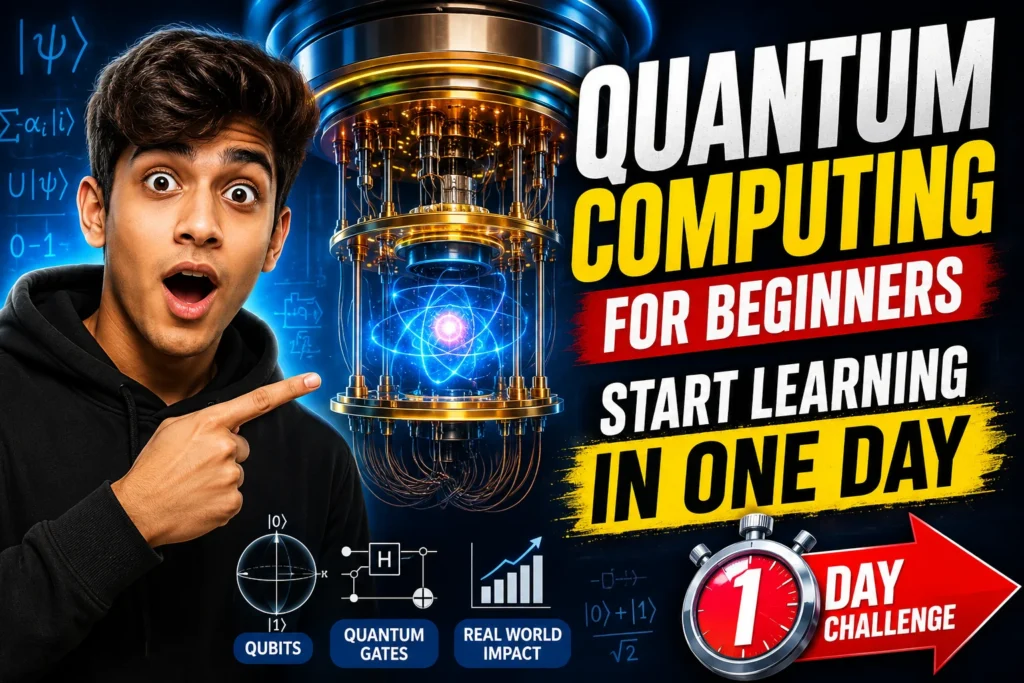
- Can You Learn Quantum Computing in One Day?
- Beginner's Guide to Quantum Computing: Step-by-Step Learning Roadmap
- Essential Skills for Future Quantum Professionals
- Common Myths About Quantum Computing
- Career Opportunities in Quantum Computing
- Tips to Learn Quantum Computing Faster
- Frequently Asked Questions
- Conclusion
If you’re searching for Quantum Computing for Beginners, you’ve come to the right place. This guide explains the fundamentals in simple language, making it easy for anyone with little or no technical background to understand.
By the end of this guide, you’ll know:
- What quantum computing is
- How quantum computers work
- The difference between classical and quantum computers
- What qubits are
- Why superposition and entanglement matter
- Real-world applications of quantum computing
- How to begin learning quantum computing today
Whether you’re a student, software developer, IT professional, or simply curious about emerging technologies, this beginner-friendly guide will help you build a strong foundation.
What Is Quantum Computing?
Quantum computing is a new type of computing that uses the principles of quantum mechanics to process information. Unlike traditional computers that use bits represented by either 0 or 1, quantum computers use quantum bits, also known as qubits.
This unique approach allows quantum computers to perform certain calculations much faster than classical computers.
Instead of solving one possibility at a time, quantum computers can evaluate many possibilities simultaneously under specific conditions, making them incredibly powerful for specialized tasks.
For readers interested in the broader comparison between today’s computers and tomorrow’s technology, see Quantum vs classical computing.
Featured Snippet
What Is Quantum Computing?
Quantum computing is a computing technology that uses qubits instead of classical bits. By using quantum mechanics principles such as superposition and entanglement, quantum computers can solve certain complex problems much faster than traditional computers.
Why Is Quantum Computing Important?
Modern computers are excellent for everyday tasks like browsing the internet, editing videos, gaming, and programming. However, they struggle with extremely complex calculations involving massive datasets.
Quantum computers have the potential to transform industries by solving these difficult problems more efficiently.
Some areas expected to benefit include:
- Artificial Intelligence
- Drug discovery
- Climate modeling
- Financial risk analysis
- Logistics optimization
- Materials science
- Cybersecurity
- Space exploration
Although quantum computers won’t replace laptops or smartphones, they will work alongside classical computers to solve specialized challenges.
How Quantum Computing Works
Understanding How Quantum Computing Works begins with learning the difference between classical bits and quantum bits.
Every classical computer stores information using bits.
A bit has only two possible values:
- 0
- 1
Quantum computers replace these bits with qubits, which behave very differently.
Because qubits follow the laws of quantum physics, they can exist in multiple possible states until measured.
This gives quantum computers remarkable computational power for suitable problems.
Quantum Bits vs Classical Bits
One of the easiest ways to understand quantum computing is by comparing classical bits with qubits.
| Feature | Classical Bits | Quantum Bits (Qubits) |
|---|---|---|
| Values | 0 or 1 | 0, 1, or both simultaneously |
| Processing | Sequential | Parallel possibilities |
| Technology | Silicon transistors | Quantum particles |
| Speed | Fast | Extremely fast for certain tasks |
| Everyday Use | Computers, phones | Research and specialized computing |
This comparison forms the foundation of every Beginner’s Guide to Quantum Computing.
Qubits Explained
One of the most important concepts in Quantum Computing Explained Simply is understanding qubits.
A qubit is the basic unit of information in a quantum computer.
Unlike a traditional bit, a qubit isn’t restricted to a single value.
Instead, it can exist in multiple states until it is measured.
Scientists create qubits using several technologies, including:
- Superconducting circuits
- Trapped ions
- Photons
- Neutral atoms
- Quantum dots
Each method has advantages and challenges, and researchers continue improving their stability and performance.
Quantum Superposition Explained
Superposition is one of the most fascinating ideas in quantum mechanics.
Imagine flipping a coin.
A classical computer waits until the coin lands to determine whether it’s heads or tails. A quantum computer can mathematically represent multiple possibilities during computation, enabling powerful algorithms that explore many potential solutions more efficiently.
This ability allows quantum computers to process certain problems much faster than classical systems.
Why Superposition Matters
Superposition helps quantum computers:
- Explore multiple solutions simultaneously
- Reduce computation time for specific problems
- Increase efficiency for optimization tasks
- Improve scientific simulations
Without superposition, quantum computing would not offer its unique advantages.
Quantum Entanglement Explained
Another essential concept is quantum entanglement.
Entanglement occurs when two or more qubits become strongly connected so that their quantum states are correlated, even when separated by distance. This unique relationship allows quantum computers to coordinate complex calculations more effectively than classical systems. Researchers use entanglement to improve computational efficiency and develop secure communication technologies.
If you’d like to explore one practical application, read quantum encryption explained.
How Quantum Computers Solve Problems
Instead of checking one solution after another, quantum computers use quantum algorithms to evaluate many possibilities more efficiently for certain classes of problems.
This makes them especially useful for:
- Large optimization problems
- Scientific simulations
- Cryptography research
- Molecular modeling
- Complex mathematical calculations
It’s important to note that quantum computers are not universally faster than classical computers. They excel only in specific problem domains where quantum algorithms provide an advantage.
Classical Computing vs Quantum Computing
Choosing between classical and quantum computing isn’t about replacing one with the other.
Instead, each technology has its strengths.
| Classical Computing | Quantum Computing |
| Everyday computing | Specialized computing |
| Office applications | Scientific research |
| Gaming | Molecular simulations |
| Web browsing | Optimization problems |
| Mobile apps | Quantum algorithms |
The future of computing is expected to combine both technologies, using each where it performs best.
Continue exploring this topic in quantum vs classical computing.
Quantum Computing Applications
Quantum computing is still in its early stages, but it is already showing the potential to solve problems that are extremely difficult for classical computers. As hardware improves, its impact will grow across many industries.
Here are some of the most promising Quantum Computing Applications:
| Industry | How Quantum Computing Helps |
|---|---|
| Healthcare | Drug discovery, protein folding, personalized medicine |
| Finance | Portfolio optimization, fraud detection, risk analysis |
| Cybersecurity | Advanced encryption and secure communication |
| Artificial Intelligence | Faster machine learning model training |
| Logistics | Route optimization and supply chain planning |
| Manufacturing | Material design and production optimization |
| Energy | Battery research and power grid optimization |
| Climate Science | Weather forecasting and climate simulations |
As quantum technology matures, these applications are expected to become more practical and commercially available.
Can You Learn Quantum Computing in One Day?
Yes—but with realistic expectations.
You won’t become a quantum computing expert in a single day. However, you can understand the core concepts and build a strong foundation in just a few hours.
Here’s a beginner-friendly learning plan.
| Time | Topic |
| 30 Minutes | What Is Quantum Computing |
| 45 Minutes | Classical Bits vs Qubits |
| 45 Minutes | Superposition and Entanglement |
| 60 Minutes | Quantum Gates and Basic Circuits |
| 45 Minutes | Watch Beginner Tutorials |
| 60 Minutes | Explore IBM Quantum Experience or similar platforms |
By following this roadmap, you’ll gain enough knowledge to confidently continue learning more advanced topics.
Beginner’s Guide to Quantum Computing: Step-by-Step Learning Roadmap
Learning quantum computing may seem challenging at first, but breaking it into small steps makes it much easier.
Step 1: Understand Classical Computing
Before learning quantum systems, make sure you understand:
- Binary numbers
- Logic gates
- Basic computer architecture
- Algorithms
These concepts provide the foundation for understanding quantum computing.
Step 2: Learn Basic Quantum Physics
You don’t need a physics degree.
Focus on these beginner-friendly concepts:
- Wave-particle duality
- Probability
- Measurement
- Superposition
- Entanglement
Avoid diving into advanced mathematics initially.
Step 3: Learn About Qubits
Spend time understanding:
- How qubits store information
- Why qubits are different from bits
- Different qubit technologies
- Error correction basics
Mastering qubits is one of the biggest milestones for beginners.
Step 4: Understand Quantum Gates
Quantum gates manipulate qubits much like logic gates manipulate bits.
Common gates include:
- Hadamard Gate
- Pauli-X Gate
- Pauli-Y Gate
- Pauli-Z Gate
- CNOT Gate
These gates form the building blocks of quantum algorithms.
Step 5: Explore Quantum Programming
Popular beginner-friendly tools include:
- Qiskit (Python)
- Cirq
- PennyLane
If you already know Python, you’ll have an easier time getting started.
Step 6: Practice with Real Quantum Computers
One of the best ways to learn is through hands-on practice.
Many cloud-based quantum platforms allow beginners to:
- Build circuits
- Simulate algorithms
- Run programs on real quantum hardware
- Visualize qubit states
Practical experience reinforces theoretical knowledge.
Essential Skills for Future Quantum Professionals
If you’re considering a career in quantum computing, start developing these skills:
- Mathematics (Linear Algebra and Probability)
- Python Programming
- Computer Science Fundamentals
- Algorithms
- Data Structures
- Quantum Mechanics Basics
- Problem Solving
- Critical Thinking
You don’t need to master everything immediately. Consistent learning is far more valuable than trying to learn everything at once.
Common Myths About Quantum Computing
Many misconceptions surround quantum computing. Let’s separate fact from fiction.
| Myth | Reality |
| Quantum computers will replace laptops. | They will complement classical computers for specialized tasks. |
| Quantum computers are infinitely faster. | They are faster only for certain types of problems. |
| You need a PhD to learn quantum computing. | Beginners can learn the fundamentals with the right resources. |
| Quantum computing is only for scientists. | Developers, engineers, students, and researchers can all learn it. |
| Quantum computers are widely available today. | Most are still experimental and accessed through cloud platforms. |
Understanding these myths helps set realistic expectations.
Career Opportunities in Quantum Computing
The demand for professionals with quantum computing knowledge is expected to grow as the technology matures.
Some emerging career paths include:
- Quantum Software Developer
- Quantum Research Scientist
- Quantum Hardware Engineer
- Quantum Algorithm Engineer
- Quantum Machine Learning Engineer
- Quantum Security Specialist
- Quantum Application Developer
- Quantum Systems Engineer
Professionals with expertise in programming, mathematics, and cloud technologies may find it easier to transition into quantum-related roles over time.
If you’re interested in the companies driving innovation, check out top quantum computing companies.
Tips to Learn Quantum Computing Faster
Learning quantum computing doesn’t have to feel overwhelming.
Here are a few practical tips:
- Focus on understanding concepts before formulas.
- Learn one topic at a time.
- Practice regularly with simulations.
- Strengthen your Python skills.
- Follow trusted educational resources.
- Join online quantum computing communities.
- Build simple quantum circuits as you learn.
Most importantly, stay curious. Quantum computing is a rapidly evolving field, and continuous learning is key.
Frequently Asked Questions
What is quantum computing in simple words?
Quantum computing is a new type of computing that uses qubits and quantum mechanics to solve certain complex problems more efficiently than classical computers.
Is quantum computing difficult to learn?
It may seem challenging initially, but beginners can understand the basic concepts with clear explanations and consistent practice.
Do I need to know advanced mathematics?
No. While advanced topics involve mathematics, beginners can start by learning the concepts without deep mathematical knowledge.
Can I learn quantum computing without a physics background?
Yes. Many beginner courses explain quantum computing in simple language, making it accessible to learners from different backgrounds.
Which programming language is best for quantum computing?
Python is the most widely used language because many quantum development frameworks are built around it.
What industries use quantum computing?
Healthcare, finance, cybersecurity, logistics, artificial intelligence, manufacturing, energy, and scientific research are among the leading industries exploring quantum computing.
Will quantum computing replace classical computers?
No. Quantum computers are designed for specialized tasks, while classical computers remain the best choice for everyday computing.
Conclusion
Quantum computing is one of the most exciting technological advancements of this century. While the field may seem complex at first, understanding concepts such as qubits, superposition, and entanglement makes it much more approachable.
This guide has introduced the essential building blocks of Quantum Computing for Beginners, explained how quantum computers differ from classical systems, highlighted practical applications, and provided a step-by-step roadmap to begin your learning journey.
Remember, becoming proficient in quantum computing doesn’t happen overnight. However, spending just one focused day learning the fundamentals can give you the confidence to explore this rapidly growing field further.
If you’re just getting started, don’t forget to revisit IBM VS Google whenever you need a quick refresher on the basics.