
Introduction
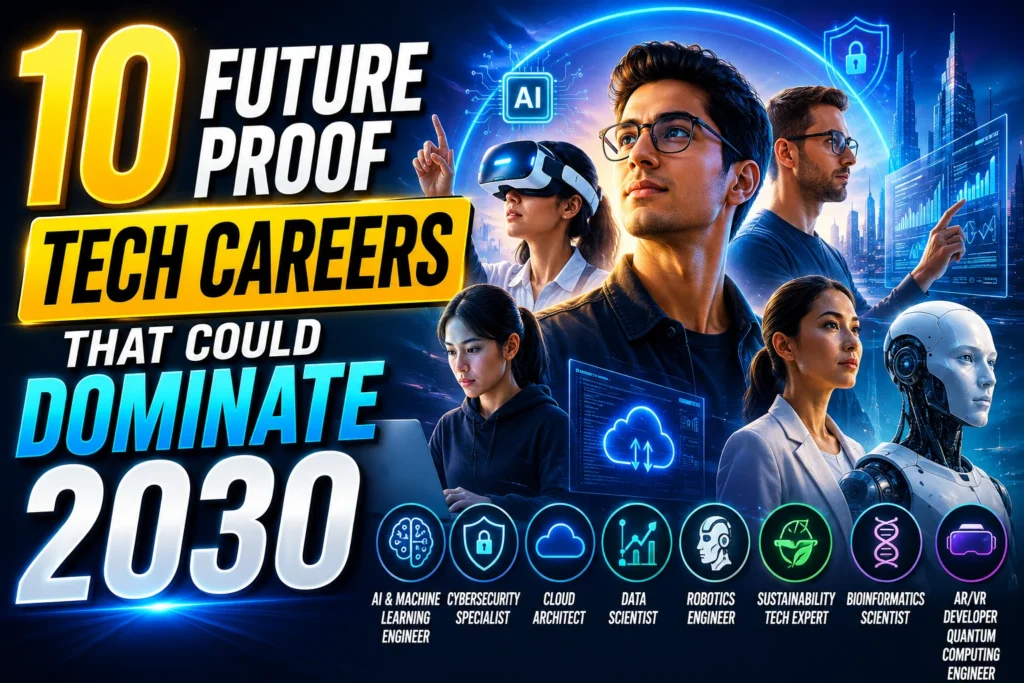
Technology is evolving faster than ever before. Artificial intelligence, cloud computing, cybersecurity, automation, and data-driven decision-making are transforming industries across the globe. As businesses continue to adopt emerging technologies, the demand for skilled professionals is expected to rise significantly throughout this decade.
- Introduction
- Why Future Proof Tech Careers Matter in 2030
- 1. AI Engineer Career
- 2. Machine Learning Engineer
- 3. Cybersecurity Specialist
- 4. Cloud Solutions Architect
- 5. Data Engineer
- Career Comparison Table
- Skills Students Should Start Learning Today
- 6. DevOps Engineer
- 7. Robotics Engineer
- 8. Blockchain Developer
- 9. AI Ethics and Governance Specialist
- 10. Digital Transformation Consultant
- Top Future Proof Tech Careers Comparison
- Tech Skills in Demand 2030
- How Students Can Prepare Today
- Future Hiring Trends Through 2030
- Frequently Asked Questions
- Conclusion
For students planning their careers, choosing a profession that remains relevant in the future is one of the most important decisions. While some traditional jobs may be affected by automation, many technology roles are expected to grow rapidly due to increasing digital transformation.
This guide explores the top Future Proof Tech Careers that are likely to dominate the job market by 2030. These careers offer strong growth potential, competitive salaries, and opportunities to work on innovative technologies shaping the future.
Quick Answer: What Are Future Proof Tech Careers?
Future Proof Tech Careers are technology-related professions expected to remain in high demand despite automation, artificial intelligence, and changing industry trends. These careers focus on skills that are difficult to replace and are essential for building, managing, and securing future technologies.
Before choosing a career path, students should understand the emerging technology trends 2026 that are influencing hiring decisions worldwide.
Why Future Proof Tech Careers Matter in 2030
The future workforce will look very different from today’s job market. According to industry forecasts, organizations are investing heavily in:
Artificial Intelligence
Machine Learning
Cloud Infrastructure
Cybersecurity
Data Analytics
Automation
Digital Transformation
As these technologies become essential to business operations, professionals with specialized technical skills will continue to be highly valuable.
Key Benefits of Choosing a Future-Proof Career
| Benefit | Why It Matters |
|---|---|
| Job Security | Demand remains strong despite automation |
| High Salaries | Specialized skills command premium pay |
| Global Opportunities | Skills are needed worldwide |
| Career Growth | Multiple advancement paths available |
| Innovation Exposure | Work with cutting-edge technologies |
Students who start developing relevant technical skills today can position themselves for long-term success in one of the Highest Paying Tech Careers of the next decade.
1. AI Engineer Career
Artificial intelligence is expected to become one of the most influential technologies by 2030. Companies are already integrating AI into healthcare, finance, retail, education, manufacturing, and transportation.
An AI Engineer Career involves designing, building, and deploying intelligent systems capable of learning and making decisions.
Responsibilities
Developing AI models
Creating intelligent applications
Building recommendation systems
Working with neural networks
Improving automation processes
Skills Required
Python programming
Machine learning algorithms
Deep learning frameworks
Data analysis
Mathematics and statistics
Why It Is Future-Proof
Businesses are investing billions into AI technologies, making AI engineering one of the fastest-growing technology fields globally.
Average Salary Potential
AI engineers often rank among the Highest Paying Tech Careers due to the specialized expertise required.
2. Machine Learning Engineer
A Machine Learning Engineer focuses on building systems that allow computers to learn from data without explicit programming.
As AI adoption expands, machine learning specialists will become increasingly valuable across industries.
Responsibilities
Training machine learning models
Managing datasets
Improving predictive systems
Optimizing AI performance
Deploying intelligent applications
Key Skills
Python
TensorFlow
PyTorch
Statistics
Data modeling
Why Demand Will Grow
Organizations need professionals who can transform raw data into actionable insights and intelligent solutions.
Students interested in AI should also explore the [INTERNAL LINK: most in demand it skills 2026] to build a stronger foundation.
3. Cybersecurity Specialist
Cybersecurity Careers are expected to experience massive growth as cyber threats become more sophisticated.
Every organization that stores digital information requires professionals who can protect systems, networks, and sensitive data.
Responsibilities
Threat monitoring
Security assessments
Incident response
Risk management
Network protection
Essential Skills
Network security
Ethical hacking
Security operations
Risk analysis
Security compliance
Why Cybersecurity Is Future-Proof
Cybercrime continues to rise globally, creating a persistent need for security professionals.
Students exploring Cybersecurity Careers should also read our cybersecurity career guide to understand certifications, job roles, and career progression opportunities.
4. Cloud Solutions Architect
Cloud Computing Careers are becoming increasingly important as businesses migrate their infrastructure to cloud platforms.
Cloud architects design and manage cloud environments that support modern business operations.
Responsibilities
Cloud infrastructure planning
Migration strategies
Security implementation
Performance optimization
Cost management
Popular Platforms
AWS
Microsoft Azure
Google Cloud
Why It Will Dominate 2030
Most organizations are moving toward cloud-first strategies, ensuring long-term demand for cloud professionals.
5. Data Engineer
Data Engineering Jobs are becoming essential because companies rely on data to make strategic decisions.
A data engineer builds the infrastructure that enables organizations to collect, process, and analyze large amounts of information.
Responsibilities
Creating data pipelines
Managing databases
Processing big data
Ensuring data quality
Supporting analytics teams
Skills Required
SQL
Python
Data warehousing
ETL processes
Big data technologies
Future Outlook
The amount of data generated worldwide continues to grow exponentially, making data engineers critical to business success.
Career Comparison Table
| Career | Demand Growth | Salary Potential | Future Outlook |
|---|---|---|---|
| AI Engineer | Very High | Very High | Excellent |
| Machine Learning Engineer | Very High | Very High | Excellent |
| Cybersecurity Specialist | High | High | Excellent |
| Cloud Architect | High | High | Excellent |
| Data Engineer | High | High | Excellent |
Skills Students Should Start Learning Today
To prepare for Future Proof Tech Careers, students should begin developing these skills:
Programming
Cloud Computing
Artificial Intelligence
Data Analytics
Cybersecurity Fundamentals
Problem Solving
Communication Skills
Additionally, pursuing the [INTERNAL LINK: best certifications for future tech jobs] can significantly improve employability and career growth opportunities.
6. DevOps Engineer
As businesses continue to accelerate software development and deployment, the demand for DevOps professionals is expected to grow significantly. A DevOps Engineer Career combines software development, IT operations, and automation to improve efficiency and reliability.
Responsibilities
- Automating software deployment
- Managing CI/CD pipelines
- Monitoring application performance
- Improving system reliability
- Collaborating with development and operations teams
Key Skills
- Linux
- Docker
- Kubernetes
- Jenkins
- Cloud platforms
- Scripting languages
Why It Is Future-Proof
Companies need faster software delivery without compromising quality. DevOps engineers help bridge the gap between development and operations, making them essential in modern technology organizations.
7. Robotics Engineer
Robotics is transforming manufacturing, healthcare, logistics, agriculture, and even household services. Robotics engineers design, build, and maintain intelligent machines capable of performing complex tasks.
Responsibilities
- Designing robotic systems
- Programming automation solutions
- Testing robotic equipment
- Integrating AI into robotics
- Improving operational efficiency
Skills Required
- Programming
- Electronics
- Mechanical engineering concepts
- Artificial intelligence
- Automation systems
Why Demand Will Increase
As industries automate repetitive and hazardous tasks, robotics professionals will play a critical role in driving innovation and productivity.
8. Blockchain Developer
While blockchain is often associated with cryptocurrency, its applications extend far beyond digital currencies. Businesses are exploring blockchain for secure transactions, digital identity verification, supply chain management, and smart contracts.
Responsibilities
- Developing blockchain applications
- Creating smart contracts
- Building decentralized systems
- Enhancing transaction security
- Maintaining blockchain networks
Key Skills
- Solidity
- Cryptography
- Distributed systems
- Smart contract development
- Blockchain architecture
Why It Is Future-Proof
Organizations are increasingly adopting decentralized technologies to improve transparency, security, and trust.
9. AI Ethics and Governance Specialist
As artificial intelligence becomes more powerful, companies need professionals who can ensure AI systems are ethical, transparent, and compliant with regulations.
This emerging role is expected to become one of the most important AI-Proof Jobs by 2030.
Responsibilities
- Evaluating AI risks
- Developing ethical guidelines
- Ensuring regulatory compliance
- Monitoring AI bias
- Supporting responsible AI development
Skills Required
- AI fundamentals
- Risk management
- Compliance frameworks
- Data governance
- Critical thinking
Why It Will Grow
Governments and organizations are increasing oversight of artificial intelligence, creating demand for specialists who understand both technology and ethics.
10. Digital Transformation Consultant
Every industry is undergoing digital transformation. Organizations need experts who can guide technology adoption and business modernization efforts.
Digital transformation consultants help businesses implement new technologies and improve operational efficiency.
Responsibilities
- Technology strategy planning
- Process optimization
- Change management
- Digital adoption initiatives
- Business transformation projects
Skills Required
- Business analysis
- Project management
- Cloud technologies
- Data analytics
- Leadership
Why It Is Future-Proof
Businesses will continue investing in digital transformation to remain competitive, creating long-term opportunities for consultants and technology strategists.
Top Future Proof Tech Careers Comparison
| Career | Demand by 2030 | Salary Potential | Difficulty Level |
|---|---|---|---|
| AI Engineer | Very High | Very High | High |
| Machine Learning Engineer | Very High | Very High | High |
| Cybersecurity Specialist | High | High | Medium |
| Cloud Architect | High | High | Medium |
| Data Engineer | High | High | Medium |
| DevOps Engineer | High | High | Medium |
| Robotics Engineer | High | High | High |
| Blockchain Developer | Moderate to High | High | High |
| AI Ethics Specialist | Growing Rapidly | High | Medium |
| Digital Transformation Consultant | High | High | Medium |
Tech Skills in Demand 2030
Students who want to succeed in Future Proof Tech Careers should focus on developing the following skills: The success of every AI application depends on a strong foundation, so don’t miss our in-depth guide on Future of AI Infrastructure.
Technical Skills
- Artificial Intelligence
- Machine Learning
- Cloud Computing
- Cybersecurity
- Data Analytics
- Programming
- Automation
- DevOps
Soft Skills
- Problem Solving
- Critical Thinking
- Communication
- Adaptability
- Team Collaboration
- Leadership
Employers increasingly look for professionals who combine technical expertise with strong interpersonal skills.
How Students Can Prepare Today
Starting early can provide a significant advantage in the competitive technology job market.
Step 1: Learn Programming
Begin with languages such as:
- Python
- JavaScript
- SQL
Step 2: Build Real Projects
Create practical projects that demonstrate your skills and problem-solving abilities.
Step 3: Earn Industry Certifications
Certifications help validate your knowledge and improve employability.
Step 4: Stay Updated
Technology evolves quickly. Follow industry developments and continue learning throughout your career.
Step 5: Build a Portfolio
A strong portfolio often matters more than academic qualifications alone when applying for technology roles.
Future Hiring Trends Through 2030
Several factors will drive demand for technology professionals:
- Growth of artificial intelligence
- Expansion of cloud infrastructure
- Rising cybersecurity threats
- Increased automation
- Data-driven business strategies
- Smart devices and IoT adoption
These trends suggest that Future Proof Tech Careers will continue to offer excellent opportunities for students entering the workforce over the next decade.
Frequently Asked Questions
Which tech career has the highest future demand?
AI Engineer Career and Machine Learning Engineer roles are expected to experience some of the strongest growth due to increasing adoption of artificial intelligence across industries.
Are Cybersecurity Careers still worth pursuing in 2030?
Yes. Cybersecurity professionals will remain highly valuable as organizations continue facing sophisticated cyber threats and data security challenges.
What are the highest paying tech careers?
AI Engineers, Machine Learning Engineers, Cloud Architects, Data Engineers, and Cybersecurity Specialists are commonly considered among the Highest Paying Tech Careers.
Which tech career is best for beginners?
Data Engineering Jobs, Cloud Computing Careers, and Cybersecurity Careers often provide accessible entry points for students willing to develop the necessary technical skills.
Can AI replace technology professionals?
AI may automate repetitive tasks, but it is unlikely to replace professionals who design, manage, secure, and improve technology systems.
What skills should students learn first?
Programming, data analysis, cloud computing, cybersecurity fundamentals, and problem-solving skills are excellent starting points.
Do I need a computer science degree?
Not always. Many employers value practical experience, certifications, and project portfolios alongside formal education.
What are AI-Proof Jobs?
AI-Proof Jobs are careers that rely heavily on creativity, strategic thinking, human judgment, leadership, and specialized technical expertise that cannot easily be automated.
Conclusion
The technology industry is expected to create millions of new opportunities by 2030. Careers such as AI Engineer, Machine Learning Engineer, Cybersecurity Specialist, Cloud Architect, Data Engineer, DevOps Engineer, Robotics Engineer, Blockchain Developer, AI Ethics Specialist, and Digital Transformation Consultant are positioned to thrive in the coming decade.
For students planning their future, investing in technology skills today can lead to strong career growth, excellent salaries, and long-term job security. The key is to start learning early, stay adaptable, and continuously build expertise in areas that support innovation and digital transformation.