Introduction
Artificial intelligence is no longer a technology reserved for large tech companies and research labs. It has become a part of everyday life, helping people work smarter, automate routine tasks, and make better decisions. As we move into 2026, AI is expected to evolve faster than ever before.
- Introduction
- Quick Overview: Future of AI 2026
- Why 2026 Could Be a Turning Point for Artificial Intelligence
- AI Agents Will Become Digital Employees
- Generative AI Will Become More Accurate and Reliable
- AI Automation Will Reach New Levels
- AI and the Future of Work Will Change Career Paths
- AI in Cybersecurity Will Become Essential
- H2: AI Will Revolutionize Healthcare
- AI-Powered Education Will Transform Learning
- AI Will Power the Next Generation of Smart Cities
- AI Robotics Will Expand Beyond Factories
- AI Will Make Businesses More Data-Driven
- AI Will Create New Career Opportunities
- AI Will Strengthen Cyber Defense Against Advanced Threats
- AI Will Become More Regulated and Ethical
- AI Assistants Will Become Everyday Companions
- AI Will Accelerate Scientific Discoveries
- Key AI Trends to Watch in 2026
- FAQs
- Conclusion
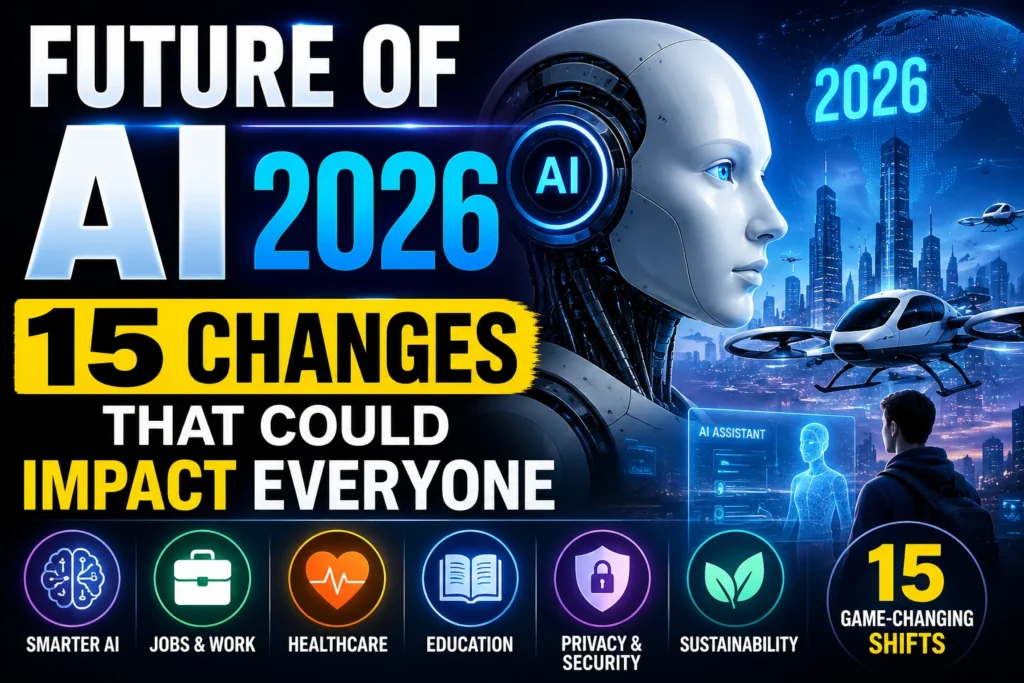
The Future of AI 2026 is not just about smarter chatbots or improved automation. It is about a fundamental shift in how businesses operate, how employees work, how students learn, and how consumers interact with technology. From AI Agents capable of completing complex tasks independently to advanced cybersecurity systems that can detect threats in real time, the next phase of artificial intelligence could affect almost everyone.
In this guide, we will explore the most significant AI developments expected in 2026 and how they may reshape industries, careers, and daily life.
Quick Overview: Future of AI 2026
| AI Trend | Expected Impact |
|---|---|
| AI Agents | Autonomous task execution |
| Generative AI | Advanced content creation |
| AI Automation | Increased productivity |
| AI in Cybersecurity | Better threat detection |
| AI and Future of Work | Workforce transformation |
| Healthcare AI | Faster diagnosis and treatment |
| AI-Powered Education | Personalized learning |
| Smart Cities | Improved urban management |
| AI Robotics | Expanded industrial automation |
| Emerging AI Technologies | New business opportunities |
Why 2026 Could Be a Turning Point for Artificial Intelligence
Several factors are accelerating AI adoption worldwide:
- More powerful AI models
- Lower computing costs
- Increased business investment
- Rapid growth of AI Agents
- Expansion of cloud infrastructure
- Greater access to AI tools for individuals and small businesses
Experts believe that AI will become more integrated into everyday workflows than ever before. Businesses that adapt early may gain significant competitive advantages.
For a broader look at technology innovations shaping the future, explore emerging technology trends 2026 .
AI Agents Will Become Digital Employees
One of the biggest AI Trends 2026 is the rise of AI Agents.
Unlike traditional AI tools that require constant user input, AI Agents can independently complete tasks, make decisions, and coordinate multiple activities.
What Are AI Agents?
AI Agents are intelligent software systems capable of:
- Managing schedules
- Conducting research
- Writing reports
- Analyzing data
- Handling customer support
- Executing workflows
Instead of acting like assistants, they may function more like digital employees.
How AI Agents Could Impact Businesses
Organizations are already experimenting with AI Agents for:
- Marketing campaigns
- Customer service operations
- Software development
- Financial analysis
- Human resources
This shift could dramatically improve productivity while reducing repetitive work.
Generative AI Will Become More Accurate and Reliable
Generative AI has transformed content creation over the last few years. However, 2026 may bring a major improvement in accuracy and reliability.
Current challenges such as hallucinations and inconsistent outputs are expected to decrease significantly.
Future Generative AI Capabilities
Advanced Generative AI systems may:
- Create professional-quality videos
- Generate software code
- Design websites
- Produce marketing campaigns
- Develop business strategies
Businesses could use a single AI platform to perform tasks that currently require multiple tools.
Industries Most Affected
| Industry | AI Application |
| Marketing | Content creation |
| Education | Learning materials |
| Software | Code generation |
| Healthcare | Medical documentation |
| Media | Video production |
These improvements are expected to make Generative AI one of the most influential technologies of 2026.
AI Automation Will Reach New Levels
Automation has existed for decades, but AI-powered automation is creating entirely new possibilities.
Unlike traditional automation systems that follow fixed rules, AI systems can learn, adapt, and improve over time.
Areas Experiencing Rapid AI Automation
- Customer support
- Supply chain management
- Data analysis
- Financial reporting
- Sales operations
- Inventory management
As AI Automation becomes more advanced, businesses may reduce operational costs while increasing efficiency.
Benefits of AI Automation
- Faster workflows
- Lower costs
- Reduced human error
- Better decision-making
- Increased scalability
Organizations adopting AI early may gain a substantial advantage over competitors.
AI and the Future of Work Will Change Career Paths
The relationship between AI and employment remains one of the most discussed topics in technology.
Rather than replacing all jobs, AI is expected to transform how people work.
Jobs Likely to Evolve
Many roles may become AI-assisted rather than fully automated:
- Marketing specialists
- Software developers
- Financial analysts
- Content creators
- Customer support teams
Employees who learn to collaborate with AI could become significantly more productive.
Skills That Will Matter in 2026
The demand for technical and human-centered skills is expected to increase.
Key skills include:
- AI literacy
- Data analysis
- Prompt engineering
- Strategic thinking
- Problem-solving
- Communication
Professionals looking to stay competitive should also review most in demand it skills 2026.
AI in Cybersecurity Will Become Essential
Cyber threats continue to become more sophisticated every year.
As attacks grow more complex, organizations are increasingly relying on AI in Cybersecurity to defend digital assets.
How AI Strengthens Cybersecurity
AI systems can:
- Detect suspicious behavior
- Monitor networks continuously
- Identify malware patterns
- Prevent phishing attacks
- Analyze security risks in real time
Unlike traditional systems, AI can process massive volumes of data instantly.
Benefits of AI Security Systems
| Capability | Advantage |
| Threat Detection | Faster response |
| Risk Analysis | Better protection |
| Network Monitoring | Continuous surveillance |
| Incident Response | Reduced damage |
| Fraud Detection | Improved security |
Professionals interested in this growing field can learn more through our [INTERNAL LINK: cybersecurity career guide].
H2: AI Will Revolutionize Healthcare
Healthcare is expected to become one of the biggest beneficiaries of the Artificial Intelligence Future.
AI-powered tools are already assisting doctors with diagnostics, medical imaging, and treatment recommendations.
Key Healthcare Changes Expected in 2026
- Faster disease detection
- Improved patient monitoring
- Personalized treatments
- Drug discovery acceleration
- Enhanced medical imaging analysis
These developments could improve outcomes while reducing healthcare costs.
AI-Powered Personalized Medicine
Future AI systems may analyze:
- Medical history
- Genetic information
- Lifestyle habits
- Real-time health data
This could help healthcare providers deliver highly customized treatment plans.
AI-Powered Education Will Transform Learning
Education is moving toward personalized learning experiences, and AI is playing a major role.
Traditional one-size-fits-all teaching methods may gradually give way to adaptive learning systems.
Benefits of AI in Education
- Customized lesson plans
- Instant feedback
- Personalized learning paths
- Automated assessments
- Improved accessibility
Students may learn at their own pace while receiving targeted support based on their strengths and weaknesses.
AI Tutors Could Become Common
AI-powered tutoring systems may offer:
- 24/7 assistance
- Personalized guidance
- Real-time explanations
- Interactive learning experiences
This could make high-quality education more accessible worldwide.
AI Will Power the Next Generation of Smart Cities
Cities around the world are becoming more connected, and AI will play a major role in managing urban infrastructure. By 2026, many governments are expected to invest heavily in AI-powered systems that improve efficiency and quality of life.
How AI Can Improve Smart Cities
AI can help city authorities:
- Optimize traffic flow
- Reduce energy consumption
- Improve waste management
- Monitor public safety
- Enhance emergency response systems
For example, AI-driven traffic systems can analyze real-time road conditions and automatically adjust signals to reduce congestion.
Benefits for Citizens
| Smart City Feature | Potential Benefit |
|---|---|
| Intelligent Traffic Systems | Reduced travel time |
| Smart Energy Grids | Lower energy waste |
| AI Surveillance | Improved safety |
| Automated Public Services | Faster response times |
As urban populations grow, AI could become essential for sustainable city development.
AI Robotics Will Expand Beyond Factories
Industrial robots have existed for decades, but future AI technologies are making robots smarter, more flexible, and capable of working alongside humans.
Unlike traditional robots that perform repetitive tasks, AI-powered robots can learn from their environment and adapt to changing conditions.
Industries Adopting AI Robotics
- Manufacturing
- Healthcare
- Agriculture
- Warehousing
- Logistics
- Retail
In warehouses, robots may manage inventory, package products, and assist with order fulfillment more efficiently than ever before.
Why This Matters
AI robotics can help organizations:
- Reduce operational costs
- Improve workplace safety
- Increase production efficiency
- Address labor shortages
This trend is expected to accelerate significantly throughout 2026 and beyond.
AI Will Make Businesses More Data-Driven
Data has become one of the world’s most valuable resources, but many businesses struggle to turn data into actionable insights.
AI is changing that.
How AI Improves Decision-Making
Modern AI systems can:
- Analyze large datasets instantly
- Identify hidden trends
- Predict customer behavior
- Forecast market changes
- Recommend business strategies
This allows leaders to make faster and more informed decisions.
Competitive Advantages of AI Analytics
Businesses using AI analytics may achieve:
- Better customer experiences
- Increased revenue opportunities
- Improved operational efficiency
- Faster innovation cycles
Organizations that effectively use data may outperform competitors in nearly every industry.
AI Will Create New Career Opportunities
While AI automation may change some jobs, it is also expected to create entirely new career paths.
Historically, technological revolutions have generated more opportunities than they eliminated, and AI may follow a similar pattern.
Emerging AI-Related Careers
Some growing roles include:
- AI Engineer
- AI Product Manager
- Machine Learning Specialist
- AI Ethics Consultant
- Data Scientist
- AI Security Analyst
- Prompt Engineer
These careers are expected to be among the most attractive and high-paying opportunities in the coming years.
Preparing for Future AI Careers
Professionals can improve their prospects by pursuing:
- AI certifications
- Cloud computing skills
- Data analytics training
- Cybersecurity expertise
- Machine learning knowledge
A useful starting point is exploring [INTERNAL LINK: best certifications for future tech jobs].
AI Will Strengthen Cyber Defense Against Advanced Threats
Cybercriminals are increasingly using AI to launch sophisticated attacks. As a result, organizations must also leverage AI-powered defense systems.
The battle between attackers and defenders is becoming an AI-versus-AI environment.
Advanced AI Security Capabilities
Future security platforms may:
- Predict attack patterns
- Detect zero-day vulnerabilities
- Automate threat response
- Identify insider threats
- Prevent fraud in real time
This makes AI in Cybersecurity one of the most important emerging AI technologies.
Why Cybersecurity Will Remain Critical
As AI adoption grows, the demand for cybersecurity professionals and intelligent security systems is expected to increase significantly.
Organizations that neglect AI-powered security may face higher risks and financial losses.
AI Will Become More Regulated and Ethical
As artificial intelligence becomes more powerful, governments and organizations are introducing regulations to ensure responsible development.
The future of AI is not only about innovation but also about trust and accountability.
Key Areas of AI Regulation
Authorities are focusing on:
- Data privacy
- Transparency
- Bias reduction
- Intellectual property
- AI accountability
Businesses that adopt ethical AI practices may gain greater consumer trust.
Why Ethical AI Matters
Responsible AI can help:
- Reduce misinformation
- Protect user privacy
- Improve transparency
- Build public confidence
The Artificial Intelligence Future will likely depend on balancing innovation with responsible governance.
AI Assistants Will Become Everyday Companions
AI assistants are evolving from simple voice tools into highly capable digital companions.
By 2026, many people may rely on AI assistants throughout their daily routines.
Future AI Assistant Capabilities
Advanced AI assistants may help users:
- Plan schedules
- Manage finances
- Conduct research
- Create content
- Book travel
- Learn new skills
These systems could become deeply integrated into smartphones, computers, vehicles, and smart homes.
Impact on Daily Life
Benefits may include:
- Increased productivity
- Better organization
- Faster information access
- Personalized recommendations
AI assistants are expected to become one of the most visible examples of the Future of AI 2026.
AI Will Accelerate Scientific Discoveries
One of the most exciting possibilities of AI is its ability to help researchers solve complex problems faster.
Scientists are already using AI to analyze data, model simulations, and identify patterns that would take humans years to discover.
Areas Where AI Could Drive Breakthroughs
- Medicine
- Climate science
- Renewable energy
- Space exploration
- Material science
AI’s ability to process massive datasets may significantly reduce research timelines.
Long-Term Impact
Future AI technologies could contribute to:
- New medical treatments
- Cleaner energy solutions
- Better climate forecasting
- Faster scientific innovation
This may be one of the most transformative impacts of AI over the next decade.
Key AI Trends to Watch in 2026
Featured Snippet: What Are the Biggest AI Trends in 2026?
The most important AI Trends 2026 include:
- AI Agents performing complex tasks independently
- More powerful Generative AI platforms
- Widespread AI Automation
- AI-driven cybersecurity solutions
- Personalized AI education systems
- AI-powered healthcare innovations
- Smart city development
- Advanced AI robotics
- Ethical AI regulations
- Scientific research acceleration
Together, these trends are expected to shape the next phase of the Artificial Intelligence Future.
FAQs
1. What is the Future of AI 2026?
The Future of AI 2026 refers to expected advancements in artificial intelligence, including AI Agents, automation, cybersecurity, healthcare innovation, robotics, and workplace transformation.
2. Will AI replace human jobs in 2026?
AI is more likely to transform jobs rather than completely replace them. Many roles will become AI-assisted, requiring new skills and workflows.
3. What industries will benefit most from AI?
Healthcare, cybersecurity, education, finance, manufacturing, logistics, and technology are expected to see significant benefits from AI adoption.
4. What are AI Agents?
AI Agents are intelligent systems capable of performing tasks, making decisions, and managing workflows with minimal human intervention.
5. How will AI impact cybersecurity?
AI can detect threats faster, analyze large volumes of security data, automate responses, and strengthen organizational defenses against cyberattacks.
6. Which skills are important for the AI future?
AI literacy, data analysis, machine learning, cybersecurity, cloud computing, and problem-solving skills are expected to remain highly valuable.
7. Is AI safe for everyday use?
AI can be safe when developed responsibly and supported by strong regulations, transparency measures, and ethical standards.
8. How can professionals prepare for AI-driven changes?
Learning new digital skills, staying updated with industry developments, and understanding AI tools can help professionals remain competitive.
Conclusion
The Future of AI 2026 is not a distant conceptit is rapidly becoming reality. Artificial intelligence is expected to influence how we work, learn, communicate, secure our digital assets, and solve complex global challenges. From AI Agents and Generative AI Trends to smart cities and scientific breakthroughs, the coming years could redefine the relationship between humans and technology. While challenges such as regulation, ethics, and workforce adaptation remain important, the opportunities created by AI are likely to be far greater.
Businesses, professionals, and students who embrace these changes early may be better positioned to succeed in an increasingly AI-driven world.
For a broader understanding of technologies shaping the next decade, don’t miss emerging technology trends 2026.