Multi-Agent AI Systems Explained – Complete Beginner to Advanced Guide
Introduction to Multi-Agent AI Systems 🚀
Artificial Intelligence is evolving rapidly. Earlier AI systems were designed to perform single tasks like answering questions, generating text, or analyzing data independently. But in 2026, businesses are moving toward something much more powerful — Multi-Agent AI Systems.
- Multi-Agent AI Systems Explained - Complete Beginner to Advanced Guide
- What Are Multi-Agent AI Systems? 🤖
- Simple Explanation of Multi-Agent AI 🧠
- Centralized vs Decentralized Multi-Agent Systems ⚙️
- Why Businesses Use Multi-Agent AI Systems 📈
- How Multi-Agent AI Systems Work 🔄
- Task Distribution
- Agent Communication
- Decision Making
- Memory Sharing
- Workflow Coordination
- Feedback Loops
- Multi-Agent AI System Architecture 🏗️
- 1. Orchestrator
- 2. Planner Agent
- 3. Execution Agents
- 4. Memory Layer
- 5. APIs and Tools
- 6. Databases
- 7. Human Feedback Layer
- Types of AI Agents in Multi-Agent Systems 🤝
- Research Agent
- Coding Agent
- Planning Agent
- Customer Support Agent
- Data Analysis Agent
- Content Generation Agent
- QA and Monitoring Agent
- Single AI Agent vs Multi-Agent AI Systems ⚖️
- Benefits of Multi-Agent AI Systems 🌟
- Real-World Applications of Multi-Agent AI 🌎
- AI Sales Teams
- AI Software Development
- Marketing Automation
- AI Research Systems
- Financial Analysis
- Supply Chain Automation
- Healthcare AI Systems
- Multi-Agent AI Systems in Business Automation 🏢
- CRM Automation
- AI Email Handling
- AI Project Management
- AI HR Systems
- AI Sales Funnels
- AI Lead Generation
- How Startups Use Multi-Agent AI Systems 🚀
- Enterprise Use Cases of Multi-Agent AI 🏛️
- Popular Multi-Agent AI Frameworks 🛠️
- Framework Comparison Table
- Challenges of Multi-Agent AI Systems ⚠️
- AI Memory and Context Management 🧠
- Multi-Agent AI vs Traditional Automation ⚙️
- Future of Multi-Agent AI Systems 🔮
- How to Build a Multi-Agent AI System 🏗️
- Tech Stack Required for Multi-Agent AI Systems 💻
- Best Industries for Multi-Agent AI Adoption 🏭
- Why Businesses Are Investing in Agentic AI 💰
- Frequently Asked Questions
- Final Conclusion 🎯
So, what exactly are Multi-Agent AI Systems?
Imagine a digital company where multiple AI agents work together like a real human team. One AI agent handles research, another writes content, another analyzes data, while another manages customer interactions and workflows automatically. Instead of relying on one AI model to do everything, organizations now use multiple specialized AI agents collaborating together to complete complex business operations.
This shift is transforming:
- Business automation
- SaaS platforms
- Customer support systems
- Enterprise workflows
- AI software development
- Marketing automation
- Research systems
In this complete beginner-to-advanced guide, you’ll learn:
- What Multi-Agent AI Systems are
- How AI agents work together
- Multi-agent AI architecture
- Real-world business applications
- Benefits and challenges
- Popular AI agent frameworks
- Enterprise use cases
- Future of agentic AI systems
- How businesses build AI orchestration systems
Let’s dive into the future of AI-powered collaboration.
What Are Multi-Agent AI Systems? 🤖
Understanding Multi-Agent AI in Simple Terms
Multi-Agent AI Systems are intelligent environments where multiple autonomous AI agents collaborate to complete tasks, automate workflows, and achieve business goals together.
In simple words:
Instead of one AI handling everything alone, businesses deploy multiple specialized AI agents that communicate and coordinate with each other. You can Discover the biggest risks of autonomous AI systems, including security threats, AI hallucinations, alignment issues, and governance challenges.
Each AI agent has a dedicated responsibility.
For example:
- One AI agent collects customer data
- Another analyzes customer behavior
- A third generates personalized marketing campaigns
- Another handles customer support automatically
Together, these agents create a scalable AI orchestration system capable of automating complex workflows.
Simple Explanation of Multi-Agent AI 🧠
AI Agents Working Like a Digital Team
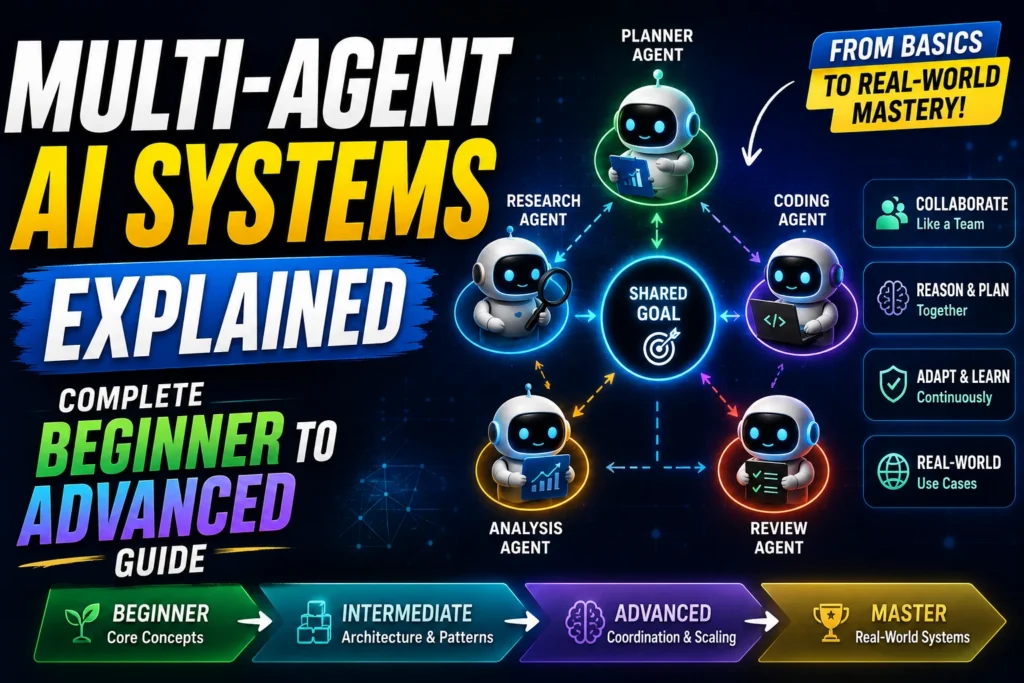
A Multi-Agent AI System works similarly to a company team structure.
Example of AI Agent Roles
| AI Agent | Role |
|---|---|
| Planner Agent | Manager |
| Research Agent | Analyst |
| Coding Agent | Developer |
| Customer Support Agent | Executive |
| QA Agent | Reviewer |
These collaborative AI systems allow businesses to scale operations faster and more efficiently.
Centralized vs Decentralized Multi-Agent Systems ⚙️
Different Types of AI Coordination Models
Centralized Multi-Agent System
In centralized systems, one main orchestrator controls all agents.
The orchestrator:
- Assigns tasks
- Monitors workflows
- Coordinates communication
- Manages execution
Decentralized Multi-Agent System
In decentralized systems, agents communicate independently without relying on a central controller.
These systems offer:
- Better scalability
- Higher resilience
- More distributed intelligence
Comparison Table
| System Type | Description |
|---|---|
| Centralized Multi-Agent System | One orchestrator controls all agents |
| Decentralized Multi-Agent System | Agents collaborate independently |
Centralized systems are easier to manage, while decentralized systems are more scalable.
Why Businesses Use Multi-Agent AI Systems 📈
The Rise of Enterprise AI Automation
Businesses adopt Multi-Agent AI Systems because they help:
- Automate repetitive tasks
- Reduce operational costs
- Improve productivity
- Enable 24/7 workflows
- Scale customer operations
- Improve decision-making
- Increase enterprise efficiency
Many companies now consider agentic AI systems the future of business infrastructure.
How Multi-Agent AI Systems Work 🔄
Understanding AI Workflow Coordination
A Multi-Agent AI System follows a coordinated workflow where specialized agents collaborate to execute tasks.
Task Distribution
Breaking Large Workflows into Smaller Tasks
The orchestrator divides complex workflows into smaller tasks and assigns them to different AI agents.
Example Workflow
- Research Agent gathers information
- Writing Agent creates content
- SEO Agent optimizes content
- Publishing Agent uploads content
This enables large-scale AI workflow automation.
Agent Communication
How AI Agents Talk to Each Other
AI agents communicate using:
- APIs
- Message queues
- Shared memory systems
- Event systems
- Vector databases
Efficient communication is essential for smooth AI orchestration.
Decision Making
Autonomous AI Decision Systems
AI agents evaluate:
- Task priority
- Confidence scores
- Business rules
- Historical data
Advanced AI frameworks use reasoning engines for autonomous decisions.
Memory Sharing
Shared Context Between AI Agents
Agents share information through:
- Vector databases
- Memory layers
- RAG systems
- Persistent storage
Shared memory helps prevent duplicated work and improves collaboration.
Workflow Coordination
Orchestrating Enterprise Automation
The orchestrator manages:
- Task execution
- Dependencies
- Retries
- Monitoring
- Approvals
This creates synchronized enterprise AI automation.
Feedback Loops
Continuous Learning and Improvement
AI agents improve using:
- Human feedback
- Reinforcement learning
- Monitoring systems
- Analytics
Feedback loops help autonomous AI agents evolve over time.
Multi-Agent AI System Architecture 🏗️
Core Components of AI Agent Systems
A typical Multi-Agent AI architecture contains several layers.
1. Orchestrator
The Central AI Controller
The orchestrator acts as the system coordinator.
Responsibilities include:
- Assigning tasks
- Monitoring workflows
- Handling failures
- Managing communication
- Coordinating execution
2. Planner Agent
Breaking Goals into Executable Tasks
The planner converts large objectives into actionable workflows.
Example
“Launch a marketing campaign” becomes:
- Keyword research
- Content writing
- Ad creation
- Analytics setup
3. Execution Agents
Specialized AI Workers
Execution agents perform actual tasks such as:
- Coding
- Research
- Data analysis
- Customer support
- Content creation
4. Memory Layer
Long-Term AI Context Storage
The memory layer stores:
- Business rules
- Conversation history
- Workflow context
- Long-term knowledge
5. APIs and Tools
Connecting AI Systems with External Platforms
AI agents connect with tools such as:
- CRMs
- ERPs
- Slack
- Email systems
- Databases
- Analytics tools
6. Databases
Infrastructure Behind AI Workflows
Popular databases include:
- PostgreSQL
- Redis
- Pinecone
- Weaviate
- ChromaDB
7. Human Feedback Layer
Governance and Quality Control
Human approvals help ensure:
- Security compliance
- Quality assurance
- Ethical monitoring
- Governance standards
Types of AI Agents in Multi-Agent Systems 🤝
Specialized AI Roles for Different Tasks
Different AI agents specialize in different business operations.
Research Agent
AI-Powered Market Intelligence
Research agents:
- Collect data
- Analyze trends
- Monitor competitors
- Summarize documents
Useful for business intelligence and research automation.
Coding Agent
AI Software Development Automation
Coding agents assist with:
- Code generation
- Debugging
- Testing
- DevOps automation
Widely used in AI-powered software engineering workflows.
Planning Agent
AI Workflow Strategy and Coordination
Planning agents:
- Define workflows
- Prioritize tasks
- Allocate resources
- Optimize execution
Customer Support Agent
AI Customer Service Automation
Support agents handle:
- Live chat
- Customer tickets
- CRM interactions
- FAQs
These systems significantly improve customer experience.
Data Analysis Agent
AI-Powered Business Insights
Data analysis agents:
- Process datasets
- Generate insights
- Create dashboards
- Identify trends
Content Generation Agent
AI Content Creation Systems
Content agents generate:
- Blog articles
- Product descriptions
- Emails
- Ad copy
- SEO content
QA and Monitoring Agent
Ensuring Workflow Accuracy
QA agents:
- Validate outputs
- Detect hallucinations
- Monitor failures
- Improve quality control
Single AI Agent vs Multi-Agent AI Systems ⚖️
Comparing AI Architectures
| Feature | Single Agent | Multi-Agent System |
|---|---|---|
| Scalability | Limited | High |
| Task Handling | Sequential | Parallel |
| Collaboration | No | Yes |
| Complexity Handling | Moderate | Advanced |
| Automation Power | Medium | Very High |
| Flexibility | Low | High |
| Reliability | Moderate | Advanced |
| Enterprise Readiness | Limited | Excellent |
Multi-Agent AI Systems outperform single-agent systems in enterprise-scale environments.
Benefits of Multi-Agent AI Systems 🌟
Why Businesses Are Investing Heavily
Workflow Automation
Businesses automate complete workflows using collaborative AI systems.
Scalability
New AI agents can be added without redesigning the infrastructure.
Parallel Task Execution
Multiple agents work simultaneously, reducing execution time.
Faster Decision-Making
AI agents process information in real time.
Cost Reduction
Businesses significantly reduce staffing and operational costs.
Improved Productivity
Teams focus on strategy while AI handles repetitive work.
Enterprise Efficiency
Organizations achieve better coordination across departments.
Real-World Applications of Multi-Agent AI 🌎
How Businesses Use AI Agent Systems
Customer Support Automation
AI agents handle:
- Ticket routing
- Chat support
- Issue escalation
- Sentiment analysis
AI Sales Teams
Sales AI agents automate:
- Lead qualification
- CRM updates
- Outreach campaigns
- Follow-ups
AI Software Development
AI development agents assist with:
- Coding
- Testing
- Deployment
- Documentation
Marketing Automation
Marketing teams automate:
- SEO optimization
- Ad campaigns
- Content publishing
- Analytics
AI Research Systems
Research agents gather and summarize massive information quickly.
Financial Analysis
Finance companies use AI agents for:
- Fraud detection
- Risk assessment
- Forecasting
- Portfolio analysis
Supply Chain Automation
AI systems optimize:
- Inventory management
- Logistics
- Demand forecasting
- Vendor coordination
Healthcare AI Systems
Healthcare organizations use AI agents for:
- Patient management
- Scheduling
- Diagnosis assistance
- Medical data analysis
Multi-Agent AI Systems in Business Automation 🏢
Enterprise AI Transformation
Multi-agent systems are transforming enterprise AI automation.
CRM Automation
AI agents automatically:
- Update customer records
- Track interactions
- Manage sales pipelines
AI Email Handling
Agents can:
- Categorize emails
- Generate replies
- Prioritize conversations
AI Project Management
AI systems manage:
- Task assignments
- Team coordination
- Progress tracking
AI HR Systems
HR automation includes:
- Resume screening
- Employee onboarding
- HR support workflows
AI Sales Funnels
AI agents optimize:
- Lead nurturing
- Conversion tracking
- Sales outreach
AI Lead Generation
Autonomous AI agents identify and qualify potential customers automatically.
How Startups Use Multi-Agent AI Systems 🚀
Lean AI-Powered Operations
Startups use Multi-Agent AI Systems to scale quickly while keeping teams small.
Benefits include:
- Reduced hiring costs
- Automated workflows
- Faster operations
- AI-powered business assistants
Small teams can automate:
- Marketing
- Customer support
- Reporting
- Onboarding workflows
Enterprise Use Cases of Multi-Agent AI 🏛️
Large-Scale AI Orchestration
Enterprises use AI agent systems for:
- Massive operational coordination
- Distributed team management
- Process orchestration
- Real-time data analysis
- Governance and compliance monitoring
Popular Multi-Agent AI Frameworks 🛠️
Leading AI Agent Development Platforms
AutoGen
Designed for conversational multi-agent collaboration workflows.
CrewAI
Focused on role-based AI collaboration systems.
LangGraph
Enables graph-based AI workflow orchestration.
LangChain
Provides tools for LLM application development.
OpenAI Agents SDK
Helps developers build scalable AI agent systems.
MetaGPT
Simulates software company-style AI collaboration.
Semantic Kernel
Integrates AI into enterprise applications.
Framework Comparison Table
| Framework | Best Use Case | Difficulty Level |
|---|---|---|
| AutoGen | Conversational Agents | Medium |
| CrewAI | Team-Based Workflows | Easy |
| LangGraph | Workflow Orchestration | Advanced |
| LangChain | AI Applications | Medium |
| OpenAI Agents SDK | Enterprise AI Systems | Medium |
| MetaGPT | AI Software Teams | Advanced |
| Semantic Kernel | Enterprise Integration | Medium |
Challenges of Multi-Agent AI Systems ⚠️
Important Limitations Businesses Must Consider
Communication Overhead
Too many agents can create inefficient communication patterns.
Hallucinations
AI agents may generate inaccurate outputs.
Agent Conflicts
Different agents may produce conflicting decisions.
Security Risks
Sensitive enterprise data requires secure infrastructure.
Orchestration Complexity
Managing multiple AI agents becomes technically challenging.
Cost Optimization
LLM APIs and infrastructure costs can grow rapidly.
AI Memory and Context Management 🧠
The Foundation of Advanced AI Collaboration
Memory systems are critical for advanced agentic AI systems.
Vector Databases
Popular vector databases include:
- Pinecone
- Weaviate
- ChromaDB
RAG Systems
Retrieval-Augmented Generation improves response accuracy using external knowledge retrieval.
Persistent Context
Persistent memory helps AI maintain long-term business knowledge.
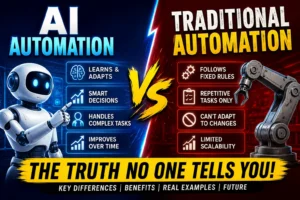
Multi-Agent AI vs Traditional Automation ⚙️
Why AI Automation Is More Powerful
| Feature | Traditional Automation | Multi-Agent AI |
|---|---|---|
| Flexibility | Low | High |
| Adaptability | Limited | Advanced |
| Decision Making | Rule-Based | Intelligent |
| Collaboration | None | Multi-Agent |
| Learning Ability | Minimal | Continuous |
| Scalability | Moderate | Excellent |
| Context Awareness | Weak | Strong |
Traditional automation follows fixed rules, while AI orchestration systems adapt dynamically.
Future of Multi-Agent AI Systems 🔮
The Next Generation of Business Infrastructure
The future of Multi-Agent AI Systems is transforming global business operations.
Experts predict:
- Autonomous businesses
- AI operating systems
- Digital AI employees
- Enterprise AI ecosystems
- AGI infrastructure development
Organizations investing in AI orchestration today may gain major competitive advantages.
How to Build a Multi-Agent AI System 🏗️
Step-by-Step Beginner Framework
Step 1 — Define the Workflow
Identify business processes to automate.
Step 2 — Select AI Models
Choose suitable LLMs and AI tools.
Step 3 — Build Orchestration Logic
Create coordination systems between agents.
Step 4 — Add Memory Systems
Integrate vector databases and context storage.
Step 5 — Connect APIs
Enable communication with external platforms.
Step 6 — Add Monitoring
Track performance, analytics, and failures.
Step 7 — Add Human Oversight
Implement governance and approval systems.
Tech Stack Required for Multi-Agent AI Systems 💻
Popular Technologies Used in AI Agent Development
Modern AI agent stacks commonly include:
- OpenAI APIs
- LangChain
- CrewAI
- LangGraph
- Python
- FastAPI
- Docker
- Redis
- PostgreSQL
- Vector databases
- Kubernetes
- Cloud hosting platforms
These technologies power scalable enterprise AI automation systems.
Best Industries for Multi-Agent AI Adoption 🏭
Industries Leading the AI Automation Revolution
SaaS
Customer operations and support automation.
Healthcare
Patient workflows and analytics systems.
Finance
Fraud analysis and risk automation.
Real Estate
Lead management and client communication.
E-commerce
Marketing, inventory, and support automation.
Marketing Agencies
Campaign automation and SEO workflows.
Manufacturing
Supply chain and operational monitoring.
Why Businesses Are Investing in Agentic AI 💰
The AI Workforce Revolution
Businesses increasingly view AI agents as digital employees.
Benefits include:
- Productivity scaling
- Operational efficiency
- AI-first business models
- Cost savings
- Enterprise automation
AI-powered organizations are becoming significantly more competitive.
Frequently Asked Questions
What is a Multi-Agent AI System?
A Multi-Agent AI System is an architecture where multiple autonomous AI agents collaborate to complete tasks, automate workflows, and make decisions together.
How do AI agents communicate with each other?
AI agents communicate using APIs, shared memory systems, event queues, databases, and orchestration frameworks.
What is the difference between AI agents and chatbots?
Chatbots mainly handle conversations, while AI agents can autonomously perform tasks, make decisions, use tools, and coordinate workflows.
Which framework is best for Multi-Agent AI Systems?
Popular frameworks include CrewAI, AutoGen, LangGraph, LangChain, and OpenAI Agents SDK depending on the business use case.
Can businesses automate operations using AI agents?
Yes. Businesses can automate customer support, CRM workflows, analytics, HR operations, sales funnels, and enterprise workflows using AI agents.
Are Multi-Agent AI Systems expensive to build?
Costs depend on infrastructure, APIs, complexity, and scalability requirements.
What industries use Multi-Agent AI Systems?
Industries including SaaS, healthcare, finance, marketing, manufacturing, and e-commerce actively use collaborative AI systems.
Can AI agents work autonomously?
Yes. Advanced autonomous AI agents can independently execute workflows with minimal human intervention.
What is Agentic AI?
Agentic AI refers to AI systems capable of autonomous planning, reasoning, decision-making, and task execution.
Final Conclusion 🎯
Multi-Agent AI Systems are rapidly becoming the backbone of next-generation business automation in 2026.
By enabling multiple AI agents to collaborate through intelligent orchestration, businesses can automate complex workflows, improve operational efficiency, reduce costs, and scale faster than traditional systems allow.
From startups building lean operations to enterprises managing massive infrastructures, collaborative AI systems are reshaping industries worldwide.
As AI technology advances, organizations investing in agentic AI systems today may gain major competitive advantages in:
- Productivity
- Innovation
- Automation
- Enterprise transformation
The future of business is increasingly AI-powered, collaborative, and autonomous.