Introduction 🚀
Artificial Intelligence is transforming the way we live, work, study, and run businesses. From smart assistants and self-driving cars to healthcare systems and industrial robots, AI is now integrated into almost every industry. But when beginners start learning about AI systems, one comparison often creates confusion:
- Introduction 🚀
- What is Edge AI? 📱
- How Edge AI Works
- What is Cloud AI? ☁️
- How Cloud AI Works
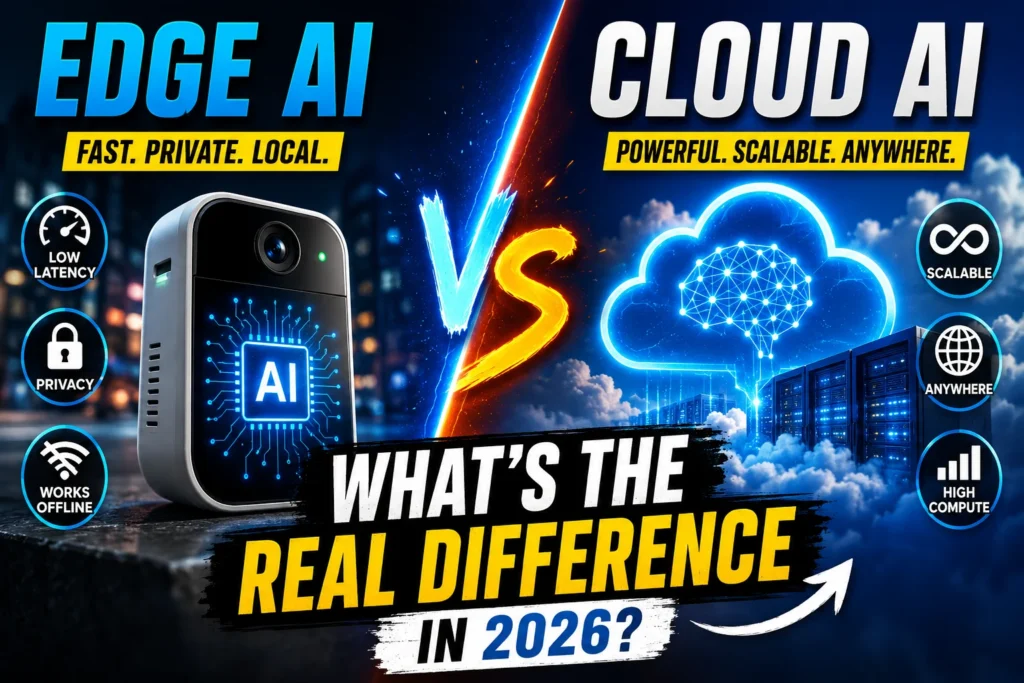
- Edge AI vs Cloud AI: Core Difference Explained 🔍
- Edge AI vs Cloud AI Comparison in 2026 ⚡
- Computing Power 💻
- Cost Comparison 💰
- Real-World Examples of Edge AI 🌍
- Real-World Examples of Cloud AI ☁️
- Why Edge AI is Growing Rapidly in 2026 📊
- Why Cloud AI Still Dominates Large-Scale AI ☁️
- Edge AI vs Cloud AI in Different Industries 🏭
- Can Edge AI and Cloud AI Work Together? 🤝
- How Hybrid AI Works
- Advantages of Edge AI ✅
- Advantages of Cloud AI ✅
- Challenges of Edge AI ⚠️
- Challenges of Cloud AI ⚠️
- Which One Should Beginners Learn First? 🎯
- Future of Edge AI vs Cloud AI in 2026 and Beyond 🔮
- Future AI Trends May Include
- Final Thoughts 💡
- FAQs ❓
Edge AI vs Cloud AI
So, what exactly do these terms mean? Which one is better? And why are companies in 2026 investing heavily in both technologies? If you are a student or beginner trying to understand modern AI infrastructure, this guide will explain everything in simple language. We will break down Edge AI and Cloud AI, compare their features, explore real-world examples, and help you understand where each technology works best.
By the end of this article, you will clearly understand how Edge AI and Cloud AI operate and why both are shaping the future of intelligent systems. 🌍 You must read full detailed blog on Top 10 Emerging Technology Trends in 2026 Every IT Professional Must Know
What is Edge AI? 📱
Understanding Edge AI in Simple Words
Edge AI refers to artificial intelligence that runs directly on a local device instead of sending data to remote cloud servers.
In simple terms, the AI model works “at the edge” of the network. That edge can be:
- Smartphones
- CCTV cameras
- Smartwatches
- Factory machines
- Drones
- Smart vehicles
Instead of uploading data to the internet for processing, the device itself analyzes information and makes decisions instantly.
For example, when your smartphone unlocks using face recognition without internet access, that is Edge AI in action.
How Edge AI Works
The Core Components of Edge AI
An Edge AI system generally includes:
AI Model
A trained machine learning model is installed directly on the device.
Local Processing Unit
The device contains a processor or AI chip capable of handling AI tasks locally.
Real-Time Decision Making
The device analyzes incoming data instantly and responds immediately.
Because everything happens locally, there is very little delay.
What is Cloud AI? ☁️
Understanding Cloud AI in Simple Words
Cloud AI refers to artificial intelligence systems that process data using remote cloud servers.
In this setup, the device sends data through the internet to powerful cloud data centers. The cloud server analyzes the information, runs AI models, and sends the results back to the device.
For example, when you ask a cloud-based AI chatbot a question, the processing happens on remote servers rather than on your device.
How Cloud AI Works
The Core Workflow of Cloud AI
Cloud AI systems generally follow these steps:
Data Collection
The device gathers information from users or sensors.
Internet Transmission
The collected data is sent to cloud servers through the internet.
AI Processing
Massive cloud computing systems analyze the data using advanced AI models.
Response Delivery
The cloud server sends the results back to the device.
Cloud AI relies heavily on stable internet connectivity and centralized computing power.
Edge AI vs Cloud AI: Core Difference Explained 🔍
The Biggest Difference Between Edge AI and Cloud AI
The primary difference between Edge AI and Cloud AI is the location where AI processing happens.
Edge AI
Processing happens directly on the local device itself.
Cloud AI
Processing happens on remote cloud servers through the internet.
This single difference affects:
- Speed
- Privacy
- Scalability
- Cost
- Performance
- Connectivity requirements
Edge AI vs Cloud AI Comparison in 2026 ⚡
Speed and Latency
Edge AI is significantly faster because data does not need to travel to remote servers.
Imagine a self-driving car detecting a pedestrian. Even a one-second delay could be dangerous. Edge AI allows the vehicle to make immediate decisions.
Cloud AI takes more time because data travels through the internet before processing.
In 2026, industries requiring real-time responses increasingly prefer Edge AI.
Internet Dependency 🌐
Edge AI can function even without internet access.
This is especially useful in:
- Remote areas
- Factories
- Military operations
- Autonomous vehicles
Cloud AI completely depends on stable internet connectivity. Without internet access, most cloud AI systems stop functioning properly.
Data Privacy and Security 🔒
Privacy has become a major global concern.
Edge AI improves privacy because data remains on the local device instead of being uploaded to remote cloud systems.
For example, a smart security camera using Edge AI can analyze video footage locally without sending sensitive recordings online.
Cloud AI often involves transferring large amounts of personal or business data over the internet, which may increase privacy risks.
However, modern cloud platforms also use advanced encryption and security technologies.
Computing Power 💻
Cloud AI performs better when it comes to raw computing power.
Cloud servers contain massive GPUs and AI infrastructure capable of training extremely large AI models.
Edge devices usually have limited hardware resources.
This means:
- Edge AI is ideal for lightweight and fast AI tasks
- Cloud AI is better for highly complex processing
Scalability 📈
Cloud AI is easier to scale.
Businesses can quickly increase:
- Storage
- Processing power
- AI capabilities
Edge AI scaling can be more challenging because physical devices may require hardware upgrades or local AI deployment.
Cost Comparison 💰
Edge AI reduces cloud bandwidth and data transfer costs because processing happens locally.
However, building intelligent edge devices with advanced AI chips can increase initial hardware costs.
Cloud AI reduces local hardware requirements but may create recurring expenses through:
- Cloud subscriptions
- Server infrastructure
- Data transfer costs
In 2026, many companies use hybrid AI systems to balance operational costs.
Real-World Examples of Edge AI 🌍
Smartphones
Modern smartphones use Edge AI for:
- Face unlock
- Camera enhancement
- Voice recognition
- Battery optimization
Smart Security Cameras
AI-powered cameras detect suspicious activity locally without requiring cloud analysis.
Self-Driving Cars 🚗
Autonomous vehicles rely heavily on Edge AI for immediate decision-making.
Smart Factories
Industrial machines use Edge AI to detect equipment failures instantly.
Healthcare Devices ❤️
Wearable health trackers analyze body signals in real time.
Real-World Examples of Cloud AI ☁️
AI Chatbots
Most advanced conversational AI systems run on cloud infrastructure.
Streaming Recommendations 🎬
Platforms like Netflix and Spotify use cloud AI to analyze user behavior and recommend content.
Business Analytics
Companies process massive datasets using cloud-based AI platforms.
Language Translation
Online translation systems rely heavily on Cloud AI infrastructure.
AI Model Training
Large AI models require cloud computing resources for training and optimization.
Why Edge AI is Growing Rapidly in 2026 📊
The Rise of Intelligent Edge Devices
The Edge AI market is expanding quickly because modern devices are becoming smarter and more powerful.
Several trends are driving this growth.
Faster AI Chips
Modern processors now include dedicated AI acceleration hardware.
5G Technology
5G networks support faster communication between edge devices and cloud systems.
IoT Expansion
Billions of connected devices require faster local intelligence.
Privacy Regulations
Governments worldwide are enforcing stricter data privacy laws.
Because of these changes, Edge AI adoption is increasing across industries.
Why Cloud AI Still Dominates Large-Scale AI ☁️
Cloud Infrastructure Remains Essential
Even though Edge AI is growing rapidly, Cloud AI remains extremely important.
Why?
Because advanced AI systems still require enormous computing power.
Training:
- Large language models
- Enterprise analytics systems
- Recommendation engines
is nearly impossible without cloud infrastructure.
Cloud AI also makes it easier for businesses to update AI systems globally.
Instead of manually updating millions of devices, companies can improve cloud AI systems centrally.
Edge AI vs Cloud AI in Different Industries 🏭
Healthcare
Edge AI supports real-time patient monitoring, while Cloud AI handles large-scale medical data analysis.
Retail
Edge AI powers smart checkout systems, while Cloud AI analyzes customer buying patterns.
Manufacturing
Factories use Edge AI for predictive maintenance and Cloud AI for operational planning.
Education 🎓
Educational platforms use Cloud AI for personalized learning systems and Edge AI for offline learning tools.
Smart Cities
Traffic systems use Edge AI for instant responses and Cloud AI for city-wide analytics.
Can Edge AI and Cloud AI Work Together? 🤝
The Future Is Hybrid AI Systems
Yes — absolutely.
The future of AI is not about choosing one technology over the other. The future belongs to hybrid AI systems.
A hybrid system combines the strengths of both Edge AI and Cloud AI.
How Hybrid AI Works
Combining Speed and Scalability
In hybrid systems:
- Edge devices handle fast local decisions
- Cloud systems manage deep analysis, storage, and large-scale learning
For example, a smart factory machine may detect equipment problems instantly using Edge AI, while cloud systems analyze long-term operational trends.
This approach provides:
- Speed
- Scalability
- Efficiency
- Better user experiences
Advantages of Edge AI ✅
Faster Real-Time Decisions
Edge AI significantly reduces delays.
Better Privacy
Sensitive data remains on the local device.
Reduced Bandwidth Usage
Less data travels through the internet.
Offline Functionality
Edge AI systems can work without stable internet access.
Lower Long-Term Cloud Costs
Businesses reduce dependency on expensive cloud infrastructure.
Advantages of Cloud AI ✅
Massive Computing Power
Cloud AI is perfect for highly complex AI tasks.
Easy Scalability
Businesses can expand AI capabilities quickly.
Centralized Updates
AI models can be updated globally from one location.
Better Storage Capacity
Cloud systems efficiently handle huge datasets.
Advanced AI Training
Cloud infrastructure is ideal for training large machine learning models.
Challenges of Edge AI ⚠️
Limited Hardware Power
Edge devices cannot handle extremely heavy AI workloads.
Higher Device Costs
Advanced AI hardware increases manufacturing expenses.
Maintenance Complexity
Managing large numbers of edge devices can become difficult.
Challenges of Cloud AI ⚠️
Internet Dependency
Poor internet connectivity affects performance.
Privacy Concerns
Data transmission can increase security risks.
Latency Issues
Real-time applications may experience delays.
Ongoing Costs
Cloud infrastructure subscriptions can become expensive over time.
Which One Should Beginners Learn First? 🎯
Best Starting Point for Students
If you are a beginner or student, start with Cloud AI concepts first.
Why?
Because most AI learning platforms, machine learning frameworks, and AI development environments are cloud-based.
Once you understand machine learning fundamentals, you can gradually move toward Edge AI systems and embedded AI development.
Learning both technologies will give you a major future advantage because businesses increasingly need professionals who understand hybrid AI systems.
Future of Edge AI vs Cloud AI in 2026 and Beyond 🔮
The Future of Intelligent Systems
The future is extremely exciting.
Experts predict that billions of smart devices will run Edge AI within the next few years.
At the same time, Cloud AI will continue powering large-scale intelligent systems worldwide.
Instead of replacing each other, both technologies will evolve together.
Future AI Trends May Include
Smarter Edge Devices
Devices will include stronger onboard AI chips.
Faster Networks
6G and advanced communication systems will improve connectivity.
Better Hybrid Systems
Edge and cloud systems will communicate more efficiently.
More Personalized AI
AI systems will adapt to users in real time.
Final Thoughts 💡
The debate around Edge AI vs Cloud AI is not about choosing one technology as universally better. It is about selecting the right solution for the right use case.
- Edge AI is ideal for speed, privacy, and real-time decision-making
- Cloud AI is perfect for large-scale processing, deep learning, and advanced analytics
In 2026, the smartest organizations are combining both approaches to build powerful hybrid AI systems. If you are entering the world of Artificial Intelligence, understanding both technologies will help you stay ahead in the future job market and evolving technology landscape. The AI revolution is only getting started. 🚀
FAQs ❓
What is the main difference between Edge AI and Cloud AI?
Edge AI processes data locally on devices, while Cloud AI processes data on remote cloud servers through the internet.
Is Edge AI faster than Cloud AI?
Yes, Edge AI is generally faster because it avoids internet transmission delays.
Which is more secure: Edge AI or Cloud AI?
Edge AI often provides better privacy because sensitive data remains on the local device.
Can Edge AI work without internet?
Yes, most Edge AI systems can function offline.
Will Edge AI replace Cloud AI in the future?
No, both technologies will work together in hybrid AI systems.