AI Automation vs Traditional Automation:
Automation is transforming the way businesses operate in 2026, but most people still misunderstand what modern automation actually means. Many companies invest heavily in automation systems expecting revolutionary results, only to realize later that not every automation technology works the same way. Some systems simply follow fixed instructions, while others can learn, adapt, and make decisions almost like humans. This is where the debate around AI Automation vs Traditional Automation becomes important. Businesses, students, and professionals everywhere are trying to understand which approach is better, more future-proof, and more effective for solving real-world problems. The truth is that both technologies have strengths, limitations, and completely different purposes. Understanding the real difference between AI-powered automation and traditional rule-based systems is now essential because automation is no longer just about saving time. It is about intelligence, scalability, customer experience, and staying competitive in a rapidly evolving digital world.
- AI Automation vs Traditional Automation:
- Understanding the Automation Spectrum
- What Is Traditional Automation?
- How Traditional Automation Works
- What Is AI Automation?
- AI Automation vs Traditional Automation: The Core Difference
- Why Businesses Still Use Traditional Automation
- Traditional Automation Limitations
- Why AI Automation Is Growing Rapidly
- AI vs Rule-Based Automation in Real Life
- Intelligent Automation vs RPA
- Machine Learning in Automation Systems
- AI Automation Use Cases in Industries
- Future of Automation With AI vs Traditional Systems
- Should Beginners Learn AI Automation?
- The Truth No One Tells You About AI Automation
- Conclusion
- FAQs
🔐 Want to strengthen your cybersecurity strategy? Explore our complete guide on Zero Trust Security Architecture for Modern Businesses.
Understanding the Automation Spectrum
Automation is not simply a choice between humans and machines. It exists on a wide spectrum where different technologies solve different types of problems. At one end, there are basic automation systems designed to perform repetitive tasks using predefined instructions. These systems are reliable, predictable, and efficient for structured workflows. At the other end, there are advanced AI automation systems capable of analyzing data, identifying patterns, understanding language, and improving continuously through machine learning. Most businesses today operate somewhere in the middle of this spectrum, combining traditional automation with intelligent technologies to improve efficiency. The biggest misunderstanding people have is assuming that all automation is intelligent. In reality, many companies still use simple rule-based workflows that cannot adapt when situations change. The key difference between modern AI systems and older automation methods lies in flexibility and decision-making ability. Traditional systems execute instructions exactly as programmed, while AI systems learn from data and evolve over time. This distinction is shaping the future of digital transformation globally.
What Is Traditional Automation?
Traditional automation refers to systems that automate tasks using predefined rules, workflows, and conditions. These systems operate on fixed logic where every action is based on “if-this-then-that” instructions. For example, if a customer places an order, the system generates an invoice automatically. If inventory drops below a specific level, the software sends a notification. Everything works according to predefined conditions created by developers. Traditional automation became popular because it significantly reduced manual work and improved operational speed across industries such as manufacturing, banking, logistics, healthcare, and administration. Businesses relied heavily on these systems because repetitive tasks are ideal for rule-based automation. The biggest strength of traditional automation is consistency. Machines do not get tired, distracted, or inconsistent like humans. However, these systems cannot think, learn, or understand context beyond programmed instructions. If an unexpected situation occurs, the workflow usually fails or requires human intervention. This is one of the biggest traditional automation limitations modern businesses face today. discover the 10 Best Free AI Tools that every student in India should start using right now 
How Traditional Automation Works
Traditional automation works through structured workflows where every step follows predefined logic. The system receives an input, checks conditions, and performs actions accordingly. For example, a payroll system calculates employee salaries using fixed formulas. An attendance system records employee timings and generates reports automatically. A traffic signal follows programmed timing sequences regardless of actual road congestion. These systems perform repetitive tasks extremely efficiently because the workflow remains stable and predictable. However, the problem arises when businesses deal with unpredictable environments, customer behavior changes, or unstructured information like voice messages, images, or natural language conversations. Traditional automation systems struggle because they are not designed to interpret complexity. They depend entirely on structured data and predefined instructions. This is why companies today are moving toward AI-powered process automation tools that can handle more dynamic and intelligent workflows.
What Is AI Automation?
AI automation combines automation with artificial intelligence technologies such as machine learning, natural language processing, predictive analytics, and computer vision. Unlike traditional automation, AI systems can analyze information, identify patterns, make decisions, and improve over time through continuous learning. This ability to adapt is what makes AI automation fundamentally different from fixed automation systems. For example, an AI-powered customer support chatbot can understand customer intent even if questions are phrased differently. An AI fraud detection system in banking can identify suspicious behavior patterns by analyzing transaction history in real time. AI recommendation systems used by platforms like Netflix or YouTube personalize content suggestions based on user preferences and viewing behavior. These are practical automation with artificial intelligence examples that demonstrate how AI systems move beyond simple task execution into intelligent decision-making. This shift is one of the biggest reasons why AI automation is growing rapidly across industries worldwide. Discover why the Zero Trust Security Model is becoming essential for cloud-native and remote work environments.
AI Automation vs Traditional Automation: The Core Difference
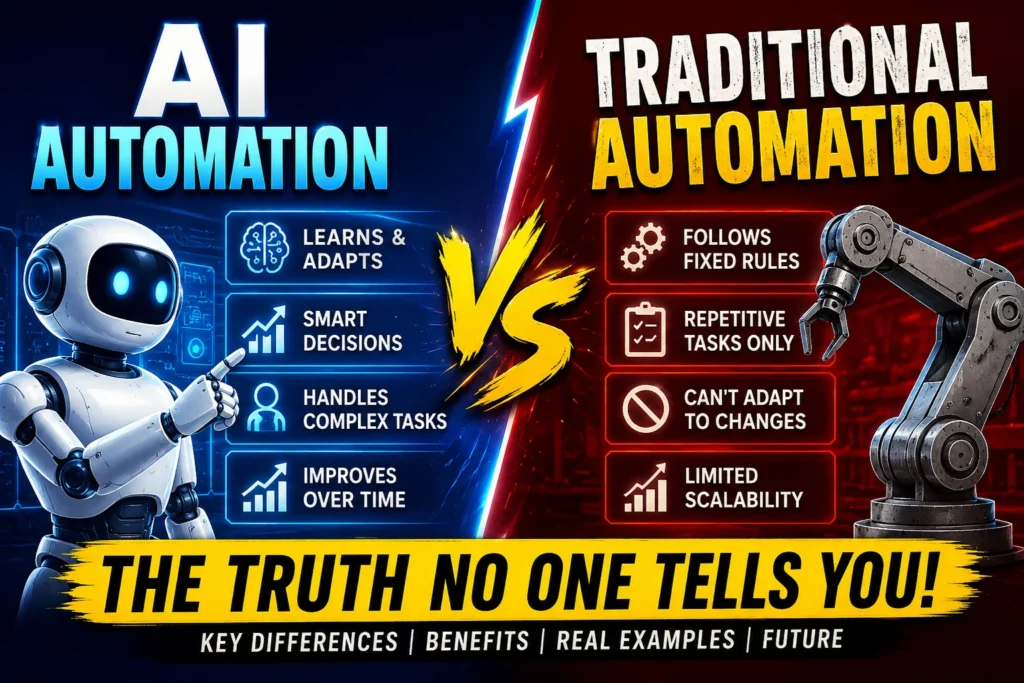
The biggest difference between AI automation and traditional automation lies in intelligence and adaptability. Traditional automation depends entirely on rules created by humans, while AI automation depends on learning from data. Traditional systems can only perform tasks they were explicitly programmed to handle. If something unexpected happens, they fail unless developers update the workflow manually. AI systems, however, continuously learn from new information and improve performance over time. Imagine a traditional customer support system that only responds to exact keywords. Now compare it with an AI-powered chatbot capable of understanding context, customer emotion, and conversational intent. That is the real difference between smart automation vs fixed automation. One system follows instructions rigidly, while the other adapts intelligently. This ability to evolve makes AI automation much more suitable for modern business environments where customer expectations, market conditions, and operational challenges change rapidly.
Why Businesses Still Use Traditional Automation
Despite the rise of artificial intelligence, traditional automation remains extremely important in 2026 because many business processes are still repetitive and predictable. Companies continue using traditional automation for tasks such as invoice generation, attendance tracking, payroll processing, inventory updates, document management, and workflow approvals because these systems are reliable, affordable, and easier to implement compared to AI solutions. Traditional automation also requires less technical complexity and lower implementation costs. Not every organization needs advanced machine learning capabilities. For many businesses, simple automation systems provide excellent operational efficiency without requiring large datasets, AI expertise, or ongoing model training. This is why AI vs rule-based automation should not be viewed as a battle where one technology completely replaces the other. Instead, businesses need to understand where each approach works best.
Traditional Automation Limitations
Although traditional automation is effective for repetitive workflows, it has serious limitations in dynamic business environments. The biggest challenge is lack of flexibility. Modern businesses deal with constantly changing customer behavior, market trends, and operational conditions, but traditional systems cannot adapt automatically when situations change. These systems also struggle with unstructured data such as voice recordings, customer conversations, images, handwritten documents, and complex decision-making processes. Another major limitation is the inability to learn from experience. Traditional automation performs the same actions repeatedly without improving efficiency or accuracy over time. This becomes problematic when businesses need predictive analysis, personalization, or intelligent decision-making capabilities. These traditional automation limitations are one of the main reasons organizations are now investing heavily in intelligent automation vs RPA solutions powered by AI technologies.
Explore how multi-agent AI systems are transforming enterprise automation, customer support, and data analysis.
Why AI Automation Is Growing Rapidly
AI automation is expanding rapidly because modern businesses generate enormous amounts of data every day. Human teams alone cannot process this information efficiently or identify hidden patterns quickly enough to remain competitive. AI systems can analyze large datasets within seconds, predict trends, optimize workflows, and improve decision-making accuracy. Companies using AI automation often achieve better customer experiences, faster operations, reduced costs, and higher productivity. One of the biggest benefits of AI automation in business is continuous improvement. Unlike traditional software, AI systems become smarter as they process more data. For example, AI recommendation engines improve personalization accuracy over time, and AI fraud detection systems become better at identifying suspicious activity through learning. This ability to evolve continuously gives businesses a significant competitive advantage in modern digital markets.
AI vs Rule-Based Automation in Real Life
The difference between AI and traditional automation becomes much easier to understand through practical examples. A traditional email autoresponder sends predefined replies based on fixed triggers. An AI-powered email assistant, however, can understand the context of messages, detect urgency, summarize conversations, and generate personalized responses. Similarly, traditional traffic management systems follow fixed timing schedules, while AI traffic systems analyze real-time traffic density and optimize signal patterns dynamically. In banking, traditional systems process transactions according to rules, but AI systems monitor customer behavior patterns to detect fraud instantly. These examples clearly demonstrate how AI automation handles complexity and decision-making more effectively than fixed rule-based systems. This is why discussions around difference between AI and RPA are becoming increasingly important in the automation industry.
Intelligent Automation vs RPA
RPA, or Robotic Process Automation, focuses mainly on automating repetitive digital tasks using predefined instructions. For example, an RPA bot may copy information from emails into spreadsheets, process invoices, or transfer data between systems automatically. However, traditional RPA systems cannot understand meaning, analyze context, or make decisions independently. Intelligent automation combines RPA with artificial intelligence technologies such as machine learning and natural language processing. This allows systems to process documents intelligently, understand human language, identify patterns, and improve through learning. In simple terms, RPA automates tasks while AI automation enhances decision-making capabilities. This is the core difference between AI and RPA. In 2026, businesses are increasingly integrating both technologies to create smarter and more efficient automation ecosystems.
Machine Learning in Automation Systems
Machine learning is one of the most important technologies behind modern AI automation systems. It enables software to learn from historical data and improve performance without explicit programming updates. For example, an AI-powered e-commerce platform studies customer behavior continuously to predict product preferences and personalize recommendations. A predictive maintenance system in manufacturing analyzes machine performance data to identify potential failures before breakdowns occur. Traditional automation cannot achieve this level of intelligence because it lacks learning capability. Machine learning in automation systems is especially valuable in industries where patterns constantly evolve, including healthcare, finance, logistics, cybersecurity, and digital marketing. This technology is one of the biggest drivers behind the rapid adoption of intelligent automation globally.
AI Automation Use Cases in Industries
AI automation is now transforming almost every major industry worldwide. In healthcare, AI systems assist doctors in medical image analysis, patient diagnosis, and hospital workflow optimization. In banking, AI-powered fraud detection systems monitor unusual transaction behavior instantly. Retail companies use AI recommendation engines to personalize shopping experiences and forecast customer demand. Manufacturing industries rely on predictive maintenance systems and AI-powered robotics to improve production efficiency. Logistics companies optimize delivery routes using AI algorithms that analyze weather, traffic, and fuel consumption data. Even education platforms are implementing AI learning assistants that personalize learning experiences according to student performance. These AI automation use cases in industries clearly show how intelligent systems are reshaping business operations globally.
Future of Automation With AI vs Traditional Systems
The future of automation is moving toward intelligence rather than simple task execution. Experts predict that AI-powered systems will dominate industries such as customer support, logistics, healthcare, finance, manufacturing, and cybersecurity over the next decade. However, traditional automation will still remain relevant because repetitive structured tasks will always exist. The future is not about eliminating traditional automation completely. Instead, it is about combining AI capabilities with existing automation systems strategically. Businesses that successfully integrate AI, RPA, analytics, and human oversight will achieve the best results. This hybrid approach is becoming the foundation of modern digital transformation strategies. The future of automation with AI vs traditional systems is therefore collaborative rather than competitive.
Should Beginners Learn AI Automation?
For students and beginners, learning automation technologies in 2026 is becoming an incredibly valuable career skill. The best approach is to first understand workflow automation and rule-based systems before moving toward advanced AI concepts. Learning traditional automation creates a strong foundation for understanding business processes and operational workflows. After that, students can explore machine learning, AI tools, predictive analytics, prompt engineering, and intelligent automation systems. The demand for professionals skilled in business process automation with AI is growing rapidly across industries because organizations need experts who can design smarter and more adaptive workflows for the future.
The Truth No One Tells You About AI Automation
Most online discussions present AI automation as a magical solution capable of replacing humans entirely, but reality is far more complex. AI systems still require quality data, continuous monitoring, human supervision, ethical guidelines, and proper training. AI can make incorrect predictions, develop biases, or generate inaccurate outcomes if the training data is poor. Successful businesses understand that AI works best when combined with human intelligence instead of replacing it entirely. The most effective organizations use AI strategically to enhance productivity, improve decision-making, and automate complex workflows while maintaining human oversight where necessary. This balanced approach is what truly drives successful automation transformation.
Conclusion
The discussion around AI Automation vs Traditional Automation is not about deciding which technology is universally better. Both approaches solve different problems and remain valuable in different scenarios. Traditional automation continues to be highly effective for repetitive and predictable tasks, while AI automation excels in environments requiring adaptability, learning, prediction, and intelligent decision-making. As businesses continue evolving in 2026 and beyond, organizations that combine both technologies strategically will gain the strongest competitive advantage. For students, professionals, and companies alike, understanding the future of intelligent automation is no longer optional. It is becoming one of the most important skills and business strategies of the modern digital era.
FAQs
What is the difference between AI automation and traditional automation?
AI automation learns from data and adapts over time, while traditional automation follows fixed rules and predefined instructions.
Is AI automation better than rule-based automation?
AI automation is better for complex and changing environments, while rule-based automation is ideal for repetitive and predictable tasks.
What are examples of AI automation?
Examples include AI chatbots, fraud detection systems, predictive maintenance software, recommendation engines, and intelligent traffic systems.
What are the limitations of traditional automation?
Traditional automation lacks flexibility, cannot learn from experience, struggles with unstructured data, and requires manual updates when conditions change.
What is the future of automation in 2026?
The future of automation involves combining AI, machine learning, RPA, and human oversight to create intelligent and adaptive business systems.