
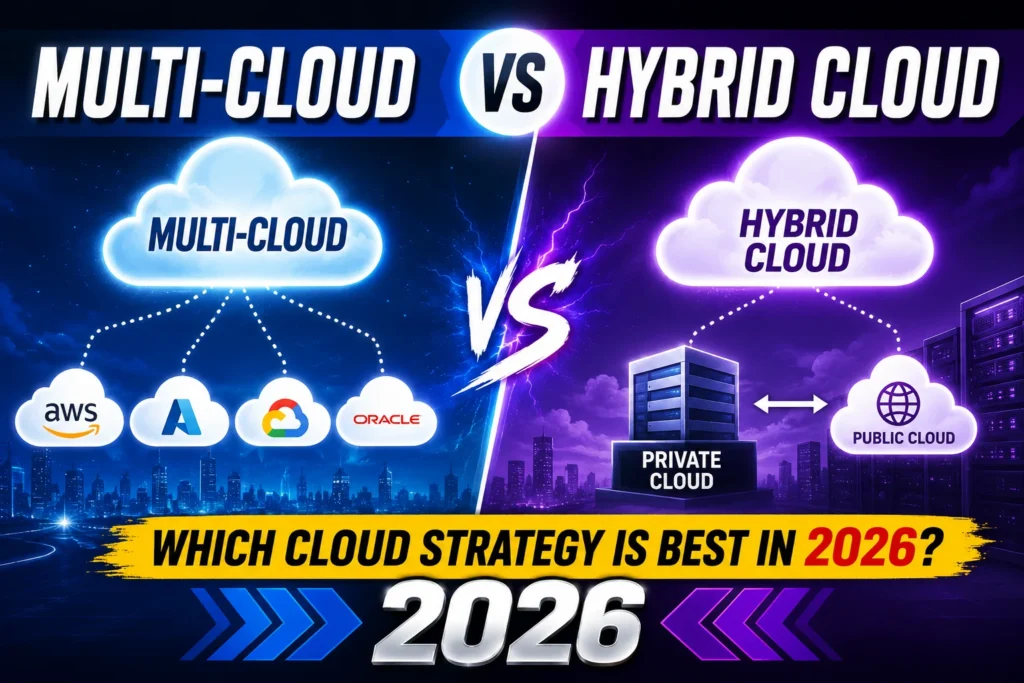
Multi-Cloud vs Hybrid Cloud: Which Cloud Strategy Is Best in 2026?
Multi-cloud and hybrid cloud are two leading cloud deployment models helping businesses improve scalability, flexibility, security, and operational efficiency in 2026. A multi-cloud strategy uses services from multiple public cloud providers like Amazon Web Services, Microsoft Azure, and Google Cloud, while a hybrid cloud combines public cloud services with private cloud or on-premise infrastructure. Both approaches support digital transformation, but they differ in architecture, cost, security, deployment, and management.
This complete comparison guide explains multi-cloud vs hybrid cloud to help startups, enterprises, CTOs, and IT teams choose the best cloud strategy for their business needs. discover the Top 10 Best Free AI Tools for students that every student in India should start using right now 
What Is Multi-Cloud?
A multi-cloud architecture is a cloud computing strategy where businesses use multiple public cloud providers simultaneously instead of relying on a single vendor. Companies distribute workloads, applications, databases, storage, and services across different cloud platforms to improve availability, performance, scalability, and vendor flexibility.
In a multi-cloud environment, organizations may use:
- AWS for computing
- Azure for enterprise integrations
- Google Cloud for AI and analytics
- Oracle Cloud for database services
Examples of Multi-Cloud Deployment
- AWS + Azure
- Azure + Google Cloud
- AWS + Oracle Cloud
A multi-cloud strategy helps businesses avoid dependence on one cloud provider while allowing teams to choose the best services from each platform.
Key Components of Multi-Cloud Architecture
- Multiple public cloud providers
- Distributed workloads
- API integrations
- Kubernetes orchestration
- Cloud-native applications
- Centralized monitoring tools
- Disaster recovery systems
Businesses adopting multi-cloud architecture often focus on uptime optimization, global performance, and service specialization.
Benefits of Multi-Cloud Deployment
- Improved business continuity
- Reduced vendor lock-in
- Better geographic coverage
- High service availability
- Flexible pricing options
- Optimized workload performance
For deeper understanding, businesses can also explore What is Cloud Computing and Kubernetes Explained to understand the foundation of cloud-native infrastructure. Discover why the Zero Trust Security Model is becoming essential for cloud-native and remote work environments.
What Is Hybrid Cloud?
Hybrid cloud is a cloud deployment model that combines public cloud infrastructure with private cloud environments or on-premise data centers. Businesses using hybrid cloud can run sensitive workloads internally while using public cloud resources for scalability and flexibility.
Hybrid cloud architecture is commonly used by enterprises that need:
- Strong compliance control
- Secure data storage
- Legacy application integration
- Private infrastructure management
Examples of Hybrid Cloud Deployment
- Private server + AWS
- Data center + Azure
- On-premise ERP + cloud applications
Hybrid cloud allows organizations to maintain operational control over critical systems while benefiting from cloud scalability.
Core Elements of Hybrid Cloud Architecture
- Public cloud platforms
- Private cloud infrastructure
- On-premise servers
- Secure VPN connectivity
- Unified workload management
- Cloud bursting capabilities
Why Enterprises Use Hybrid Cloud
Many organizations choose hybrid cloud benefits because it enables gradual cloud adoption without replacing existing infrastructure immediately.
Hybrid cloud is widely used in:
- Banking
- Healthcare
- Government
- Manufacturing
- Enterprise ERP systems
Businesses comparing deployment models should also review Benefits of Hybrid Cloud and Cloud Security Best Practices for strategic planning.
Multi-Cloud vs Hybrid Cloud: Key Differences
| Feature | Multi-Cloud | Hybrid Cloud |
|---|---|---|
| Infrastructure | Multiple public clouds | Public + private cloud |
| Flexibility | High | Moderate |
| Security Control | Distributed | Centralized |
| Vendor Lock-In | Reduced | Moderate |
| Complexity | Higher | Medium |
| Cost Management | Challenging | Controlled |
| Scalability | Excellent | High |
| Deployment Style | Cloud-to-cloud | Private + public integration |
| Best For | Global scalability | Sensitive enterprise workloads |
| Infrastructure Ownership | Mostly cloud vendors | Partial internal ownership |
The main difference between multi-cloud and hybrid cloud lies in infrastructure composition. Multi-cloud focuses on multiple public cloud providers, while hybrid cloud integrates private and public environments together.
Multi-Cloud Architecture Explained
Multi-cloud architecture distributes applications and workloads across different cloud providers for flexibility, resilience, and performance optimization.
Main Components of Multi-Cloud Infrastructure
Distributed Workloads
Applications are divided across cloud platforms based on performance requirements, geographic location, or service specialization.
API Integrations
Different cloud services communicate using APIs to ensure seamless interoperability.
Containerization
Containers allow applications to run consistently across multiple cloud environments.
Kubernetes Orchestration
Kubernetes automates deployment, scaling, and management across cloud providers.
Disaster Recovery
Multi-cloud environments improve redundancy by replicating workloads across regions and vendors.
How Multi-Cloud Improves Reliability
If one cloud provider experiences downtime, workloads can shift to another provider. This ensures high availability and business continuity.
Companies adopting this approach often compare AWS vs Azure Comparison before selecting cloud vendors.
Hybrid Cloud Architecture Explained
Hybrid cloud architecture integrates private infrastructure with public cloud resources to balance security and scalability.
Components of Hybrid Cloud Infrastructure
Private Infrastructure
Sensitive workloads remain inside private data centers or enterprise servers.
Cloud Bursting
Applications temporarily use public cloud resources during traffic spikes.
Secure Enterprise Workloads
Critical business systems remain under organizational control.
Sensitive Data Management
Regulated industries store confidential data internally for compliance.
Internal Server Integration
Legacy systems connect with modern cloud applications without full migration.
Why Hybrid Cloud Matters
Hybrid cloud enables businesses to modernize gradually while protecting existing investments in infrastructure and applications.
Advantages of Multi-Cloud
Avoid Vendor Lock-In
Businesses are not dependent on a single provider, reducing operational and pricing risks.
Better Service Availability
Using multiple cloud providers improves uptime and redundancy.
Global Infrastructure
Organizations can deploy workloads closer to customers worldwide for lower latency.
High Scalability
Multi-cloud platforms offer flexible scaling for growing applications.
Performance Optimization
Businesses can choose the best cloud services for specific workloads such as AI, analytics, storage, or databases.
Advantages of Hybrid Cloud
Better Data Security
Sensitive information remains within private infrastructure.
Compliance Control
Hybrid cloud supports regulatory requirements across industries.
Cost Optimization
Businesses avoid migrating all workloads to expensive public cloud services.
Legacy System Integration
Existing enterprise systems can connect with cloud applications smoothly.
Flexible Infrastructure
Organizations can scale workloads dynamically while maintaining internal control.
Disadvantages of Multi-Cloud
While multi-cloud offers flexibility, it also introduces operational challenges.
Operational Complexity
Managing multiple cloud providers requires advanced expertise.
Cost Tracking Challenges
Cloud billing becomes difficult across multiple vendors.
Security Management Issues
Different providers require different security policies and monitoring systems.
Higher Skill Requirements
Organizations need experienced DevOps and cloud architects.
Monitoring Difficulties
Tracking performance across multiple platforms requires centralized monitoring tools. Businesses planning deployment should also study DevOps vs Cloud Engineering to understand operational responsibilities.
Disadvantages of Hybrid Cloud
Infrastructure Cost
Private infrastructure maintenance increases operational expenses.
Setup Complexity
Hybrid integration requires networking and architecture expertise.
Maintenance Requirements
Internal servers require ongoing monitoring and upgrades.
Integration Challenges
Connecting legacy systems with cloud platforms can be difficult.
Hardware Dependency
Organizations still rely on physical infrastructure management.
Multi-Cloud vs Hybrid Cloud Security Comparison
| Security Factor | Multi-Cloud | Hybrid Cloud |
|---|---|---|
| Data Protection | Distributed security policies | Centralized protection |
| Encryption | Provider-specific encryption | Internal + cloud encryption |
| Compliance | Complex compliance management | Easier regulatory control |
| Identity Management | Multi-platform IAM systems | Centralized IAM |
| Disaster Recovery | Excellent redundancy | Controlled recovery planning |
| Threat Visibility | Distributed monitoring | Unified monitoring |
| Sensitive Data Storage | Mostly public cloud | Private infrastructure |
Hybrid cloud generally offers stronger centralized security control, while multi-cloud improves redundancy and disaster recovery. For additional protection strategies, businesses should review Cloud Security Best Practices.
Cost Comparison: Multi-Cloud vs Hybrid Cloud
| Cost Factor | Multi-Cloud | Hybrid Cloud |
|---|---|---|
| Cloud Billing | Multiple vendors | Mixed billing |
| Infrastructure Investment | Lower hardware investment | Higher infrastructure investment |
| Maintenance | Higher management cost | Hardware maintenance required |
| Scaling Cost | Flexible pay-as-you-go | Controlled scaling |
| Licensing | Multi-platform licensing | Enterprise licensing |
| Monitoring Tools | Advanced tools required | Moderate tooling |
| Operational Staffing | Higher expertise needed | Internal IT dependency |
Multi-Cloud Cost Insights
- Lower upfront hardware investment
- Higher operational complexity
- Flexible service pricing
Hybrid Cloud Cost Insights
- Higher private infrastructure expenses
- Better predictable operational costs
- Suitable for long-term enterprise environments
Organizations evaluating cloud infrastructure comparison should also explore Best Cloud Hosting Providers for pricing insights. You can also Explore how multi-agent AI systems are transforming enterprise automation, customer support, and data analysis.
Performance and Scalability Comparison
Traffic Handling
Multi-cloud distributes traffic globally across providers, improving reliability during peak demand.
Latency Optimization
Cloud providers with global regions improve application performance.
Load Balancing
Multi-cloud environments balance workloads dynamically across vendors.
Resource Allocation
Hybrid cloud offers internal resource control for sensitive applications.
Edge Computing
Both strategies support edge computing, but multi-cloud enables wider geographic coverage.
Best Use Cases for Multi-Cloud
SaaS Platforms
SaaS companies require global scalability and uptime optimization.
Global Applications
Applications serving international users benefit from distributed cloud regions.
Large Enterprises
Large organizations use multiple cloud vendors for specialization and resilience.
AI and Big Data Workloads
Different providers offer unique AI and analytics services.
High Availability Systems
Mission-critical applications benefit from multi-cloud redundancy.
Best Use Cases for Hybrid Cloud
Banking
Banks use hybrid cloud for compliance and secure financial data processing.
Healthcare
Healthcare organizations protect patient data while scaling digital services.
Government Organizations
Government systems require strong infrastructure control and compliance.
Manufacturing
Manufacturers integrate operational technology with cloud analytics.
ERP Systems
Hybrid cloud supports enterprise ERP modernization without replacing legacy systems.
Multi-Cloud vs Hybrid Cloud for Startups
Startups typically prioritize:
- Low operational complexity
- Fast scalability
- Budget efficiency
- Agile deployment
- DevOps simplicity
Multi-Cloud for Startups
Multi-cloud works well for rapidly scaling SaaS companies needing global reach.
Hybrid Cloud for Startups
Hybrid cloud may not be ideal initially due to infrastructure costs and maintenance complexity. Most startups begin with public cloud deployment and later expand into hybrid or multi-cloud environments. Businesses planning migration should explore Cloud Migration Strategy before implementation.
Which Cloud Strategy Is Better for Enterprises?
Enterprises require:
- Compliance management
- Infrastructure control
- Global scalability
- Operational reliability
- Disaster recovery
Why Enterprises Prefer Hybrid Cloud
- Better control over sensitive workloads
- Easier compliance management
- Integration with legacy systems
Why Enterprises Choose Multi-Cloud
- Reduced vendor dependency
- Improved global availability
- Specialized cloud services
Many enterprises eventually combine both approaches into a hybrid multi-cloud strategy.
Popular Multi-Cloud and Hybrid Cloud Platforms
Major cloud providers include:
- Amazon Web Services
- Microsoft Azure
- Google Cloud
- Oracle Cloud
- IBM Cloud
Common Platform Combinations
- AWS + Azure
- Google Cloud + AWS
- Oracle Cloud + Azure
- IBM Cloud + private infrastructure
Businesses often compare providers through AWS vs Azure Comparison before deployment decisions.
How to Choose the Right Cloud Strategy
Choosing between hybrid cloud vs multi-cloud depends on several factors.
Company Size
Large enterprises often require hybrid or multi-cloud infrastructure.
Workload Type
Sensitive workloads favor hybrid cloud.
Budget
Multi-cloud reduces hardware costs but increases operational management complexity.
Compliance
Regulated industries benefit from hybrid cloud control.
Security Requirements
Private infrastructure offers stronger internal governance.
Scalability Needs
Multi-cloud delivers excellent global scalability.
Existing Infrastructure
Organizations with large on-premise investments usually prefer hybrid deployment.
Future of Multi-Cloud and Hybrid Cloud in 2026
Cloud computing for business is evolving rapidly.
AI Integration
Cloud providers are expanding AI and machine learning services.
Edge Computing
Businesses are moving workloads closer to users for lower latency.
Automation
Infrastructure automation reduces management complexity.
Kubernetes Adoption
Kubernetes continues becoming the standard for orchestration.
Cloud-Native Applications
Modern applications are increasingly designed for distributed cloud environments. The future enterprise cloud strategy will heavily focus on automation, AI, and distributed infrastructure.
Why Businesses Are Moving to Multi-Cloud and Hybrid Cloud
Digital Transformation
Organizations modernize infrastructure for agility and scalability.
Business Continuity
Cloud redundancy improves operational resilience.
Remote Work Enablement
Cloud infrastructure supports distributed teams and collaboration.
Global Infrastructure Expansion
Businesses deploy applications closer to customers worldwide.
Cybersecurity Improvements
Modern cloud security frameworks strengthen threat protection. Cloud modernization is becoming essential for long-term competitiveness.
Cloud Consulting and Deployment Services
Businesses adopting cloud infrastructure often require:
- Cloud migration services
- Infrastructure architecture planning
- DevOps implementation
- Security optimization
- Monitoring and performance management
- Kubernetes deployment
- Disaster recovery planning
Professional cloud consulting helps organizations reduce migration risks and optimize infrastructure performance.
Frequently Asked Questions
What is the difference between multi-cloud and hybrid cloud?
Multi-cloud uses multiple public cloud providers, while hybrid cloud combines public cloud with private or on-premise infrastructure.
Which is more secure: hybrid cloud or multi-cloud?
Hybrid cloud generally offers stronger centralized security and compliance control.
Is AWS a hybrid cloud?
AWS itself is a public cloud platform, but it can be part of a hybrid cloud environment.
Why do companies use multi-cloud strategies?
Companies use multi-cloud to reduce vendor lock-in, improve availability, and optimize performance.
Which cloud strategy is better for startups?
Most startups prefer public cloud or multi-cloud because of scalability and lower infrastructure costs.
Can hybrid cloud reduce IT costs?
Yes, hybrid cloud can optimize costs by balancing private infrastructure with scalable cloud services.
What are the disadvantages of multi-cloud?
Operational complexity, cost monitoring, and security management are major challenges.
Is hybrid cloud suitable for enterprises?
Yes, hybrid cloud is highly suitable for enterprises requiring compliance and infrastructure control.
What industries use hybrid cloud the most?
Banking, healthcare, manufacturing, and government sectors heavily use hybrid cloud.
Can businesses use both multi-cloud and hybrid cloud together?
Yes, many enterprises implement hybrid multi-cloud environments for maximum flexibility and resilience.
Final Conclusion
The debate around multi-cloud vs hybrid cloud depends entirely on business goals, infrastructure requirements, security needs, and scalability expectations. Multi-cloud offers flexibility, global scalability, and reduced vendor lock-in, making it ideal for SaaS platforms, global applications, and cloud-native businesses. Hybrid cloud provides stronger control, compliance management, and legacy integration, making it suitable for enterprises handling sensitive workloads. As cloud modernization continues in 2026, businesses must choose a cloud strategy aligned with long-term operational goals, cybersecurity requirements, and digital transformation initiatives. Whether an organization selects multi-cloud, hybrid cloud, or a combination of both, scalability and infrastructure flexibility will remain critical for future growth.