
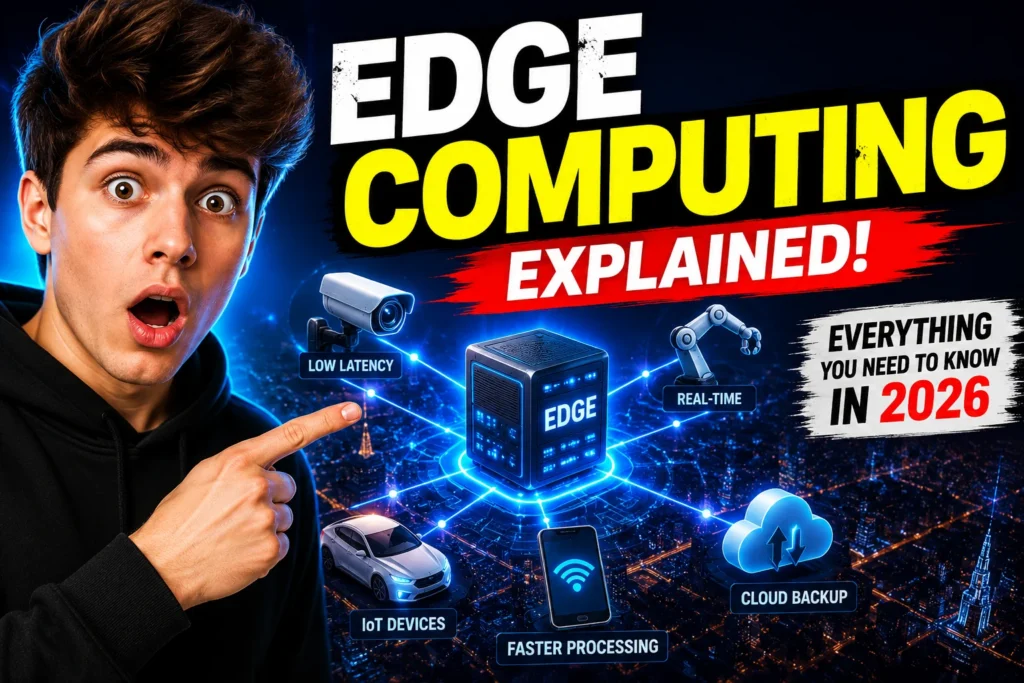
The amount of data generated every second is growing at an incredible rate. Smart devices, connected cars, industrial sensors, AI applications, and IoT systems are producing massive amounts of information that needs to be processed instantly. Traditional cloud computing alone is no longer enough for applications that require real-time responses.
- What is Edge Computing?
- Why Edge Computing is Becoming Essential in 2026
- How Edge Computing Works
- Edge Computing Architecture
- Edge Computing vs Cloud Computing
- Major Edge Computing Benefits
- Edge Computing and IoT
- Edge AI: Intelligence at the Edge
- Real-World Edge Computing Use Cases
- Edge Computing Security
- Challenges of Edge Computing
- The Future of Edge Computing
- Should Businesses Adopt Edge Computing?
- Frequently Asked Questions (FAQs)
- Conclusion
This is where Edge Computing becomes essential.
If you’ve ever wondered What is Edge Computing, how it works, and why companies like Amazon, Microsoft, Google, Tesla, and countless manufacturers are investing heavily in it, this guide covers everything you need to know. In this Edge Computing Explained guide, you’ll learn how edge computing works, its architecture, major benefits, real-world applications, security challenges, and why experts believe it will play a major role in the future of digital technology.
You’ll also discover how edge computing works alongside cloud computing instead of replacing it, making it one of the most valuable technologies for businesses entering the AI era.
What is Edge Computing?
Edge Computing is a computing model where data is processed as close as possible to the device or source generating it instead of sending everything to a distant cloud data center.
Rather than transmitting every piece of information across the internet, edge devices analyze and process important data locally before sending only necessary information to the cloud.
Featured Snippet Answer
Edge Computing is a distributed computing approach that processes data near the source where it is generated. This reduces latency, improves speed, lowers bandwidth usage, enhances security, and enables real-time decision-making for applications like IoT, AI, autonomous vehicles, and smart cities.
Imagine a self-driving car.
Waiting several seconds for a cloud server to process obstacle detection could lead to accidents. Instead, edge computing allows the vehicle to process camera and sensor data immediately, making real-time decisions within milliseconds.
This is why edge computing has become a critical technology for modern applications.
Why Edge Computing is Becoming Essential in 2026
The digital world is changing rapidly.
Several emerging technologies require instant processing that traditional cloud infrastructure cannot always provide efficiently.
These include:
- Artificial Intelligence
- Internet of Things (IoT)
- Smart factories
- Autonomous vehicles
- Smart healthcare
- AR and VR applications
- Smart cities
- Industrial automation
As businesses continue adopting these technologies, edge computing has become a foundation for digital transformation.
For readers interested in broader innovations shaping technology, explore emerging technology trends 2026.
How Edge Computing Works
Understanding the basic workflow makes edge computing much easier to grasp.
A typical process looks like this:
| Step | What Happens |
|---|---|
| Data Generation | Sensors, cameras, smartphones, or IoT devices collect information. |
| Local Processing | Nearby edge devices analyze data instantly. |
| Decision Making | Immediate actions are performed when required. |
| Cloud Synchronization | Only important or summarized data is sent to cloud servers. |
| Long-Term Storage | Cloud platforms store historical data and run deeper analytics. |
Instead of sending every byte to the cloud, edge computing filters and processes information locally.
This significantly reduces network traffic while improving application performance.
Edge Computing Architecture
Understanding Edge Computing Architecture helps explain why this technology performs so efficiently.
A typical architecture consists of multiple layers working together.
Edge Devices
These are the devices generating data.
Examples include:
- Smart cameras
- Industrial sensors
- Medical equipment
- Smartphones
- Autonomous vehicles
- Smart home devices
Edge Gateways
Edge gateways collect data from multiple devices.
Their responsibilities include:
- Data filtering
- Protocol conversion
- Device management
- Security
- Local analytics
These gateways reduce unnecessary communication with cloud servers.
Edge Servers
Edge servers are located much closer to users than centralized cloud data centers.
They perform tasks such as:
- AI inference
- Video analytics
- Data processing
- Local application hosting
Because they are nearby, response times are significantly faster.
Cloud Data Centers
The cloud still plays an important role.
It handles:
- Long-term storage
- Machine learning model training
- Big data analytics
- Backup
- Disaster recovery
- Enterprise applications
Rather than replacing cloud computing, edge computing extends it.
This relationship is explained further in future of cloud computing.
Edge Computing vs Cloud Computing
One of the biggest misconceptions is that edge computing will replace cloud computing.
In reality, they complement each other.
| Feature | Edge Computing | Cloud Computing |
| Processing Location | Near the data source | Centralized data centers |
| Speed | Extremely fast | Depends on internet connectivity |
| Latency | Very low | Higher |
| Internet Dependency | Minimal | High |
| Bandwidth Usage | Lower | Higher |
| Scalability | Moderate | Very High |
| Best For | Real-time applications | Large-scale storage and analytics |
Businesses increasingly use hybrid architectures combining both technologies for maximum efficiency.
Major Edge Computing Benefits
Organizations across industries are adopting edge computing because it offers several advantages.
Faster Response Time
Applications receive responses in milliseconds.
This is critical for:
- Autonomous driving
- Robotics
- Healthcare monitoring
- Financial trading
- Manufacturing automation
Lower Latency
Latency refers to the delay between sending data and receiving a response.
Since processing occurs nearby, delays are greatly reduced.
Reduced Bandwidth Costs
Instead of transmitting all raw data continuously, only useful information reaches cloud servers.
This lowers network costs significantly.
Better Reliability
Even if internet connectivity is interrupted, local edge devices can continue functioning.
This makes systems more resilient.
Enhanced Privacy
Sensitive information often remains on local devices rather than traveling across multiple networks.
This reduces exposure of confidential data.
Improved Scalability
Businesses can gradually deploy additional edge devices as demand increases without overloading central infrastructure.
Edge Computing and IoT
The Internet of Things generates enormous amounts of information every second.
Without edge computing, every sensor reading would need to travel to cloud servers for processing.
That approach becomes expensive and slow.
Edge computing enables IoT devices to make immediate decisions locally.
Examples include:
- Smart traffic lights
- Connected factories
- Agricultural sensors
- Wearable healthcare devices
- Smart energy grids
- Building automation systems
This combination of Edge Computing and IoT creates faster, smarter, and more reliable connected environments.
Edge AI: Intelligence at the Edge
Artificial Intelligence is becoming increasingly powerful when combined with edge computing.
Instead of sending images, videos, or sensor data to the cloud for AI processing, machine learning models can run directly on local devices.
Examples include:
- Facial recognition
- Voice assistants
- Smart cameras
- Industrial defect detection
- Predictive maintenance
- Drone navigation
This reduces delays while improving privacy and reliability.
For a detailed comparison, see edge ai vs cloud ai.
Real-World Edge Computing Use Cases
Edge computing is already transforming industries by enabling faster decisions, reducing latency, and improving reliability. Here are some of the most impactful Edge Computing Use Cases in 2026.
1. Smart Manufacturing
Factories use thousands of sensors to monitor machines, temperature, and production lines. Edge devices process this data instantly to detect equipment failures before they happen.
Benefits:
- Predictive maintenance
- Reduced downtime
- Improved production efficiency
- Better quality control
2. Autonomous Vehicles
Self-driving cars rely on cameras, LiDAR, and radar to make split-second decisions. Processing this information at the edge allows vehicles to react immediately without waiting for cloud servers.
3. Healthcare
Hospitals and wearable devices generate continuous patient data. Edge computing enables real-time monitoring of heart rate, oxygen levels, and other vital signs.
Examples:
- Remote patient monitoring
- Smart medical devices
- Emergency alert systems
- AI-assisted diagnostics
4. Retail
Retail stores use edge-powered cameras and AI to improve customer experiences.
Common applications include:
- Smart checkout systems
- Inventory tracking
- Personalized promotions
- Theft detection
5. Smart Cities
Cities generate huge amounts of data from traffic signals, surveillance cameras, public transport, and utility systems.
Edge computing helps optimize:
- Traffic management
- Public safety
- Waste collection
- Street lighting
- Energy consumption
6. Telecommunications
Telecom providers deploy edge servers closer to users to improve:
- 5G performance
- Video streaming
- Gaming
- Voice communication
- Network optimization
7. Agriculture
Modern farms use IoT sensors to monitor:
- Soil moisture
- Weather conditions
- Crop health
- Irrigation systems
Edge computing enables immediate adjustments, improving crop yield while reducing water usage.
Edge Computing Security
While edge computing offers many advantages, it also introduces new security challenges because data is processed across many distributed devices instead of one centralized location. Organizations must protect every endpoint connected to the network.
Common Security Challenges
- Unauthorized device access
- Data interception
- Physical tampering
- Malware attacks
- Device vulnerabilities
- Weak authentication
Best Practices for Edge Security
To strengthen Edge Computing Security, organizations should:
- Encrypt data both in transit and at rest.
- Use multi-factor authentication.
- Keep firmware and software updated.
- Implement Zero Trust security models.
- Monitor devices continuously.
- Segment networks to reduce attack risks.
A strong security strategy ensures edge deployments remain reliable and resilient.
Challenges of Edge Computing
Despite its advantages, edge computing comes with several implementation challenges.
| Challenge | Description |
|---|---|
| High Initial Cost | Deploying edge infrastructure requires investment in hardware and networking. |
| Device Management | Managing thousands of distributed devices can be complex. |
| Security Risks | More connected endpoints increase the attack surface. |
| Limited Computing Power | Edge devices may have fewer resources than cloud servers. |
| Maintenance | Regular updates and monitoring are essential. |
Businesses should carefully evaluate these factors before implementing large-scale edge environments.
The Future of Edge Computing
The Future of Edge Computing looks incredibly promising as more industries adopt AI, IoT, robotics, and 5G technologies.
Several trends are expected to shape the next generation of edge computing:
- AI-powered edge devices
- Growth of autonomous systems
- Expansion of smart cities
- Wider 5G adoption
- Increased industrial automation
- Real-time healthcare monitoring
- Intelligent transportation systems
- Sustainable energy management
As computing moves closer to users and devices, businesses will achieve faster performance, lower costs, and improved customer experiences. To understand how AI will influence this transformation, read future of ai 2026
Organizations adopting multiple cloud providers can also benefit from understanding [INTERNAL LINK: multi cloud vs hybrid cloud] when designing scalable edge architectures.
Developers building modern applications should also explore our serverless computing guide to understand how serverless platforms complement edge deployments.
Should Businesses Adopt Edge Computing?
For organizations that rely on real-time data processing, the answer is increasingly yes.
Edge computing is particularly valuable if your business uses:
- IoT devices
- Artificial Intelligence
- Video analytics
- Autonomous systems
- Smart manufacturing
- Healthcare monitoring
- Retail automation
- Logistics tracking
Businesses that combine edge computing with cloud services can build highly scalable, secure, and efficient digital ecosystems.
Frequently Asked Questions (FAQs)
What is Edge Computing in simple words?
Edge computing is a technology that processes data close to where it is created instead of sending everything to a distant cloud server. This improves speed and reduces delays.
Is Edge Computing replacing Cloud Computing?
No. Edge computing and cloud computing work together. Edge handles real-time processing, while the cloud provides large-scale storage, analytics, and long-term management.
What are the biggest benefits of Edge Computing?
The main benefits include:
- Lower latency
- Faster processing
- Better privacy
- Reduced bandwidth usage
- Improved reliability
- Real-time decision-making
Which industries use Edge Computing?
Healthcare, manufacturing, automotive, retail, agriculture, telecommunications, logistics, finance, and smart cities are among the leading adopters.
How does Edge Computing improve IoT?
Edge computing allows IoT devices to process data locally, reducing delays and minimizing the amount of information sent to cloud servers.
Is Edge Computing secure?
Yes, when implemented correctly. Organizations should use encryption, authentication, continuous monitoring, and regular software updates to protect edge devices.
What skills are needed for Edge Computing careers?
Professionals should understand:
- Networking
- Linux
- Cloud platforms
- IoT
- Artificial Intelligence
- Cybersecurity
- Container technologies
- Programming languages like Python and Go
Conclusion
Edge computing has become one of the most important technologies driving digital transformation in 2026. By processing data closer to its source, organizations can reduce latency, improve performance, lower bandwidth costs, and deliver real-time experiences that traditional cloud-only models cannot achieve.
From autonomous vehicles and smart factories to healthcare and retail, edge computing is reshaping how businesses operate and innovate. Rather than replacing cloud computing, it complements cloud infrastructure by handling time-sensitive workloads locally while leaving large-scale storage and analytics to centralized platforms. As AI, IoT, and 5G continue to evolve, organizations that invest in edge computing today will be better prepared for tomorrow’s connected world.