Introduction
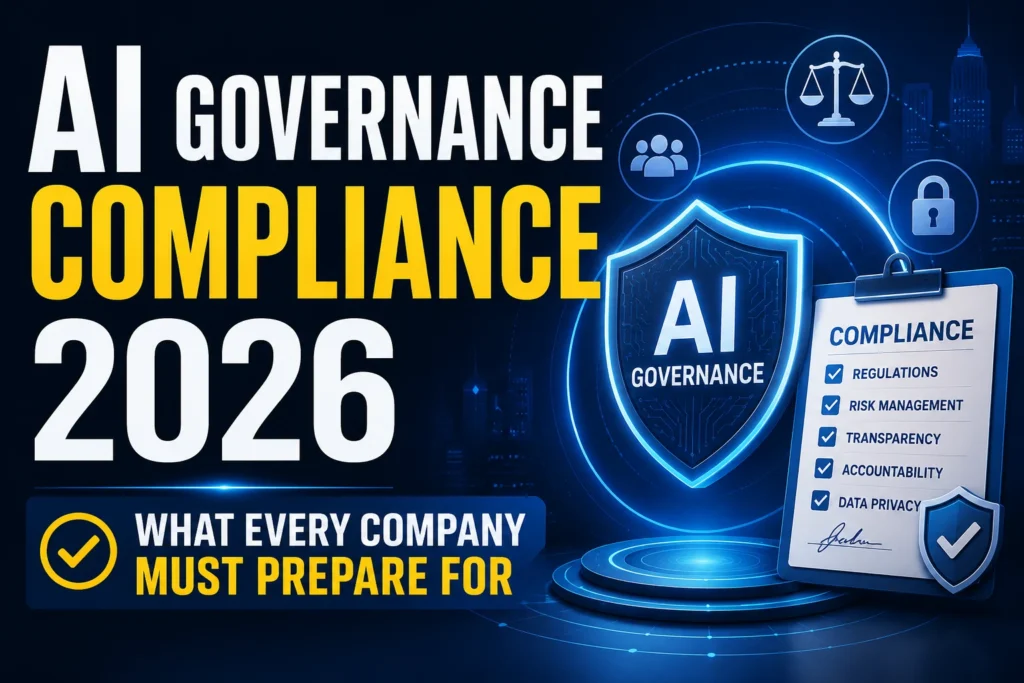
Artificial intelligence is becoming a core part of business operations worldwide. From customer support and automation to analytics and decision-making, AI systems are now influencing critical processes across industries. As AI adoption grows, governments and standards organizations are introducing new rules to ensure AI remains safe, transparent, and trustworthy.
- Introduction
- What Is AI Governance Compliance 2026?
- Why AI Governance Matters in 2026
- Major AI Regulations Companies Must Watch
- AI Governance Framework: Building a Strong Foundation
- AI Risk Management Framework Explained
- Understanding NIST AI RMF
- ISO 42001 AI Standard: A Global Benchmark
- Responsible AI Governance
- Enterprise AI Governance: What Businesses Should Build in 2026
- AI Ethics and Governance Best Practices
- Preparing Your Organization for AI Compliance Regulations
- AI Governance Checklist for 2026
- Multi-Agent Systems and Governance Challenges
- Tech Trends Increasing Compliance Pressure
- Skills Companies Need for Responsible AI Governance
- The Future of AI Governance Beyond 2026
- Frequently Asked Questions
- Conclusion
This makes AI Governance Compliance 2026 one of the most important priorities for organizations of every size. Companies that fail to establish proper governance may face legal risks, reputational damage, and operational challenges. Businesses are now expected to implement structured policies, monitor AI systems, and follow international frameworks for responsible AI deployment. Organizations that prepare early will have a competitive advantage and build greater trust with customers and regulators. You can also Read emerging technology trends 2026.
What Is AI Governance Compliance 2026?
AI Governance Compliance 2026 refers to the policies, standards, and regulatory requirements organizations must follow when designing, deploying, and managing AI systems.
Its purpose is to ensure that AI technologies are:
- Transparent
- Fair and unbiased
- Secure
- Accountable
- Explainable
- Aligned with human values
Key Areas Covered by AI Governance
| Governance Area | Purpose |
|---|---|
| Risk Management | Identify and reduce AI risks |
| Transparency | Explain AI decisions |
| Security | Protect systems and data |
| Accountability | Define ownership and responsibility |
| Compliance | Meet legal requirements |
| Ethics | Ensure responsible AI use |
Why AI Governance Matters in 2026
AI regulations are rapidly evolving worldwide. Organizations are under increasing pressure to establish a strong AI Governance Framework that balances innovation with responsibility.
Without proper governance, businesses may face:
- Regulatory penalties
- Data privacy violations
- AI bias issues
- Security vulnerabilities
- Loss of customer trust
- Operational disruptions
Companies adopting Enterprise AI Governance early are better positioned to scale AI responsibly.
Major AI Regulations Companies Must Watch
Several regulations and standards are shaping AI Governance Compliance 2026.
EU AI Act 2026
The EU AI Act 2026 is expected to become one of the world’s most influential AI regulations.
It categorizes AI systems according to risk levels:
Minimal Risk
Examples include spam filters and recommendation engines.
Limited Risk
Chatbots and content generation tools may require transparency obligations.
High Risk
Healthcare, finance, education, and recruitment AI systems face strict requirements.
Unacceptable Risk
Certain AI applications may be prohibited entirely. Organizations operating globally may need to align with these rules regardless of location.
AI Governance Framework: Building a Strong Foundation
A robust AI Governance Framework helps companies control AI throughout its lifecycle.
Essential components include:
Leadership and Accountability
Organizations should assign clear ownership for AI oversight.
Key roles include:
- AI Governance Committee
- Compliance Officers
- Data Protection Teams
- Risk Management Teams
- Security Teams
Policies and Standards
Companies should establish policies for:
- AI development
- Data usage
- Human oversight
- Bias mitigation
- Documentation
- Model monitoring
Risk Assessment
Every AI model should undergo regular evaluations to identify:
- Bias
- Privacy concerns
- Cybersecurity threats
- Accuracy issues
- Regulatory risks
AI Risk Management Framework Explained
An AI Risk Management Framework enables organizations to identify and minimize threats before they become serious problems.
Common AI risks include:
| Risk Type | Examples |
| Bias | Discrimination and unfair outcomes |
| Security | Adversarial attacks |
| Privacy | Data leakage |
| Operational | System failures |
| Legal | Regulatory violations |
| Reputation | Loss of customer trust |
Organizations implementing effective risk management create safer and more reliable AI environments.
[INTERNAL LINK: risks of autonomous ai systems]
Understanding NIST AI RMF
The NIST AI RMF (AI Risk Management Framework) provides guidance for developing trustworthy AI systems.
It focuses on four core functions:
Govern
Establish policies and responsibilities.
Map
Identify AI-related risks.
Measure
Evaluate performance and risks.
Manage
Monitor and improve AI systems continuously.
The framework helps organizations improve transparency and accountability across the AI lifecycle.
ISO 42001 AI Standard: A Global Benchmark
The ISO 42001 AI Standard provides a structured approach to managing AI systems.
Benefits include:
- Improved governance
- Better risk control
- Increased customer trust
- Easier regulatory compliance
- Stronger operational consistency
Companies pursuing international expansion may find ISO 42001 particularly valuable.
Responsible AI Governance
Responsible AI Governance ensures AI systems align with ethical principles and societal expectations.
Core principles include:
- Fairness
- Transparency
- Accountability
- Human oversight
- Privacy protection
- Reliability
Organizations implementing responsible AI practices are more likely to gain long-term customer confidence.
Enterprise AI Governance: What Businesses Should Build in 2026
Enterprise AI Governance goes beyond compliance. It creates a framework that helps organizations scale AI safely while maintaining trust and accountability.
Companies should establish:
- AI governance committees
- Cross-functional oversight teams
- Documentation procedures
- Model monitoring systems
- Internal audits
- Incident response plans
Large organizations should also ensure that legal, IT, cybersecurity, and business leaders work together to manage AI systems effectively.
AI Ethics and Governance Best Practices
AI Ethics and Governance are becoming strategic priorities rather than technical concerns. Organizations should follow these best practices:
Ensure Human Oversight
Critical decisions should always involve human review.
Improve Transparency
Users should understand when AI systems are making recommendations or decisions.
Reduce Bias
Regular testing helps identify unfair outcomes and improve accuracy.
Protect Privacy
Strong data governance policies reduce security and compliance risks.
Maintain Documentation
Keeping records of model training, datasets, and updates supports regulatory audits.
Preparing Your Organization for AI Compliance Regulations
Businesses should begin preparing now instead of waiting for regulations to become mandatory.
Conduct AI Inventory
Identify all AI systems currently being used across departments.
Classify Risk Levels
Determine whether systems are low-risk, medium-risk, or high-risk.
Develop Internal Policies
Create clear rules for:
- Data collection
- Model deployment
- Human oversight
- Security controls
- Incident reporting
Train Employees
AI literacy and awareness are essential for responsible AI adoption.
Monitor AI Systems Continuously
AI models evolve over time. Continuous monitoring ensures reliability and compliance.
AI Governance Checklist for 2026
Organizations can use the following checklist to strengthen their AI Governance Compliance 2026 strategy.
| Area | Status |
|---|---|
| AI inventory completed | ✓ |
| Governance committee established | ✓ |
| Risk assessments performed | ✓ |
| Human oversight defined | ✓ |
| Documentation maintained | ✓ |
| Bias testing implemented | ✓ |
| Security controls established | ✓ |
| Compliance audits scheduled | ✓ |
| Employee training provided | ✓ |
| Monitoring processes active | ✓ |
Multi-Agent Systems and Governance Challenges
As AI evolves, companies are deploying multiple AI agents that collaborate to perform complex tasks.
These systems create new challenges involving:
- Accountability
- Data security
- Transparency
- Decision conflicts
- Risk management
Organizations exploring advanced automation should understand how distributed AI architectures operate. Explore our multi agent ai systems blog on detailed.
Tech Trends Increasing Compliance Pressure
Several emerging technologies are increasing the need for stronger governance.
These include:
- Generative AI
- Autonomous AI agents
- AI copilots
- Large language models
- Robotics
- Synthetic media
- Agentic AI systems
Businesses following [INTERNAL LINK: emerging technology trends 2026] are likely to encounter stricter compliance requirements as AI capabilities continue to advance.
Skills Companies Need for Responsible AI Governance
Organizations should invest in professionals with expertise in:
- AI risk management
- Cybersecurity
- Data governance
- Compliance and legal frameworks
- Privacy engineering
- Model validation
- Ethics and policy management
Cross-functional teams will play a major role in successful AI governance programs.
The Future of AI Governance Beyond 2026
The next phase of AI governance will focus on:
Global Harmonization
Countries may align regulations to create common standards.
Continuous AI Monitoring
Real-time oversight tools will become standard.
Explainable AI
Organizations will need to provide greater transparency regarding AI decisions.
Third-Party Audits
Independent assessments will become increasingly common.
Industry-Specific Rules
Healthcare, finance, education, and critical infrastructure sectors are likely to face stricter requirements.
Companies that invest in Responsible AI Governance today will be better prepared for future regulations. Experts Reveal the Biggest Risks of Autonomous AI Systems
Frequently Asked Questions
What is AI Governance Compliance 2026?
AI Governance Compliance 2026 refers to the frameworks, regulations, and standards organizations must follow to ensure AI systems are safe, ethical, transparent, and legally compliant.
What is the EU AI Act 2026?
The EU AI Act 2026 is a regulatory framework that categorizes AI systems by risk level and establishes requirements for high-risk AI applications.
What is the NIST AI RMF?
NIST AI RMF stands for AI Risk Management Framework developed by the National Institute of Standards and Technology. It helps organizations identify and manage AI-related risks.
What is ISO 42001 AI Standard?
ISO 42001 is an international standard designed to help organizations establish and maintain AI management systems.
Why is Enterprise AI Governance important?
Enterprise AI Governance enables organizations to manage AI responsibly, reduce risks, and comply with evolving regulations.
How can businesses prepare for AI compliance regulations?
Companies should create governance policies, conduct risk assessments, train employees, maintain documentation, and continuously monitor AI systems.
What are the biggest AI governance challenges?
Common challenges include bias, transparency, privacy, accountability, security, and changing regulatory requirements.
Conclusion
AI is becoming deeply integrated into business operations, making governance more important than ever. AI Governance Compliance 2026 is no longer just a legal requirement—it is a strategic necessity. Organizations that establish strong AI Governance Frameworks, adopt the NIST AI RMF, align with the ISO 42001 AI Standard, and embrace Responsible AI Governance will be better positioned to innovate with confidence. Preparing early helps businesses reduce risk, build trust, and stay ahead of rapidly evolving AI Compliance Regulations.