
Introduction: Why the Passwordless Authentication Future Matters
The Passwordless Authentication Future is quickly becoming one of the most important shifts in modern cybersecurity. For decades, we have relied on passwords to protect our emails, social media, banking apps, and even classroom platforms. But here’s the truth—passwords are no longer enough. Students today live in a digital-first world where almost everything is online. From submitting assignments to attending virtual classes, everything requires logins. And with that comes a serious problem: weak passwords, repeated passwords, and constant hacking risks. This is exactly why the Passwordless Authentication Future is gaining global attention.
- Introduction: Why the Passwordless Authentication Future Matters
- What is Passwordless Authentication Future?
- Why Passwordless Authentication is the Future of Security
- How Passwordless Authentication Actually Works
- Benefits of Passwordless Authentication for Students
- The Dark Side: Challenges in a Passwordless World
- AI, Cybersecurity, and the Passwordless Revolution
- Role of Cloud Computing in Passwordless Authentication
- Real-World Examples of Passwordless Technology
- The Bigger Picture: Top Emerging Technology Trends in 2026
- Future Outlook: Where Are We Heading?
- Conclusion
- FAQs
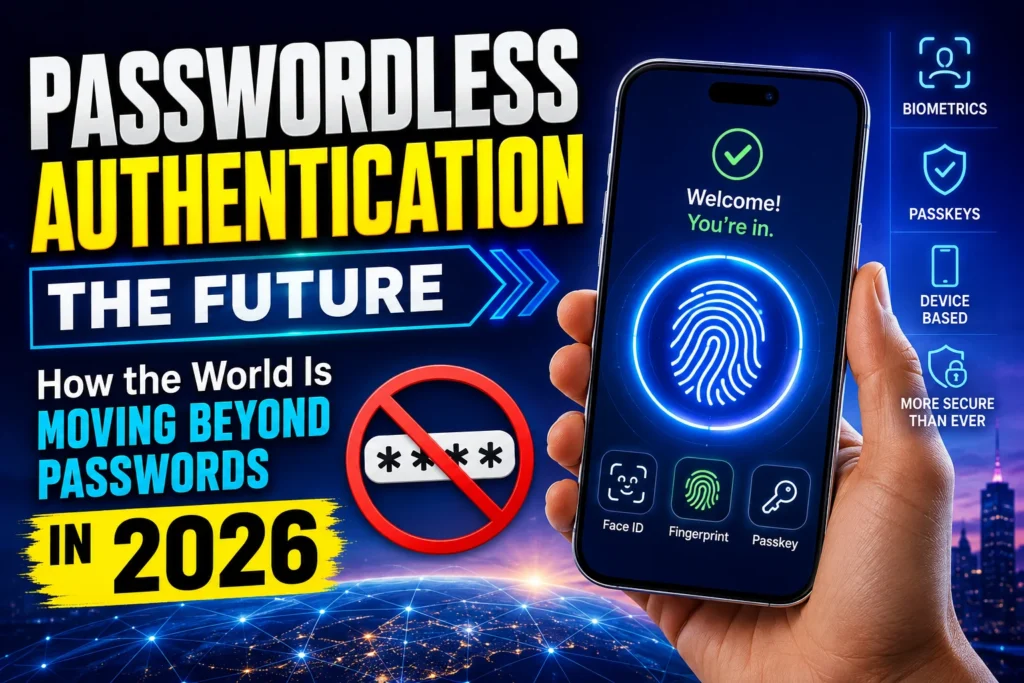
Instead of remembering complex passwords, users will soon rely on safer methods like biometrics, passkeys, and secure device-based authentication. In a world shaped by AI-Powered Cyber Attacks, rising Generative AI Trends, and evolving digital ecosystems, passwordless systems are not just an upgrade—they are a necessity.
So, what does this future actually look like, and why should students care? Let’s break it down in a simple, practical way.
What is Passwordless Authentication Future?
The Passwordless Authentication Future refers to a security model where users no longer need traditional passwords to access accounts or systems. Instead, identity is verified using advanced methods such as:
- Fingerprint or face recognition
- One-time secure links (magic links)
- Authentication apps
- Device-based trust systems
- Cryptographic passkeys
In simple terms, your identity becomes your password. This shift is already being adopted by tech giants like Google, Apple, and Microsoft. The idea is to eliminate human dependency on remembering passwords and reduce cyber risks caused by weak credentials.
As part of the broader Top 10 Emerging Technology Trends in 2026, passwordless systems are becoming a foundation for secure digital transformation.
Why Passwordless Authentication is the Future of Security
Passwords have failed us in many ways. People reuse them, forget them, or create weak combinations. Hackers exploit this every single day.
The Passwordless Authentication Future solves these problems by removing passwords entirely.
Here’s why it matters:
- No more phishing attacks stealing passwords
- No risk of brute-force hacking
- Faster and smoother login experience
- Reduced dependency on memory
- Stronger identity verification
When combined with evolving Cybersecurity Trends in 2026, passwordless systems create a much stronger defense layer for individuals and organizations. Students especially benefit because they handle multiple platforms—learning apps, email systems, exam portals—and password fatigue is very real.
How Passwordless Authentication Actually Works
The technology behind passwordless systems is more advanced than it looks, but the concept is simple.
1. Biometrics
Your face, fingerprint, or even voice becomes your identity. Devices like smartphones already use this daily.
2. Magic Links
You enter your email, and a secure login link is sent directly to your inbox. One click, and you’re in.
3. Passkeys
A newer innovation where cryptographic keys stored on your device replace passwords entirely.
4. Authentication Apps
Apps like Google Authenticator generate time-based codes for secure login.
5. Device Trust
Your phone or laptop becomes a trusted device. If you’re using it, you are automatically verified.
This system is becoming even more powerful when combined with the Future of Cloud Computing, where authentication happens across distributed, secure cloud networks.
Benefits of Passwordless Authentication for Students
For students, the Passwordless Authentication Future is not just a tech upgrade—it’s a lifestyle improvement.
Here’s how it helps:
Easier Access to Learning Platforms
No more resetting forgotten passwords before exams or assignments.
Stronger Security for Academic Accounts
Protects personal data, notes, and project submissions from hackers.
Saves Time and Reduces Stress
No more “Forgot Password?” loops during urgent submissions.
Better Digital Experience
Smooth login experience across multiple educational apps and tools.
Students working on digital projects or exploring Generative AI Trends also benefit from safer access to AI tools and cloud platforms.
The Dark Side: Challenges in a Passwordless World
Even though the Passwordless Authentication Future sounds perfect, it still has challenges.
- Device dependency: Losing your phone can create access issues
- Privacy concerns: Biometric data must be securely stored
- System compatibility: Not all platforms support passwordless login yet
- Recovery problems: Account recovery must be carefully designed
Cybersecurity experts are actively working to solve these issues, especially as threats evolve with AI-Powered Cyber Attacks becoming more sophisticated.
AI, Cybersecurity, and the Passwordless Revolution
Technology is evolving fast, and AI is playing a major role in both attack and defense systems.
On one side, AI-Powered Cyber Attacks are becoming more advanced. Hackers now use AI to automate phishing emails, crack weak systems, and mimic human behavior.
On the other side, AI is also strengthening security systems by:
- Detecting unusual login behavior
- Blocking suspicious access attempts
- Improving biometric accuracy
- Strengthening authentication models
At the same time, Cybersecurity Trends in 2026 show a clear shift toward zero-trust systems, where no login is trusted by default.
This is where passwordless authentication fits perfectly—it removes one of the biggest weak points in cybersecurity: human passwords.
Role of Cloud Computing in Passwordless Authentication
The Future of Cloud Computing is deeply connected with passwordless systems.
Cloud platforms store and verify identity data securely across multiple servers. This allows:
- Instant authentication across devices
- Secure storage of cryptographic keys
- Scalable identity verification systems
- Real-time threat detection
Without cloud infrastructure, global passwordless systems would not be possible.
As more education platforms, apps, and tools move to the cloud, students will naturally experience passwordless login as the new normal.
Real-World Examples of Passwordless Technology
You might already be using passwordless systems without realizing it.
- Unlocking your phone with Face ID
- Logging into apps using fingerprint
- Receiving OTP-free secure login on trusted devices
- Using “Sign in with Google/Apple” options
Big companies like Microsoft and Apple are already pushing passkeys as the default login method.
This is only the beginning of the Passwordless Authentication Future.
The Bigger Picture: Top Emerging Technology Trends in 2026
Passwordless authentication is just one piece of a much larger digital transformation.
According to Top 10 Emerging Technology Trends in 2026, we are entering a world where:
- AI becomes deeply integrated into daily life
- Cybersecurity becomes autonomous and predictive
- Cloud systems become more decentralized
- Identity verification becomes continuous and invisible
In this ecosystem, passwords feel outdated—like floppy disks in a smartphone world.
Future Outlook: Where Are We Heading?
The future is clear: passwords are slowly disappearing.
In the next few years, we will likely see:
- Password-free banking systems
- Biometric-only university logins
- AI-driven identity verification
- Global adoption of passkeys
- Fully integrated cloud-based authentication systems
The Passwordless Authentication Future is not a question of “if”—it is a question of “how soon.”
Are we ready to trust technology more than memory? And more importantly, are we ready for a world where security becomes invisible?
Conclusion
The Passwordless Authentication Future is reshaping how we think about digital security. For students, it means simpler access, stronger protection, and a smoother digital experience.
As threats evolve through AI-Powered Cyber Attacks, and innovation continues through Generative AI Trends, the need for passwordless systems becomes even more critical. Combined with advancements in Cybersecurity Trends in 2026 and the Future of Cloud Computing, we are moving toward a safer and smarter digital world.
Passwords had a long run—but their era is ending. The future is faster, safer, and completely password-free.
FAQs
1. What is the Passwordless Authentication Future?
It refers to a security system where users log in without passwords using biometrics, passkeys, or secure links.
2. Is passwordless authentication safe?
Yes, it is generally safer than passwords because it reduces phishing and brute-force attacks.
3. Will passwords completely disappear?
Yes, over time most systems are expected to shift toward passwordless authentication.
4. How does passwordless login work?
It uses biometrics, device trust, authentication apps, or cryptographic keys instead of passwords.
5. Why is passwordless authentication important for students?
It makes logging into learning platforms faster, easier, and more secure.