Introduction
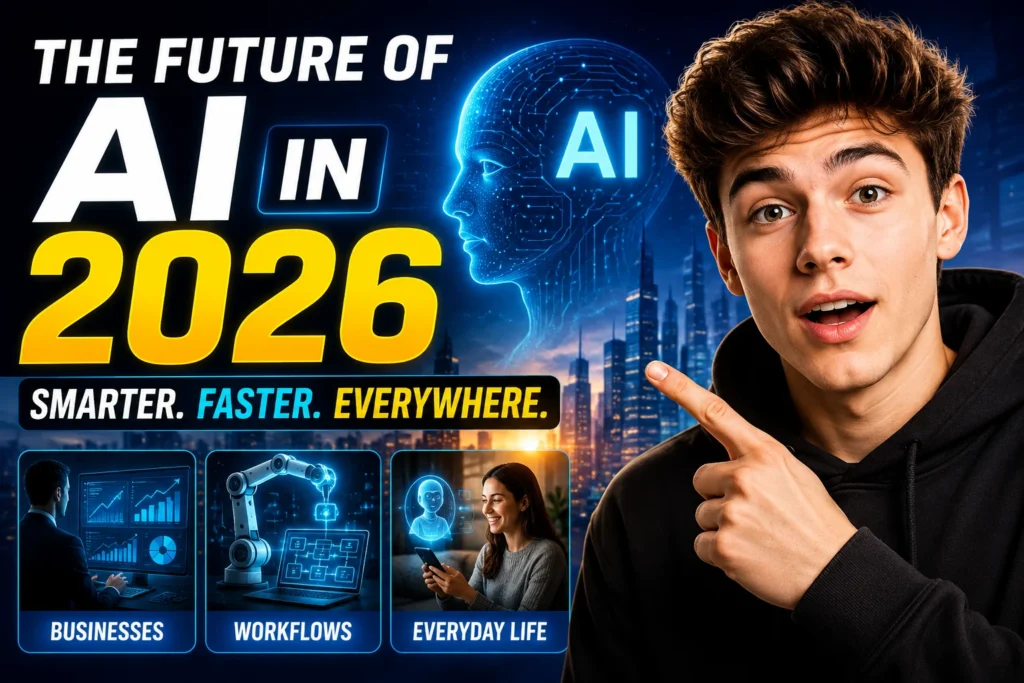
The Future of AI in 2026 is no longer a distant prediction discussed only in research labs or technology conferences. Artificial intelligence is now becoming a core part of how businesses operate, how consumers interact with digital platforms, and how industries make decisions at scale. Over the last few years, AI has evolved from simple automation systems into intelligent ecosystems capable of reasoning, creating content, analyzing massive datasets, and performing complex tasks with minimal human intervention. In 2026, this transformation is expected to accelerate dramatically as enterprises adopt smarter AI infrastructure, autonomous systems, and advanced multimodal technologies.
- The Evolution of AI From Automation to Autonomous Intelligence
- AI Trends 2026 That Will Define the Next Technological Era
- Agentic AI and the Rise of Autonomous Decision-Making Systems
- Generative AI Future Beyond Content Creation
- AI Business Transformation and Enterprise AI Solutions
- AI Cybersecurity Trends and the Future of Digital Protection
- AI Tools 2026 and the New Productivity Economy
- FAQ: Future of AI in 2026
- Conclusion
One of the biggest reasons behind this rapid evolution is the rise of Agentic AI, where AI systems can independently plan, execute, and optimize workflows without constant human input. Businesses are increasingly integrating AI Workflow Automation into customer service, cybersecurity, marketing, healthcare, finance, and software development. Instead of using AI merely as a support tool, organizations are now treating AI as a strategic operational layer capable of improving productivity, reducing costs, and driving innovation.
At the same time, the Generative AI Future is expanding far beyond text generation. Modern AI models can now understand images, videos, voice commands, code, and real-time data simultaneously through Multimodal AI systems. These advancements are reshaping digital experiences and opening new possibilities for intelligent applications. Enterprises are investing heavily in Enterprise AI Solutions because companies that fail to adapt may struggle to compete in increasingly automated markets.
The growth of AI is also deeply connected with other emerging technologies. Businesses exploring the Emerging Technology Trends 2026 are seeing how AI integrates with cloud computing, cybersecurity, Web3 ecosystems, and quantum computing. AI is becoming the connecting layer between modern technologies, enabling faster analysis, predictive decision-making, and autonomous digital operations.
As we move deeper into 2026, AI will not simply automate repetitive work. It will redefine how organizations think, innovate, and scale. Understanding the future direction of artificial intelligence is now essential for businesses, developers, marketers, entrepreneurs, and professionals who want to stay competitive in the next era of digital transformation.
The Evolution of AI From Automation to Autonomous Intelligence
Artificial intelligence has undergone a massive transformation over the last decade. Early automation systems were primarily rule-based and dependent on predefined instructions. They could perform repetitive tasks efficiently, but they lacked adaptability and contextual understanding. The Future of Artificial Intelligence in 2026 is fundamentally different because AI systems are becoming increasingly autonomous, adaptive, and capable of independent reasoning.
Traditional automation relied heavily on human configuration. For example, older business systems could automate invoices, emails, or customer support tickets using static workflows. Modern AI Automation systems are far more intelligent because they can analyze patterns, predict outcomes, and optimize operations dynamically. This shift is creating a new generation of autonomous AI infrastructure that can handle decision-making processes with minimal supervision.
One of the most important developments driving this change is the emergence of Autonomous AI Agents. These intelligent agents are capable of performing multiple connected tasks independently. Instead of simply responding to prompts, they can plan actions, gather information, communicate with other systems, and continuously improve performance through feedback loops. Businesses are already using autonomous agents for marketing optimization, financial analysis, software testing, logistics management, and customer engagement.
The evolution of AI is also tightly connected with the growth of cloud infrastructure. Companies adopting scalable AI systems are increasingly investing in modern cloud environments that support real-time data processing and model deployment. The future relationship between AI and cloud technology is explored in Future of Cloud Computing, where distributed computing environments are becoming essential for enterprise-scale AI operations.
Another major factor shaping AI evolution is the increasing availability of large datasets and computational power. Advanced machine learning models now require sophisticated infrastructure capable of processing billions of parameters. This has accelerated innovation in neural networks, natural language processing, and intelligent reasoning systems.
As AI becomes more autonomous, ethical considerations are also becoming increasingly important. Governments and organizations are now discussing transparency, AI governance, data privacy, and responsible AI deployment. Businesses that adopt ethical AI practices early will likely gain stronger customer trust and long-term competitive advantages in the AI-driven economy.
AI Trends 2026 That Will Define the Next Technological Era
The most significant AI Trends 2026 are centered around intelligence expansion, real-time automation, enterprise integration, and human-AI collaboration. Unlike previous years where AI adoption was experimental, 2026 is expected to mark the beginning of widespread operational dependency on AI systems across industries.
One major trend is the rise of Multi-Agent AI Systems. Instead of relying on a single AI model, organizations are deploying networks of specialized agents that collaborate to complete complex objectives. For example, in e-commerce, one AI agent may analyze customer behavior, another may optimize pricing, while another manages inventory forecasting. Together, these agents create a coordinated decision-making ecosystem capable of operating continuously at scale.
Another major trend is the expansion of Multimodal AI. Future AI systems will no longer process only text or images independently. Instead, they will combine multiple forms of data simultaneously, including voice, video, sensor information, live analytics, and visual understanding. This will dramatically improve virtual assistants, healthcare diagnostics, autonomous vehicles, and intelligent workplace tools.
The rise of AI-powered business ecosystems is also changing the software industry itself. Modern platforms are embedding AI directly into productivity applications, CRMs, cybersecurity systems, and development environments. Businesses are no longer purchasing isolated AI tools; they are building AI-native operational ecosystems.
The connection between AI and decentralized technologies is another emerging trend. The future of decentralized AI, digital ownership, and blockchain integration is discussed in Web3 Trends in 2026. AI systems integrated with decentralized networks may improve transparency, identity verification, and secure autonomous transactions.
AI-generated software development is also accelerating rapidly. Developers increasingly rely on AI coding assistants capable of generating applications, debugging systems, and improving infrastructure performance. This is reducing development cycles while increasing productivity for engineering teams.
At the same time, businesses are prioritizing AI governance and regulatory compliance. Governments worldwide are preparing frameworks for responsible AI deployment, particularly in finance, healthcare, and public systems. Organizations that proactively implement transparent AI policies will likely avoid future legal and operational risks.
The next stage of AI will not be defined by isolated innovations. It will be defined by interconnected intelligent systems capable of collaborating across industries, platforms, and global digital infrastructures.
Agentic AI and the Rise of Autonomous Decision-Making Systems
One of the most revolutionary developments shaping the Future of AI in 2026 is the rapid advancement of Agentic AI. Unlike traditional AI models that require continuous prompts and human oversight, Agentic AI systems are designed to act independently toward achieving specific goals. These systems can analyze situations, make decisions, adjust strategies, and execute multi-step processes autonomously.
The importance of Agentic AI lies in its ability to transform AI from a reactive tool into a proactive digital workforce. Businesses are beginning to use autonomous AI agents for managing customer interactions, automating financial operations, optimizing supply chains, and even handling internal decision-making processes. These AI agents can continuously monitor environments, detect problems, and implement solutions without waiting for manual instructions.
For example, an autonomous AI system in digital marketing could analyze campaign performance, identify weak-performing advertisements, redesign creative assets using generative AI, reallocate advertising budgets, and optimize targeting parameters automatically. What once required multiple teams and hours of manual analysis can now happen in real time.
This evolution is also leading to the development of sophisticated AI Workflow Automation systems. Instead of automating individual tasks, businesses are automating entire operational workflows. AI agents can coordinate with CRMs, databases, APIs, analytics platforms, and communication systems to create seamless operational pipelines.
The impact of Agentic AI extends beyond businesses. In healthcare, autonomous AI systems may assist in diagnostics, patient monitoring, and treatment planning. In finance, AI agents can monitor market conditions, detect fraud patterns, and manage investment portfolios dynamically. In manufacturing, intelligent agents can optimize production schedules and predictive maintenance.
However, the rise of autonomous systems also introduces challenges related to accountability, transparency, and security. Organizations deploying autonomous AI must establish governance frameworks that define operational boundaries, risk management protocols, and human oversight mechanisms.
Agentic AI represents a major shift in how technology interacts with human workflows. Instead of being passive tools, AI systems are evolving into intelligent collaborators capable of independently contributing to organizational growth and operational efficiency.
Generative AI Future Beyond Content Creation
The early phase of generative AI focused heavily on text generation, image creation, and chatbot interactions. However, the Generative AI Future in 2026 extends far beyond simple content production. Generative AI is becoming a foundational technology layer that influences software development, product design, business strategy, scientific research, and enterprise operations.
Modern generative AI systems are capable of producing code, simulations, predictive models, training datasets, marketing campaigns, and even strategic recommendations. Businesses are increasingly integrating generative AI into their internal operations because it dramatically reduces manual workload while improving scalability.
In software engineering, AI-powered coding assistants can now generate functional applications, identify vulnerabilities, optimize infrastructure, and automate debugging processes. This is reducing development timelines while enabling smaller teams to build highly sophisticated digital products.
Generative AI is also transforming education and professional training. AI-powered learning systems can personalize educational experiences based on individual performance, learning speed, and skill gaps. Enterprises are using generative AI to create adaptive employee training programs that continuously evolve based on workforce performance data.
Another major area of innovation is scientific research. AI models are now assisting researchers in molecular simulations, drug discovery, climate modeling, and advanced data analysis. The relationship between AI and advanced computational systems becomes even more powerful when combined with emerging quantum technologies discussed in Quantum Computing for Beginners.
The future of generative AI is also strongly connected with personalization. Businesses are increasingly delivering hyper-personalized customer experiences using AI-generated recommendations, dynamic content, and predictive engagement strategies. E-commerce platforms, streaming services, and social media networks are already using these capabilities extensively.
Despite these opportunities, organizations must address concerns surrounding misinformation, copyright ownership, AI hallucinations, and ethical deployment. Generative AI systems require responsible governance to ensure reliability and trustworthiness.
The next phase of generative AI will not simply create content faster. It will fundamentally reshape how humans innovate, solve problems, and interact with digital systems across every major industry.
AI Business Transformation and Enterprise AI Solutions
The role of AI in business is shifting from operational support to strategic transformation. In 2026, companies are no longer asking whether they should adopt AI. Instead, they are focusing on how quickly they can integrate AI into core business functions to remain competitive in rapidly evolving markets.
One of the biggest drivers of AI Business Transformation is operational efficiency. AI-powered systems can analyze vast amounts of data, identify inefficiencies, and automate repetitive processes with remarkable speed and accuracy. This allows organizations to reduce costs, improve productivity, and make faster decisions based on real-time intelligence.
Large enterprises are increasingly investing in advanced Enterprise AI Solutions because traditional software systems are no longer sufficient for modern business complexity. AI-enhanced platforms now assist with forecasting, cybersecurity monitoring, workforce management, customer support, and strategic planning.
The growing adoption of AI Productivity Tools is also reshaping workplace dynamics. Employees are using AI assistants to summarize reports, generate content, analyze spreadsheets, manage schedules, and automate administrative tasks. Rather than replacing workers entirely, AI is augmenting human capabilities and allowing professionals to focus on higher-value strategic work.
Below is a comparison of how traditional business operations differ from AI-driven enterprise systems in 2026:
| Traditional Operations | AI-Driven Operations in 2026 |
|---|---|
| Manual data analysis | Real-time predictive analytics |
| Reactive decision-making | Proactive intelligent recommendations |
| Static workflows | Adaptive AI workflow automation |
| Human-only customer support | AI-powered conversational systems |
| Periodic reporting | Continuous operational intelligence |
| Limited scalability | Autonomous scaling and optimization |
Businesses are also integrating AI with cybersecurity infrastructure to combat increasingly sophisticated digital threats. The evolving security landscape is explored in Cybersecurity Trends in 2026, where AI-driven defense systems are becoming essential for enterprise protection.
Organizations that fail to embrace AI transformation may face operational disadvantages, slower innovation cycles, and declining market competitiveness. In contrast, businesses that strategically adopt AI technologies are positioning themselves for long-term growth, efficiency, and resilience in the digital economy.
AI Cybersecurity Trends and the Future of Digital Protection
As artificial intelligence becomes more advanced, cybersecurity is entering a completely new era. The same technologies powering intelligent automation and autonomous systems are also being used to launch sophisticated cyberattacks. This creates a rapidly evolving digital battlefield where AI is both the greatest defense mechanism and a powerful threat vector.
One of the biggest AI Cybersecurity Trends in 2026 is the use of AI-powered threat detection systems. Traditional cybersecurity tools often rely on predefined rules and signature-based detection methods. Modern AI security systems, however, continuously analyze behavioral patterns, network activity, and anomaly detection in real time. This allows organizations to identify potential threats before significant damage occurs.
Cybercriminals are also leveraging generative AI and autonomous systems to automate phishing campaigns, generate realistic deepfakes, and exploit vulnerabilities faster than ever before. AI-generated attacks are becoming increasingly difficult to detect because they can mimic human behavior, communication patterns, and legitimate digital interactions.
In response, organizations are deploying intelligent security architectures capable of adaptive defense. AI-driven cybersecurity platforms can isolate compromised systems, block suspicious activities, and recommend mitigation strategies automatically. Autonomous defense systems are becoming critical for large enterprises handling massive digital infrastructures.
Another major challenge is AI model security itself. As businesses rely more heavily on AI systems, attackers may target training datasets, manipulate outputs, or exploit vulnerabilities within machine learning models. Protecting AI infrastructure is becoming just as important as protecting traditional IT environments.
Governments and regulatory bodies are also increasing focus on AI-related security standards. Businesses operating globally must now navigate evolving compliance requirements related to data privacy, AI governance, and cybersecurity transparency.
The future of digital security will depend heavily on intelligent automation. Organizations that combine AI-driven monitoring, human expertise, and adaptive cybersecurity frameworks will be better equipped to handle the increasingly complex threat landscape emerging in 2026 and beyond.
AI Tools 2026 and the New Productivity Economy
The rise of AI Tools 2026 is fundamentally changing how individuals and businesses approach productivity. AI is no longer limited to enterprise software or research environments. Intelligent tools are now deeply integrated into daily workflows, allowing professionals to complete tasks faster, reduce repetitive work, and improve decision-making.
Modern AI Productivity Tools are capable of handling a wide range of activities including writing assistance, coding support, project management, research analysis, customer communication, scheduling, and data interpretation. These tools are becoming increasingly personalized, adaptive, and context-aware.
One important shift is the movement toward AI copilots embedded directly into workplace applications. Instead of opening separate AI platforms, users now interact with AI inside email systems, spreadsheets, CRM software, design tools, and communication platforms. This seamless integration improves efficiency while reducing workflow interruptions.
Businesses are also adopting AI tools to improve collaboration between teams. AI systems can summarize meetings, generate action items, track deadlines, and organize information automatically. This reduces administrative overhead and allows employees to focus on creative and strategic work.
Some of the most influential categories of AI tools in 2026 include:
- AI coding assistants
- Autonomous research tools
- AI-powered analytics platforms
- Workflow automation systems
- Intelligent customer support agents
- AI design and content generation tools
Another major trend is the rise of personalized AI workspaces. Future AI systems may function as digital operating partners capable of understanding user preferences, goals, schedules, and workflows across multiple platforms simultaneously. The widespread adoption of AI tools is also influencing workforce expectations. Employees increasingly expect organizations to provide AI-enhanced systems that reduce repetitive tasks and improve efficiency. Companies investing in modern AI infrastructure may attract stronger talent while improving operational performance.
The productivity economy of 2026 will not be driven solely by human effort. It will be powered by intelligent collaboration between humans and adaptive AI systems working together across interconnected digital environments.
FAQ: Future of AI in 2026
What is the Future of AI in 2026 expected to look like?
The Future of AI in 2026 is expected to focus heavily on autonomous systems, enterprise automation, multimodal intelligence, and AI-powered productivity ecosystems. AI will increasingly operate as an independent decision-making layer across industries including healthcare, finance, cybersecurity, marketing, and software development.
What is Agentic AI?
Agentic AI refers to AI systems capable of independently planning, executing, and optimizing tasks without constant human instructions. These systems can analyze situations, make decisions, and adapt dynamically to achieve predefined objectives.
How will AI impact businesses in 2026?
AI will significantly improve operational efficiency, automate workflows, reduce costs, and enhance strategic decision-making. Businesses adopting Enterprise AI Solutions will likely gain competitive advantages through faster innovation and improved scalability.
What are Multi-Agent AI Systems?
Multi-Agent AI Systems involve multiple specialized AI agents working collaboratively to complete complex tasks. Each AI agent handles a specific responsibility while coordinating with others to achieve broader organizational objectives.
How is Multimodal AI changing technology?
Multimodal AI allows systems to process multiple data types simultaneously including text, images, voice, video, and real-time analytics. This improves contextual understanding and enables more advanced AI applications across industries.
Will AI replace human jobs completely?
AI will automate many repetitive tasks, but it is more likely to transform jobs rather than eliminate all human roles entirely. Professionals who adapt to AI-enhanced workflows and develop strategic, creative, and analytical skills will remain highly valuable.
Why is AI cybersecurity becoming important?
As AI adoption increases, cyber threats are also becoming more advanced. AI-powered cybersecurity systems help organizations detect threats faster, automate responses, and secure increasingly complex digital infrastructures.
Conclusion
The Future of AI in 2026 represents one of the most significant technological transformations in modern history. Artificial intelligence is rapidly evolving from simple automation software into intelligent ecosystems capable of autonomous decision-making, adaptive learning, and real-time operational optimization. Businesses, governments, and individuals are entering a new era where AI is no longer optional but deeply integrated into everyday digital infrastructure.
Technologies such as Agentic AI, Multimodal AI, Multi-Agent AI Systems, and advanced AI Workflow Automation are redefining how industries operate. Enterprises are increasingly adopting intelligent systems that can analyze data, optimize workflows, improve customer experiences, and strengthen cybersecurity operations. The rise of Enterprise AI Solutions and AI Productivity Tools is creating a more efficient and connected digital economy where human capabilities are amplified through intelligent collaboration with AI systems. At the same time, the rapid expansion of AI introduces new responsibilities. Organizations must address challenges related to ethics, governance, transparency, privacy, and cybersecurity. Responsible AI deployment will become a critical factor in maintaining customer trust and long-term sustainability. The future of artificial intelligence is not limited to technology companies alone. AI is becoming a foundational layer across healthcare, finance, education, cybersecurity, manufacturing, and digital commerce. Businesses that invest early in scalable AI strategies will likely lead the next wave of innovation and economic growth As 2026 approaches, one reality is becoming increasingly clear: AI is no longer simply shaping the future of technology. It is shaping the future of business, productivity, communication, and society itself.